

IFOY Audit
Finalists undergo the three-stage IFOY Audit as part of the IFOY Audit, which takes place during the TEST CAMP INTRALOGISTICS. This consists of the scientific IFOY Innovation Check, the IFOY Test and the jury test.
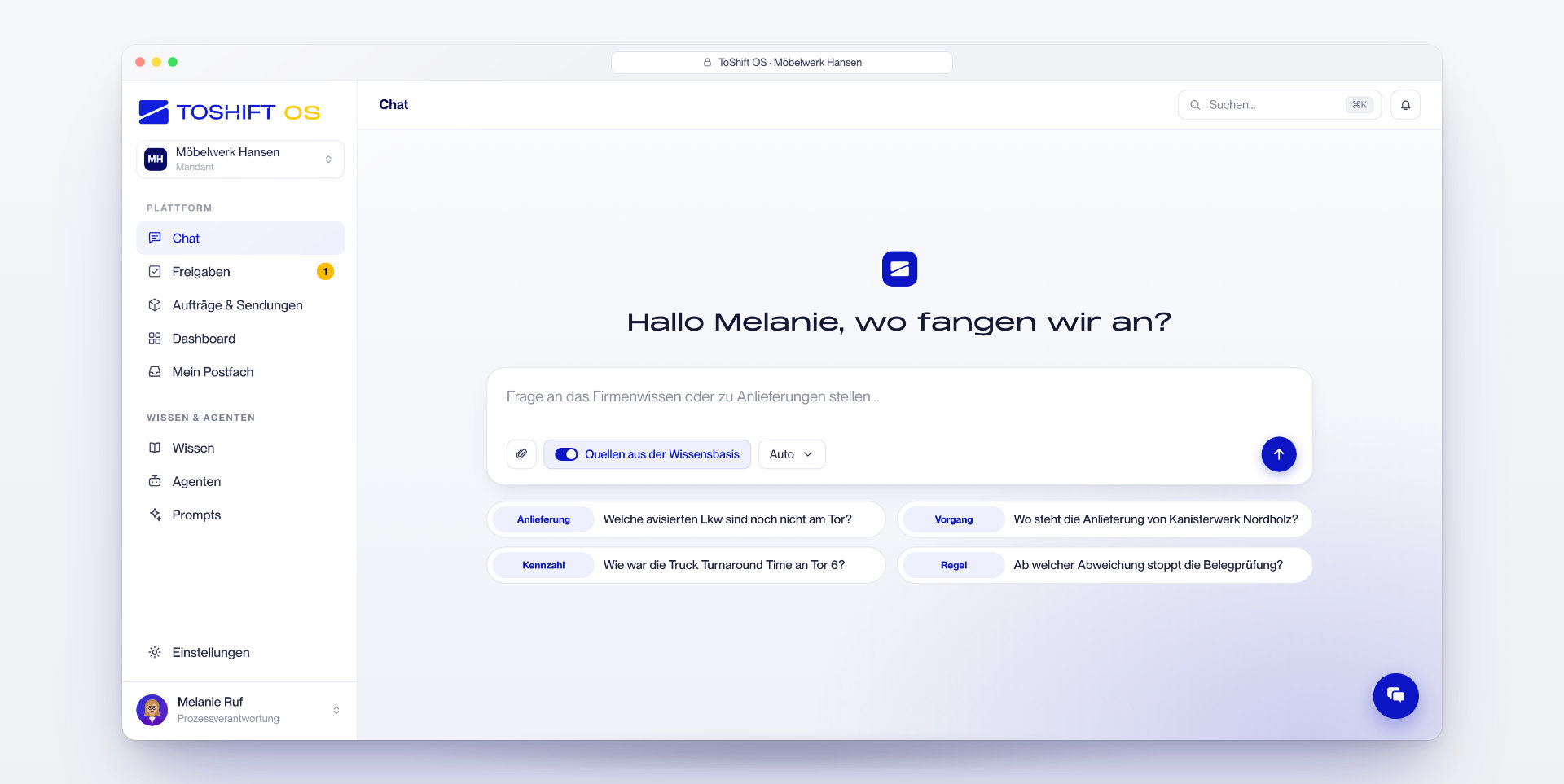
Many systems that do not communicate with each other, with people acting as the interface in between to keep processes running. This is how operational logistics works today. ToShift OS is the company’s proprietary logistics intelligence platform, which understands, connects, and operates ERP, warehouse, transport, and yard systems. It takes over the role of the human as an interface and handles routine tasks, leaving people to oversee operations and make decisions. At a plant’s goods-in area, a process runs end to end, from advance shipment notification and document verification to gate check-in, yard management, and unloading, without replacing the existing core systems.
Product name and company
ToShift OS – ToShift
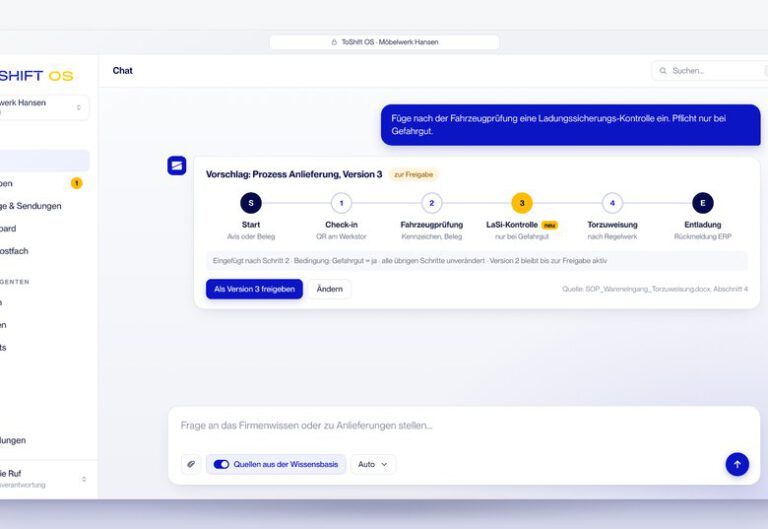
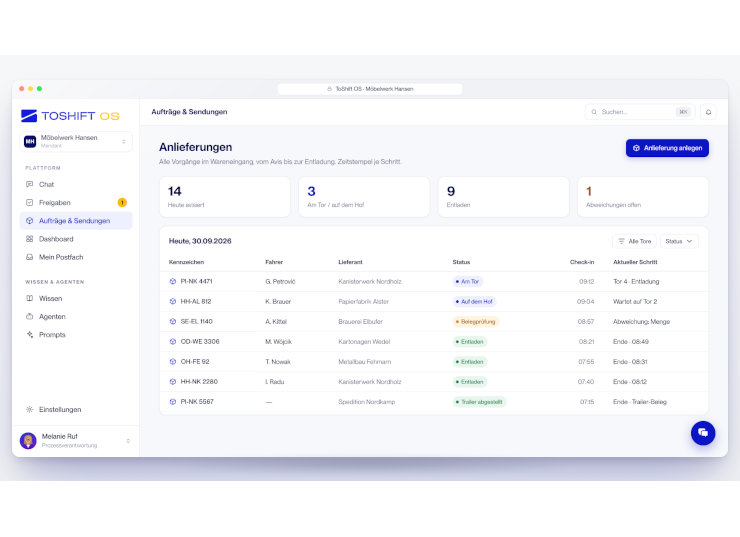
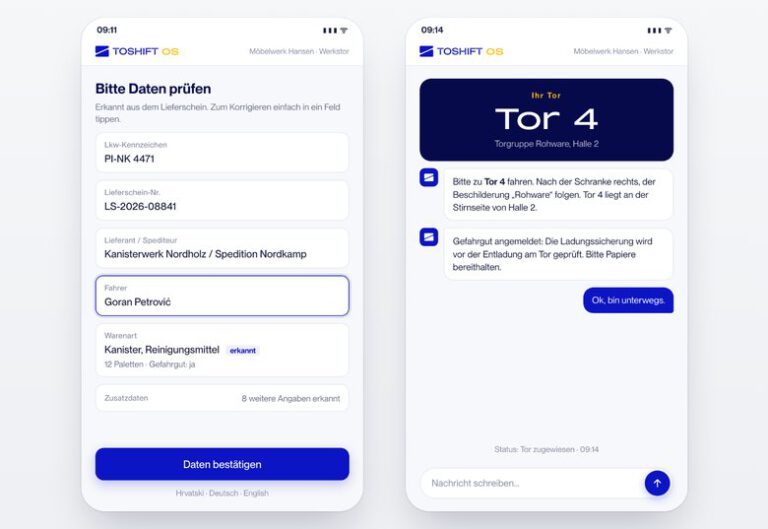
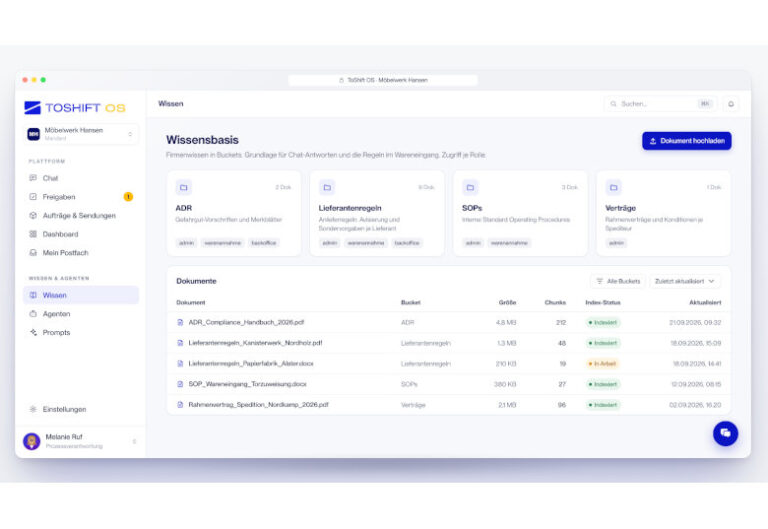
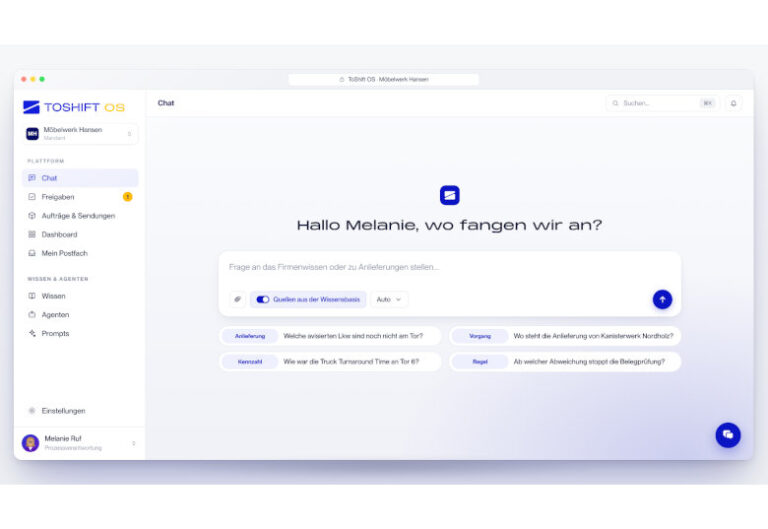
ToShift provides the operational logistics of industrial companies, freight forwarders, and logistics service providers with an operating system: ToShift OS.
All roles across a company’s own processes, from dispatchers and goods receiving staff to plant management, work in one system instead of several. ToShift OS connects to ERP, warehouse, transport, and yard systems, reads data from them and writes back to the systems of record without replacing any of them. It takes over the role of the human as an interface and handles routine tasks. People oversee the system and make the decisions associated with their roles. Each customer receives a dedicated instance, hosted in Germany and operated either by the customer or by ToShift.
Example: Incoming Delivery: The driver uploads the delivery document at the plant gate. ToShift OS reads it, creates a transaction in the yard management system or matches it to the expected delivery, directs the driver to the appropriate gate, and reports the transaction back to the ERP system. Goods receiving staff intervene only when something deviates from the expected process. Department specialists can adjust rules, thresholds, and process steps themselves, without developers. Plant management receives operational KPIs directly from the process flow, without a separate reporting project. ToShift OS identifies patterns in transactions and suggests process changes, which a human then decides whether to implement. These four levels, from operations to learning, apply to every process, from order handling to freight invoicing.
Technically, ToShift OS consists of chat, a knowledge base, agents, orchestration, and permissions.
The innovation behind ToShift OS lies in providing a single system for all operational logistics roles without replacing existing systems. Until now, people have served as the link between ERP, warehouse, transport, and yard systems. They read documents, manually entered data, called drivers, and maintained lists for plant management. ToShift OS takes over these tasks. The driver’s document, the department’s rules, and plant management’s KPIs all become part of the same process within a single instance. People no longer operate the individual systems; they manage ToShift OS.
Three aspects illustrate this approach:
1. The operating system is controlled by the business department. Teams define and modify their own rules, thresholds, and process steps. Every change is traceable and approved in line with operational procedures. No tickets, releases, or days of consulting are required. Everything the department builds within the system remains in-house.
2. Processes continue even when data is missing. If, for example, an advance shipment notification is missing, the process can start with the driver’s document at the gate. Conventional systems often stop at this point, leaving staff to continue with paper forms and phone calls.
3. AI is used only where needed. The system scans barcodes and matches expected delivery data automatically. Only free-text content is processed by a language model, while handwritten documents are read by a human. This keeps processing costs low.
To our knowledge, no other provider offers this combination: a single process spanning multiple systems and writing data back to the systems of record, combined with a dedicated instance hosted in Germany and using open-source language models on its own servers.
With an economic output of €335 billion, logistics is Germany’s third-largest economic sector. Almost half of this output is generated not by logistics service providers, but by companies themselves through planning, management, and execution (BVL, Top 100 der Logistik). This is where ToShift OS comes in.
For decades, operational logistics has been equipped with new systems: ERP, WMS, TMS, yard management, and portals. Each solves a specific problem but brings its own interface, access requirements, and integrations. Ultimately, people are left to reconcile the data manually. Meanwhile, 76% of logistics transformation initiatives fail to meet their budget, timeline, or objectives. According to Gartner (2024), the main reason is resistance from teams. This does not surprise us: every additional system increases complexity for operational departments. Task-specific agents, cloud platforms for large enterprises, and AI assistants from ERP providers introduce yet more systems. ToShift OS does not add another system to the mix. It acts as an operating system across existing systems, connecting them and taking over the work in between.
The target market comprises industrial shippers with in-house plant logistics, freight forwarders, and medium-sized logistics service providers, with a particular focus on SAP users. The German-speaking SAP User Group (DSAG) has more than 4,000 member companies. In these businesses, dispatchers and back-office staff are becoming increasingly difficult to recruit. German companies cite a lack of expertise and a shortage of personnel as their biggest obstacles to AI adoption, with each factor mentioned by more than 50% of respondents (Bitkom, 2025). ToShift OS is designed to address precisely these challenges: operational teams can manage it themselves.
The benefits extend to every role. Drivers are guided to the gate in their own language, without an app or an account. Goods-in staff no longer have to enter delivery documents manually and only intervene when something deviates from the expected process. Departments can change rules and process steps themselves, without tickets or consulting days. Plant management can see where time is lost at each gate and drill down to individual transactions. Everyone works in one system, and no one needs a new interface.
The impact can be measured in goods receipt. The industry typically measures only how quickly a truck leaves the premises (Truck Turnaround Time). The truck is off-site after 90 minutes, but the goods are not available in inventory until 360 minutes later. ToShift OS records a timestamp for each step and combines the data into four KPIs: Truck Turnaround Time, Gate-to-Available-Stock, First-time-right, and Exception Resolution Time. These metrics are generated as part of the workflow, so no separate reporting project is required.
For the company, existing systems remain in place and are connected without migration or a parallel project. AI is used only where less expensive methods are insufficient, keeping operating costs low. The instance runs on the company’s own premises or on its own servers in Germany, and data is not shared with model providers. The same access permissions apply to people and agents. What departments build in ToShift OS stays in-house and grows with every transaction. ToShift OS also handles transport orders and freight invoices using the same approach.
Image/video credits: ToShift GmbH, Demo-Instanz, alle Daten fiktiv.
Finalists undergo the three-stage IFOY Audit as part of the IFOY Audit, which takes place during the TEST CAMP INTRALOGISTICS. This consists of the scientific IFOY Innovation Check, the IFOY Test and the jury test.
The bylaws set forth the core values and standards of the IFOY AWARD, which guide the organization’s actions. These include, among other things, governing bodies, the election process, evaluation criteria, and the Code of Conduct.
The International Intralogistics and Forklift Truck of the Year has three bodies: Jury, sponsors, and advisory board.