

IFOY Audit
Finalists undergo the three-stage IFOY Audit as part of the IFOY Audit, which takes place during the TEST CAMP INTRALOGISTICS. This consists of the scientific IFOY Innovation Check, the IFOY Test and the jury test.
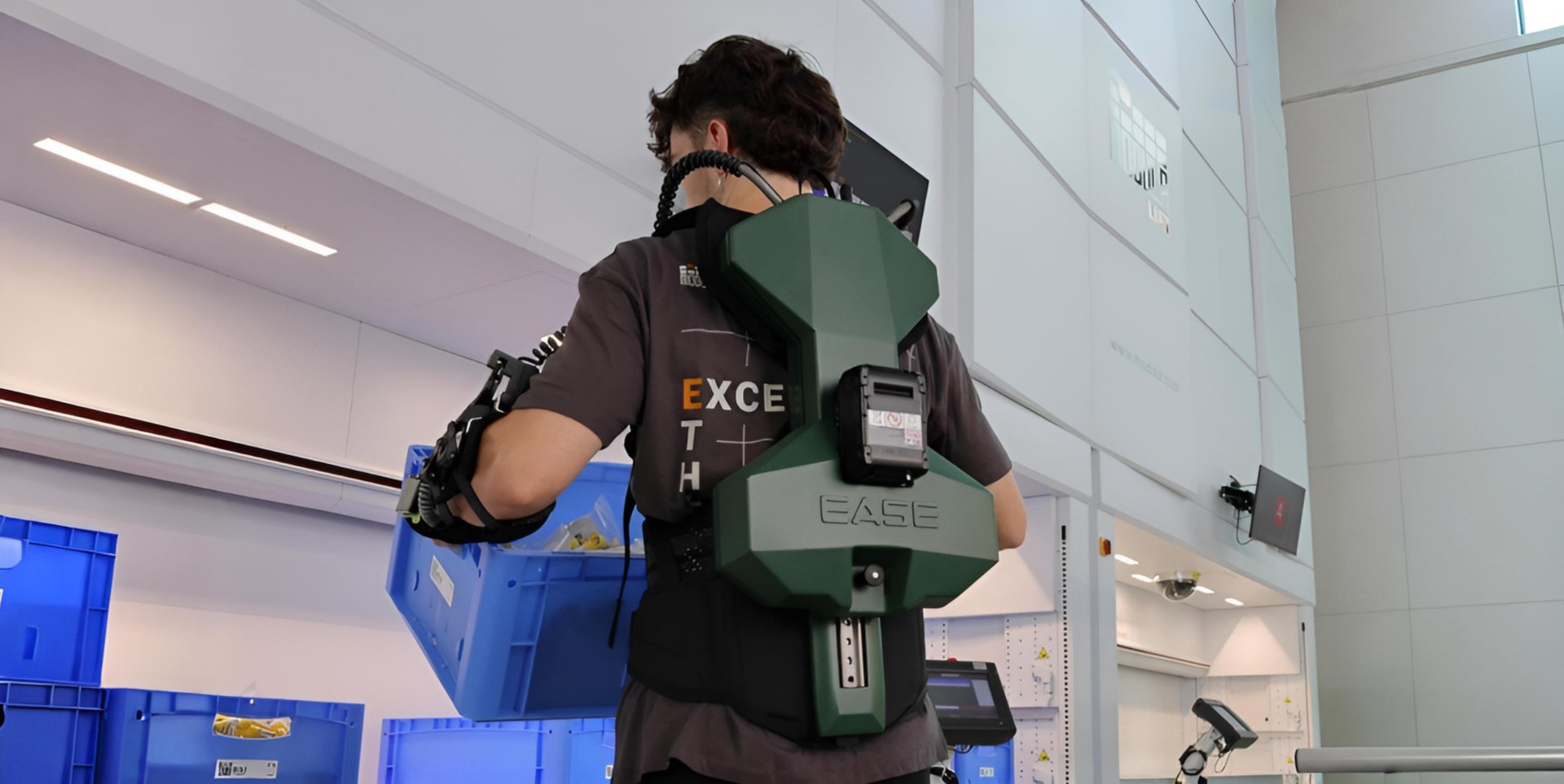
The LU 20 future-proofs manual workstations by making them more ergonomic, healthier, and more productive. It is the first exoskeleton to actively support both the arms and back and, according to pilot customers, the first that logistics employees actually enjoy wearing. It reduces strain when lifting, carrying, and lowering loads of up to 20 kg, weighs approximately 6 kg, can be put on in under a minute, and pays for itself in less than a year. In the future, it will provide anonymized process data to support digitalization and automation. EASE was founded in 2025 as a spin-off from the Technical University of Munich (TUM). The first ten customers are scheduled to receive deliveries starting in November 2026.

Product name and company
LU 20 – EASE
Category
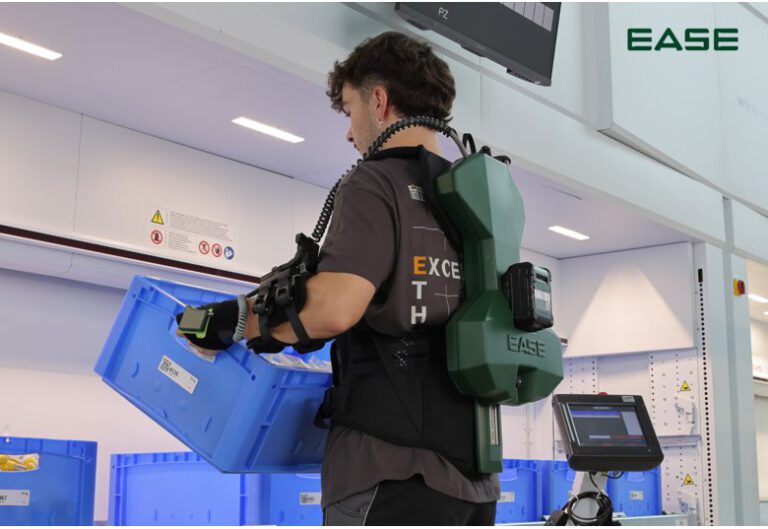
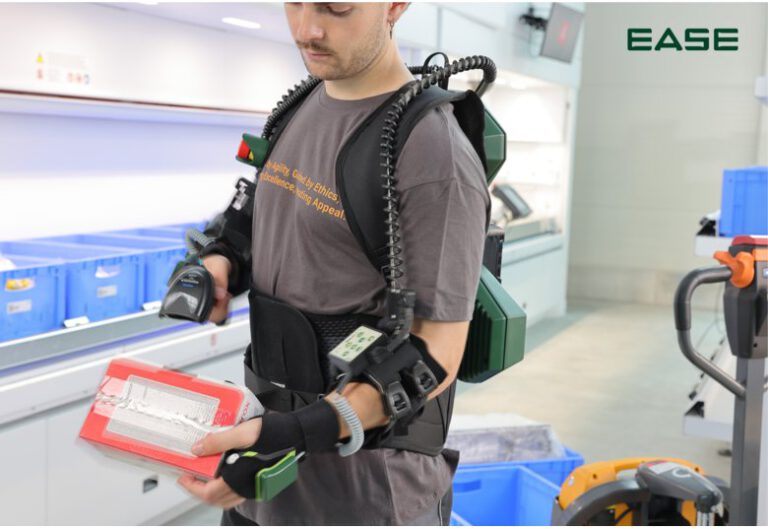
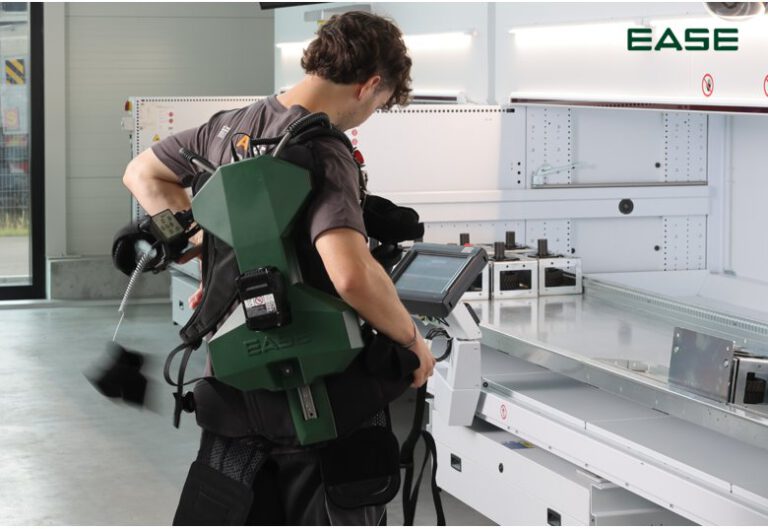
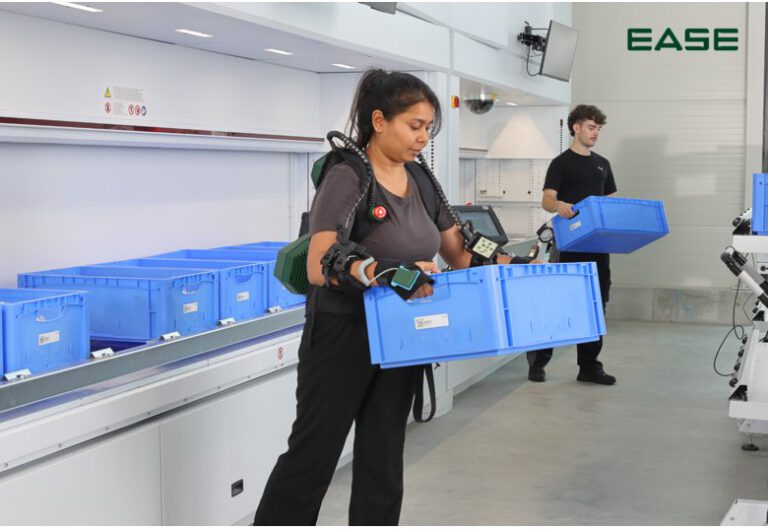
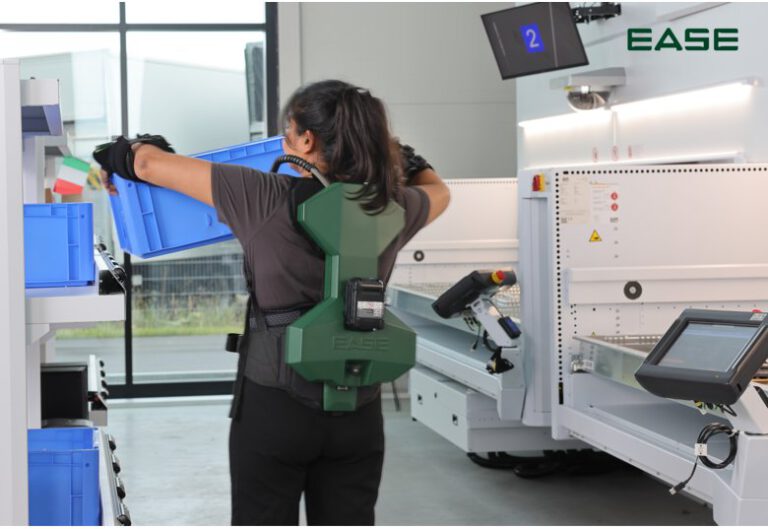
A 15 kg box lifted several hundred times per shift between knee and shoulder height: this is everyday work at order-picking and packing stations, and exactly the task the LU 20 was designed for. Sick leave rates at these workstations exceed 25%, fatigue reduces performance by around 10%, and 8% of positions remain unfilled. This can cost a site up to €1 million per year. Automation is rarely cost-effective because load shapes, packaging, and picking sequences are constantly changing.
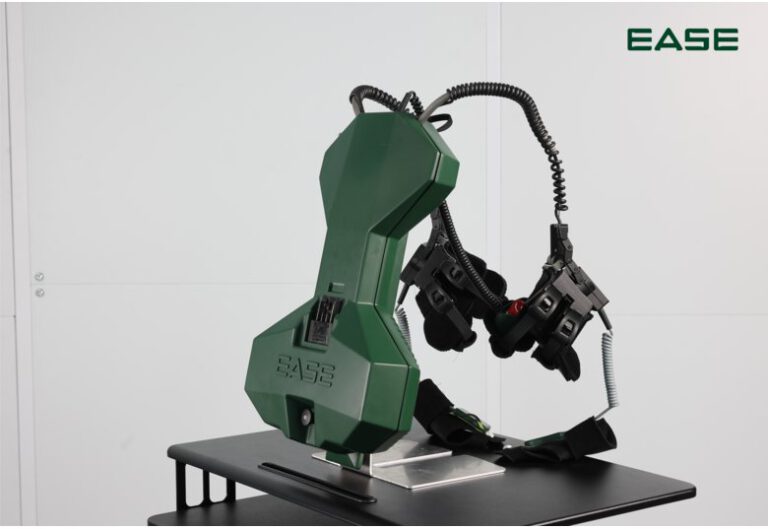
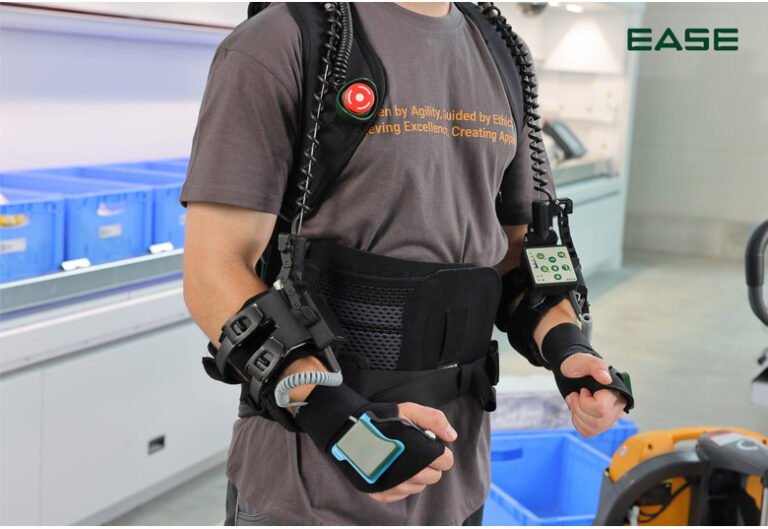
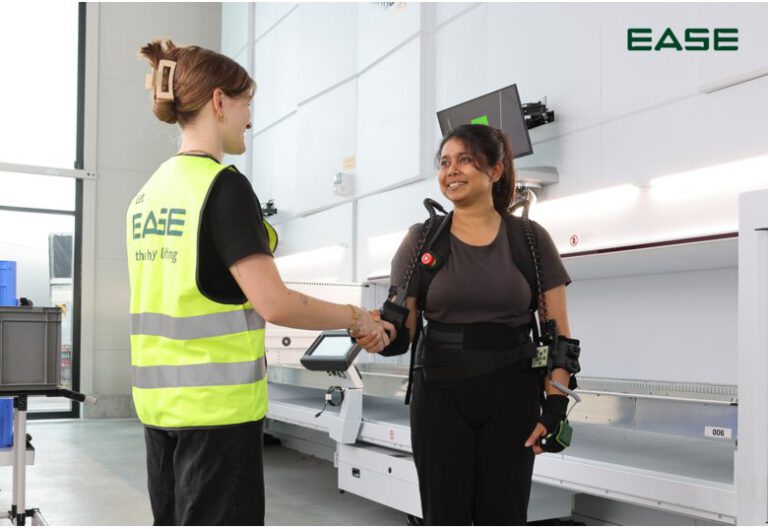
The LU 20 is an active exoskeleton that supports the back and arms. A motor unit housed in a backpack transfers force via cable drives to the forearms and upper body, providing support for loads of up to 20 kg, or 10 kg per arm. Assistance force and speed can be adjusted in increments via the control panel. The system weighs approximately 6 kg, uses a carrying system developed in collaboration with Deuter, and can be put on in under a minute. It runs on Makita XGT 40V max batteries, which many sites already have in stock. One battery lasts a full shift. With batteries swapped during operation, the device can run across three shifts.
The LU 20 is the result of eight years of research at the Chair of Ergonomics at the Technical University of Munich (TUM). EASE was founded in 2025 and is backed by EXIST Research Transfer, ESA BIC, and business angels from its first funding round. Pilot programs lasting up to six weeks were conducted at DHL, Loxxess, BMW, Siemens, SFB, Spitzhüttl, and Rohde & Schwarz. According to pilot customers, it is the first exoskeleton their teams are happy to put on. Deliveries to the first ten customers are scheduled to begin in November 2026.
The LU 20 is the first active exoskeleton to support the arms, shoulders, and back simultaneously. Comparable systems support only the lumbar spine. Five features set it apart:
1. Full-body support from a single drive unit: A motor unit with cable drives provides up to 20 kg of assistance, or 10 kg per arm.
2. Support throughout the entire handling cycle: Assistance extends beyond lifting to carrying, holding, and lowering loads. Between these tasks, the system allows unrestricted movement during secondary activities such as scanning, opening boxes, or pulling pallet trucks.
Wearability as a design priority: At approximately 6 kg, the LU 20 is lighter than its next-closest active competitor. The Deuter carrying system distributes the weight, can be put on in under a minute, and can be adjusted without tools.
3. Designed for multi-shift operation: Instead of proprietary batteries, the LU 20 uses standard Makita XGT 40V max batteries, which can be replaced during operation. With a runtime of eight hours per battery, the system supports continuous use across shifts. Replaceable, washable textiles, with one set per person, ensure hygienic shared use across three shifts.
4. A data platform for intralogistics: The integrated sensors already capture every lifting operation. In the future, the LU 20 will provide anonymized, non-personally identifiable process data, including lifting frequency, movements, and handling times. Integrated with IoT and warehouse systems, these data make manual work measurable, reveal bottlenecks, and identify which process steps could be automated. The exoskeleton becomes a bridge between manual work and digitalization.
Around five million people in the EU perform lifting and carrying tasks as part of their daily work, including order picking, parcel handling, loading and unloading, intralogistics transport, machine loading, and assembly. This is one of the largest and least digitized areas of manual work, with an annual market potential of €36 billion, based on five million workers × an assumed €500 per month for exoskeleton-as-a-service plus €100 for future data services. Automation addresses the problem only in part because loads and workflows vary too widely.
Demand has been validated through pilot programs at DHL, Loxxess, BMW, Siemens, and other companies. Initial deliveries to ten customers are scheduled to begin in November 2026.
Customers purchase a solution for an individual workstation, not a company-wide license. Target customers are businesses with 6 to 50 physically demanding handling workstations, including logistics providers with 100 to 600 employees and industrial sites with 1,000 to 5,000 employees. Larger customers typically start with five to ten devices for a proof of concept.
Three factors are driving purchasing decisions:
Around 30% of employees in these roles will retire within five years, while the pipeline of new workers is insufficient.
Section 73(2) of the German Postal Act (PostG) requires parcels weighing more than 20 kg to be delivered by two people unless a suitable technical aid is available. Contract logistics providers must also demonstrate ergonomic innovations to their customers before contract renewals.
Sales are handled through certified partners such as ProHandling and exoskelette.gmbh, which provide consulting, lend out trial devices, and sell the systems.
The LU 20 reduces the physical load on the arms, shoulders, and back by up to 20 kg, or 10 kg per arm, during lifting, carrying, and lowering.
For each workstation, the business model assumes a 30% reduction in sick days (approximately €12,000 in avoided costs) and a 10% reduction in fatigue (approximately €10,000 in recovered productivity). At a purchase price of €8,990, the device pays for itself well within one year and falls within the spending authority of site management, which typically extends to €20,000.
Whether a device is worn consistently depends on its weight, how quickly it can be put on, and freedom of movement. The LU 20 meets all three requirements: it weighs approximately 6 kg, can be put on in under a minute, and does not restrict movement during secondary tasks. After every pilot project to date, employees have wanted to keep the system permanently and continue to ask about it regularly.
The LU 20 makes physically demanding workplaces more suitable for employees of different ages and helps them remain healthy throughout their working lives. Experienced employees can stay in their jobs longer, while the work becomes accessible to more people regardless of age, fitness, or gender. This supports social sustainability while expanding the pool of potential applicants.
Replaceable batteries keep the system running across three shifts. With a service contract, a replacement device is delivered within five business days in Germany and seven business days elsewhere in the EU.
Implementation follows a structured process: a one-day workshop involving employees, management, occupational safety, occupational health services, and the works council, followed by 2.5 days on site. Wear
Image/video credits: EASE / Sweekrati Sachan / Daniel / Julia Ott
Finalists undergo the three-stage IFOY Audit as part of the IFOY Audit, which takes place during the TEST CAMP INTRALOGISTICS. This consists of the scientific IFOY Innovation Check, the IFOY Test and the jury test.
The bylaws set forth the core values and standards of the IFOY AWARD, which guide the organization’s actions. These include, among other things, governing bodies, the election process, evaluation criteria, and the Code of Conduct.
The International Intralogistics and Forklift Truck of the Year has three bodies: Jury, sponsors, and advisory board.