

IFOY Audit
Finalists undergo the three-stage IFOY Audit as part of the IFOY Audit, which takes place during the TEST CAMP INTRALOGISTICS. This consists of the scientific IFOY Innovation Check, the IFOY Test and the jury test.
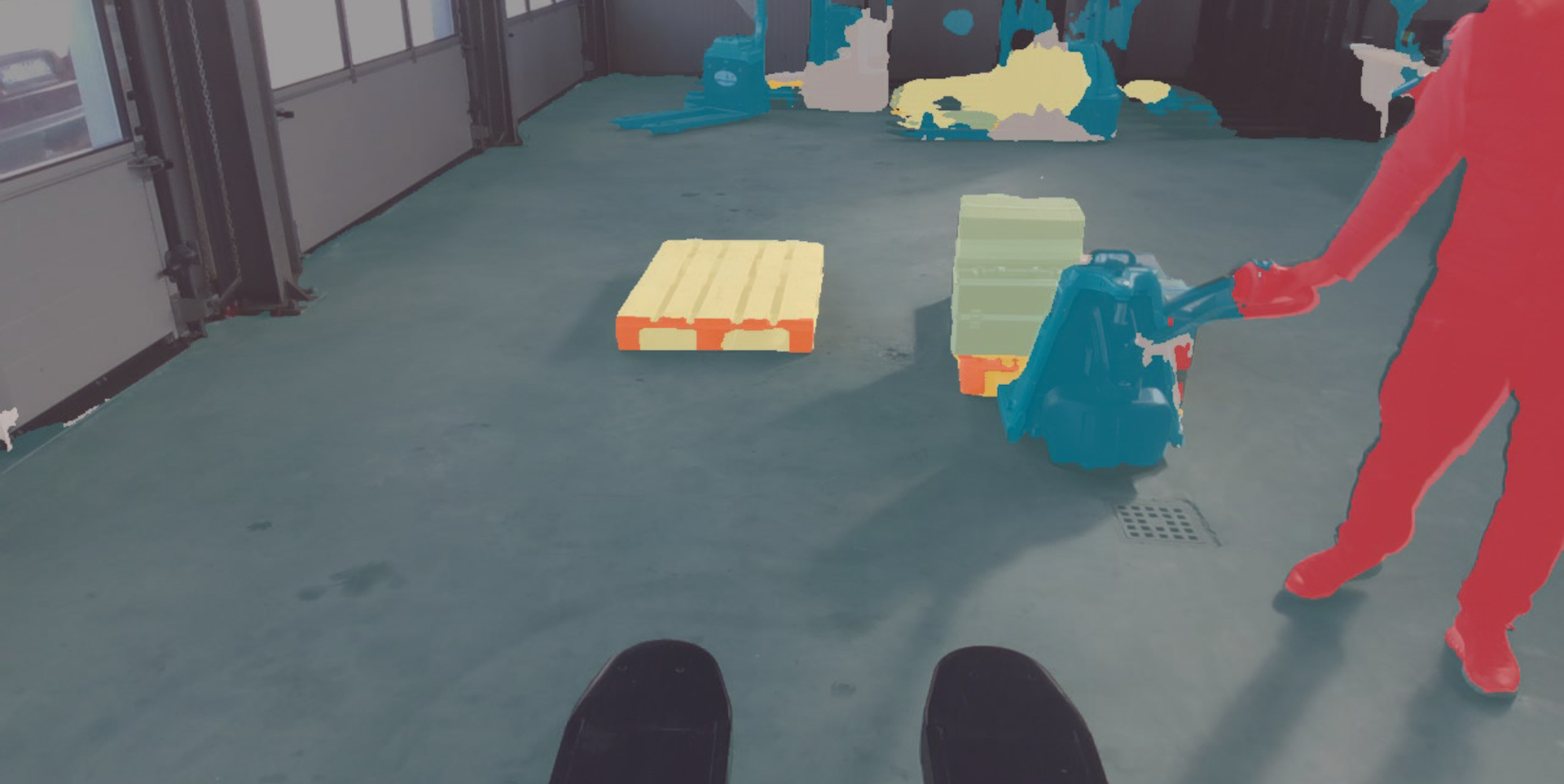
By transforming raw visual data into meaningful insights, semantic perception enables machines to truly understand and interpret their environment – enabling safer, smarter, and more efficient intralogistics operations.

Product name and company
Semantic visual intelligence for intralogistics – Romb Technologies

The technology gives machines human-like environmental understanding. Unlike traditional vision systems limited to fixed object templates, it recognizes and distinguishes between people, pallets, loads, vehicles, and navigable terrain – unlocking new capabilities such as adaptive load handling, obstacle avoidance, and real-time facility-level analytics.
Key innovations include:
Together, these features enable flexible, vision-driven automation that dramatically enhances AGV/AMR performance and facility visibility.
The innovation primarily targets AGV and AMR manufacturers as well as system integrators. By integrating our semantic perception modules, they can offer safer, more autonomous, and more efficient vehicles to end users in manufacturing and logistics.
The combined AGV/AMR market is estimated at about 70,000 units sold per year in 2024, and expected to grow to 110,000 units by 2030. With the expected target price for a semantic perception software package ranging between €1,000 and €5,000, the estimated market potential today is between €70 million and €350 million, and expected to grow by about 50 % by 2030.
A secondary market includes end users who can deploy the software on existing camera infrastructure to gain real-time insights into asset utilization and material flow. This segment could exceed the primary market in value as facilities increasingly pursue digital twins and AI-driven analytics.
The system increases operational transparency, efficiency, and safety within intralogistics environments through the following specific benefits:
The Semantic Visual Intelligence for Intralogistics from Romb Technologies is a modular solution for mobile robot systems in intralogistics that can semantically recognize people and a wide variety of objects in the warehouse (categories such as drivable surfaces, various types of full/empty pallets, pallet fronts, type of load, walls, columns, et cetera) and can trigger a correspondingly adapted robot behavior. The solution is based on state-of-the-art semantic segmentation techniques and AI model architectures and processes both RGB color image data and 3D sensor data from any sensor manufacturer, in each case based on a single frame (no tracking). Particular emphasis was placed on the low requirement for real annotated training data for the categories to be recognized: only about 20 sample images are needed per category. A dataset of this kind, comprising approximately 500 images, can be adaptively retrained by the system for a new customer within five to eight hours. For smooth operation, the system places only moderate demands on, for example, simple, embedded GPU computing hardware. In testing, the system reliably recognized the various categories of warehouse entities and people in most cases, with only a few explainable error situations and minimal fluctuation in the semantically segmented image regions.
The system’s unique feature lies in its simple and flexible adaptability to new customer use cases, requiring only a small amount of annotated real-world data for fine-tuning. As a modular system, it is highly versatile. Additionally, the system can automatically calibrate its installation position on vehicles equipped with forks. From a technical standpoint, the degree of novelty is moderate, as comparable systems are already in use in some cases in warehouse monitoring systems, cargo measurement systems, and autonomous forklifts.
The primary benefits for customers include more efficient use of AMRs through situation-adaptive obstacle avoidance behavior, automatic pallet handling, more efficient commissioning, and the implementation of a wide range of new autonomous applications with AMRs. Both existing vehicles and new AMRs can be easily equipped with Romb’s plug-and-play system. Thanks to its modularity and low target price, the system is a worthwhile investment in many cases. In addition, the short commissioning time of just one to two days significantly simplifies deployment.
The AMR market is a significant growth market, with approximately 70,000 units expected to be sold by 2024 and is increasingly opening up to more complex and demanding application scenarios. A semantic understanding of the environment is a particularly valuable feature for part of the fleet in such situations. To tap into the market, Romb is pursuing a licensing model with AMR manufacturers and is very competitively priced at 1000 to 5000 euros per system. To date, three different application scenarios have been piloted with one end customer and two interested manufacturers: the adaptive, autonomous picking of pallets, adaptive avoidance behavior depending on obstacle types (people, static objects), and stock availability checks in a buffer rack.
Romb presents a technically simple yet high-performance and compelling solution for semantic environmental understanding for AMRs, which stands out for its highly data-efficient training. Scaling and market penetration represent the next critical steps for the company.
| Functionality / type of implementation | + |
| Novelty / Innovation | Ø |
| Customer benefits | + |
| Market relevance | + |
| ++ very good / + good / Ø balanced / – less / — not available | |
Image/video credits: Romb Technologies
Finalists undergo the three-stage IFOY Audit as part of the IFOY Audit, which takes place during the TEST CAMP INTRALOGISTICS. This consists of the scientific IFOY Innovation Check, the IFOY Test and the jury test.
The bylaws set forth the core values and standards of the IFOY AWARD, which guide the organization’s actions. These include, among other things, governing bodies, the election process, evaluation criteria, and the Code of Conduct.
The International Intralogistics and Forklift Truck of the Year has three bodies: Jury, sponsors, and advisory board.