

IFOY Audit
Finalists undergo the three-stage IFOY Audit as part of the IFOY Audit, which takes place during the TEST CAMP INTRALOGISTICS. This consists of the scientific IFOY Innovation Check, the IFOY Test and the jury test.
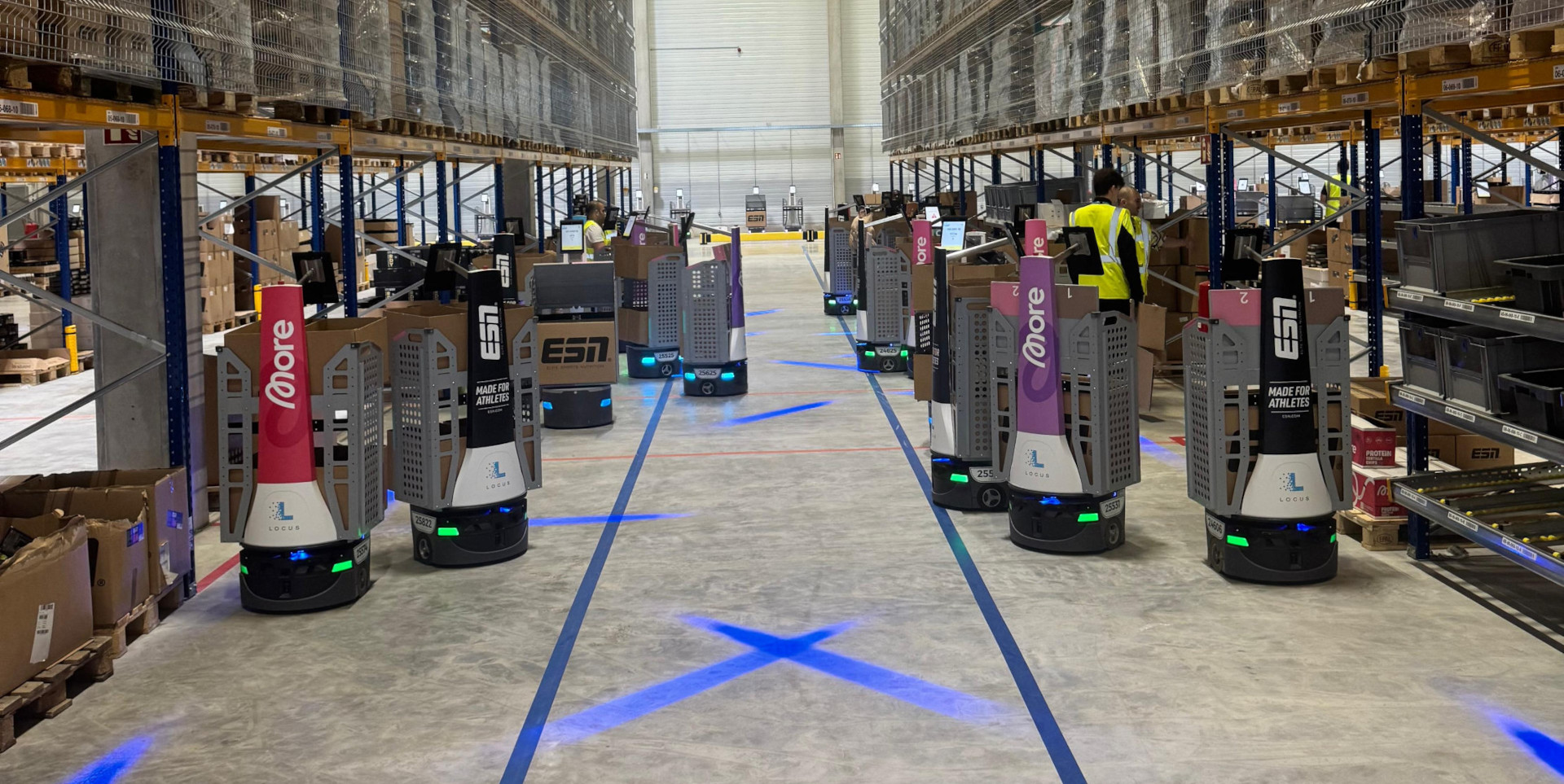
From Greenfield to Peak-Ready in Eight Months: LocusONE orchestrates up to 350 Locus Origin AMRs at The Quality Group’s 40,000 m² Elsdorf fulfilment centre. Serving the fast growing brands ESN and More Nutrition, whose influencer led campaigns can turn any SKU into a top seller overnight, the LocusONE platform adapts instantly. Tasks and robots are reallocated in real time to follow demand, keeping throughput high no matter which products surge. The operation scaled from 40 to 350 robots in only eight months, proving that flexible, software defined automation has reached fixed automation throughput while preserving the adaptability today’s e commerce business models require.

Product name and company
LocusONE at The Quality Group – Locus Robotics
Category
Integrated Customer Solution
Customer
Implementation period
From:
Until:
12/31/2025
Investment volume
300000 €
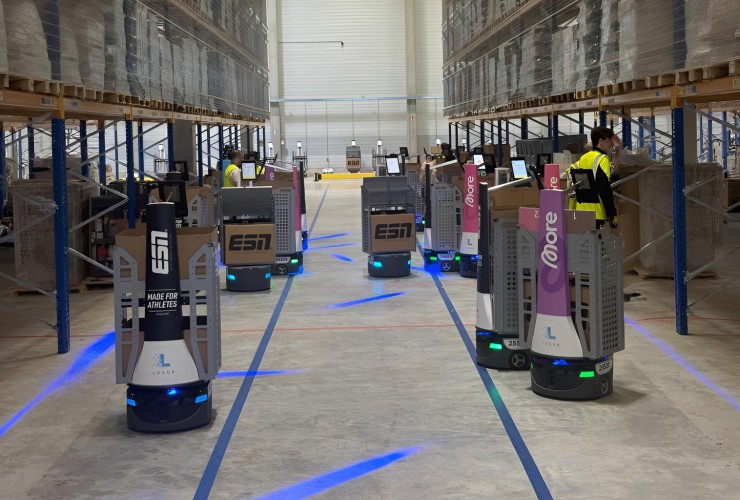
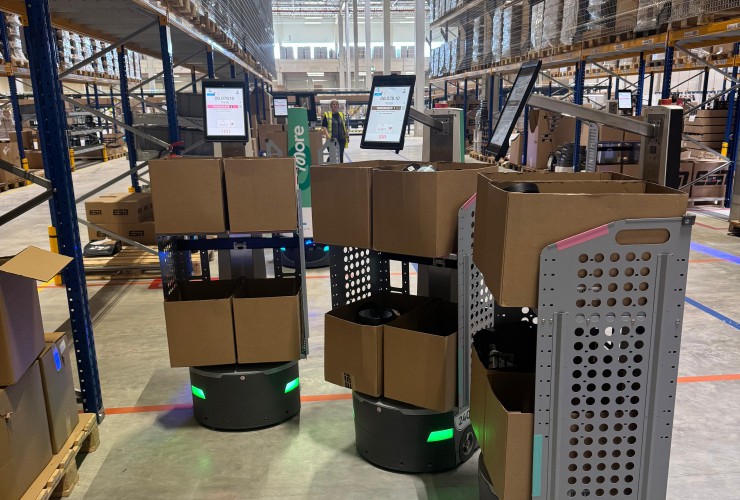
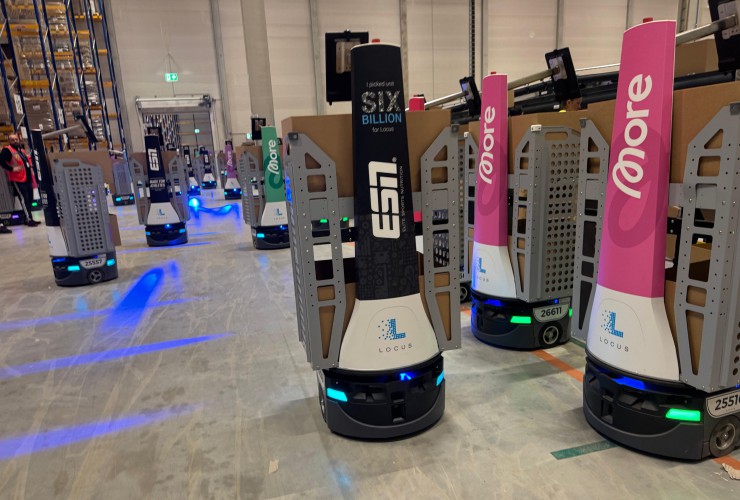
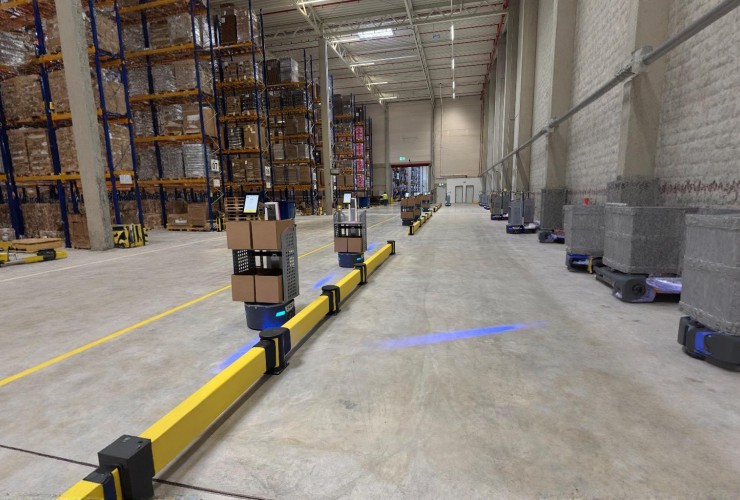
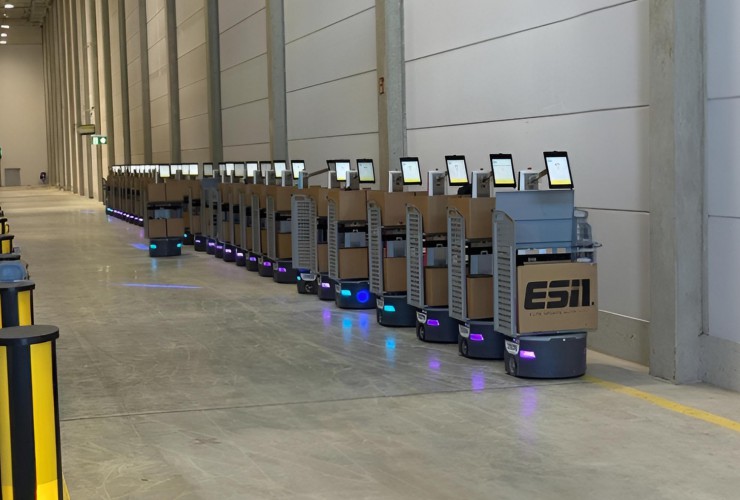
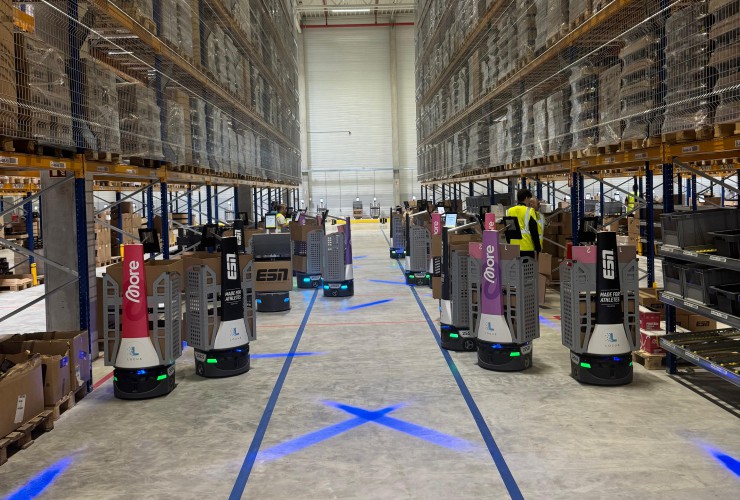
The Quality Group (TQG) is one of Germany’s fastest growing e commerce companies in functional food and sports nutrition. Through its brands ESN and More Nutrition, TQG combines premium, locally produced products in Germany with a highly digital, influencer driven go to market model. Frequent product launches, limited drops and weekly promotions create short, intense peaks and rapidly shifting demand patterns. This means SKU velocity is not stable. Any product can become an overnight fast mover, and the set of A movers changes repeatedly throughout the months.
Initial situation and project objectives
TQG built a new 40,000 m² greenfield fulfilment centre in Elsdorf to support its rapid growth and to consolidate its network. Two previously separate warehouse operations were migrated into Elsdorf, allowing TQG to centralize fulfilment, simplify flows, and free up the former main site to be transformed into a second production location. The Elsdorf facility was designed to start at roughly 45,000 e commerce orders per day and 300,000 units per day, and to scale quickly to 60,000 orders per day and beyond during peak seasons. The key requirement was to create a fulfilment operation that could deliver goods to person level throughput without locking the business into rigid fixed automation and high capital investments. In other words, TQG needed maximum performance with the flexibility to change flows, zones, and fast mover placement as campaigns and product trends shift, while keeping automation investment lightweight and primarily OPEX based.
The challenges
The project was shaped by four realities of TQG’s business model and network strategy.
The solution
Locus Robotics deployed the LocusONE platform with a fleet of Locus Origin AMRs. LocusONE integrates with TQG’s Logistics Reply WMS and orchestrates robots and workers in real time across multiple halls and picking zones. The system was designed around two principles: first, software driven orchestration that can reallocate work instantly as campaigns shift; second, scalable robotics capacity that can grow with demand rather than forcing a one time overbuild.
Staged ramp up to full scale
The deployment followed a deliberate staged ramp that mirrors TQG’s growth and the build out of the new facility.
This staged approach is a core innovation element. Instead of forcing TQG into a fixed automation build timeline, robotics capacity and orchestration scaled exactly when demand required it.
FastPick for rotating fast movers
A central feature of the solution is LocusONE FastPick. TQG uses dedicated wide aisle or gravity rack FastPick zones where bots cluster on demand to form pick walls. These zones are intentionally designed for SKU volatility. As campaigns change and different products become A movers, TQG can reslot those SKUs into the FastPick area and LocusONE automatically concentrates robots and work on that demand peak. If reslotting cannot happen in time, the system still performs: LocusONE can create a pick wall in standard zones as well, dynamically pulling bots to wherever the new fast mover sits so throughput is protected even before the physical layout is adjusted. Pallets are replenished from the back through dedicated lanes, keeping high velocity picking flowing without decanting into fixed systems. This allows TQG to reach extremely high throughput on fast movers while keeping placement fully adaptable.
Integrations and operational flow
The Locus system operates alongside the wider Elsdorf automation set up, including Vanderlande conveyance and Ranpak on demand packaging. Robots feed picked orders into the downstream flow, while conveyors and packaging systems handle transport, carton creation and final parcel processing. LocusONE provides real time visibility and workload balancing across pick zones.
Customer benefits
The integrated solution delivers clear outcomes aligned to TQG’s objectives.
Throughput comparable to fixed automation, with flexibility preserved. FastPick areas enable goods to person level productivity on high velocity SKUs without decanting or rigid infrastructure. TQG achieves high density picking with minimal walking and constant bot arrival at stations.
Instant adaptability to demand shifts. LocusONE reallocates robots and tasks in real time, so whichever SKU becomes a fast mover can be absorbed immediately without changing hardware.
Peak resilience through scalable robotics. The fleet ramped from 40 to 350 robots in eight months, including the ability to add temporary peak bots during campaigns (30 additional bots for Black Week). This removes the need for large labour spikes or over dimensioned fixed automation.
Faster time to value. The site went live in under 90 days from signature and reached full three hall scale far ahead of the original roadmap.
Improved ergonomics and ramp training. Walking is largely eliminated in FastPick zones. Pickers remain focused and productive, and new associates reach competency quickly, which is critical for a fast growing workforce.
Risk reduced investment. The RaaS model enables continuous scaling without a large upfront CAPEX bet. As the business evolves, zones and flows can be reconfigured in software.
Key data
Location: Elsdorf, Germany.
Site size: 40,000 m² with expansion capability.
Storage: high bay racking and pallet density designed for fast mover rotation.
Robots: about 40 at first go live, about 350 at full scale.
Capacity: designed for 45,000 orders per day and 300,000 units per day at launch, scaling to 60,000 orders per day and beyond in peak.
Integrations: Logistics Reply WMS, Vanderlande conveyance, Ranpak packaging, with full LocusONE orchestration and FastPick zones.
Conclusion and Outlook
This project demonstrates why flexible, software defined warehouse automation is a perfect match for today’s promotion driven e commerce environment. At The Quality Group, LocusONE delivers the throughput traditionally associated with fixed G2P automation while staying fully adaptable to rotating fast movers, frequent campaign peaks and rapid business growth. The scaled ramp to Europe’s largest Locus fleet in under eight months makes Elsdorf a benchmark reference for high performance automation without sacrificing flexibility.
Beyond the current origin based picking operation, TQG’s growth trajectory is already opening the next use cases. The B2B channel is increasing in importance, and together we are evaluating Locus Vector as a complementary robot type for heavier transport and replenishment flows connected to wholesale shipments. In parallel, TQG is also reviewing Locus Array, the next evolution of the Origin platform, as a future option for even higher density and AI driven task automation as volumes and SKU complexity continue to rise.
The robotics as a service model is a key enabler for this roadmap. It allows TQG to flex fleet size and robot types over time without taking on fixed capital risk or committing to a single automation architecture. Capacity can expand or contract with campaign intensity, channel mix, and product velocity, while the orchestration layer stays constant. This keeps the operation ready for whatever demand pattern emerges next and supports TQG’s goal to build a fulfilment engine that can scale into a future that cannot be predicted in advance.
The Locus Robotics solution LocusONE at The Quality Group is a scalable AMR-based picking system that supports picking processes in warehouse logistics through autonomous mobile robots and can be dynamically adapted to changing requirements. The functionality includes in particular intelligent order allocation, route optimization, and the flexible integration of additional robots when needed. The overall impression is good, with the solution particularly convincing due to its strong practical relevance. Fast implementability as well as adaptable performance capability and robust system functionality are of major importance. Particularly noteworthy is the efficiency increase achieved through reduced walking distances as well as the simple scalability. Usability is supported by intuitive operating concepts. However, limitations arise due to system-related constraints, especially in cases of high pick volume per order, which restricts the range of applications. Here, there is potential for improvement regarding the expansion of use scenarios, for example with other mobile robots.
The solution is to be regarded as a good innovative further development in the field of autonomous mobile robotics. While AMR systems are already established in the market, LocusONE stands out through its consistent focus on flexible scalability and rapid readiness for deployment. The ability to adjust the number of robots used at short notice to changing throughput requirements is a particularly practical feature. Compared with the state of the art, this is not entirely new, but it is implemented in a convincing way in terms of maturity and market readiness. The innovation therefore lies less in individual technological breakthroughs and more in the intelligent combination and orchestration of existing technologies into a highly flexible overall system. This can be classified as a significant further development in the competitive environment.
The solution is aimed in particular at companies with strongly varying throughput requirements, seasonal fluctuations, or the need for short-term scalable logistics processes. Customer benefit is very good, as the solution offers an exceptionally high level of flexibility and can be quickly adapted to changing operational conditions. Particularly noteworthy is the ability to reduce investment risk through short implementation times and flexible usage models. Companies benefit from rapid commissioning, high process stability, and a significant reduction in walking distances for pickers. The return on investment can also be positively influenced through demand-driven scaling. For specific use cases, such as in the example of The Quality Group, the solution is highly suitable. However, limitations arise in scenarios such as very large pick volumes per order or steady and highly predictable order patterns, although this depends on the respective application scenario.
The solution addresses the growing market for automated picking systems and in particular the area of autonomous mobile robots in intralogistics. Market relevance is good, as flexible and scalable solutions are becoming increasingly important, especially in dynamic markets with fluctuating demand. Compared with the state of the art, LocusONE positions itself as a particularly adaptable and economically attractive solution for specific requirements. Its strengths lie above all in rapid implementation and high adaptability to changing operational conditions. However, for companies with stable and very high pick volumes, relevance may be limited. Overall, the solution is nevertheless of high importance for a clearly defined target group and offers convincing competitive advantages in this segment.
The solution impresses through very high customer benefit, particularly due to its exemplary flexibility and scalability in highly variable throughput environments. In combination with good functionality and innovation performance, it creates a clear impact in the market segment of dynamic picking systems, even though the range of application remains functionally limited.
| Functionality / type of implementation | + |
| Novelty / Innovation | ++ |
| Customer benefits | ++ |
| Market relevance | + |
| ++ very good / + good / Ø balanced / – less / — not available | |
Image/video credits: Locus Robotics
Finalists undergo the three-stage IFOY Audit as part of the IFOY Audit, which takes place during the TEST CAMP INTRALOGISTICS. This consists of the scientific IFOY Innovation Check, the IFOY Test and the jury test.
The bylaws set forth the core values and standards of the IFOY AWARD, which guide the organization’s actions. These include, among other things, governing bodies, the election process, evaluation criteria, and the Code of Conduct.
The International Intralogistics and Forklift Truck of the Year has three bodies: Jury, sponsors, and advisory board.