

IFOY Audit
Finalists undergo the three-stage IFOY Audit as part of the IFOY Audit, which takes place during the TEST CAMP INTRALOGISTICS. This consists of the scientific IFOY Innovation Check, the IFOY Test and the jury test.
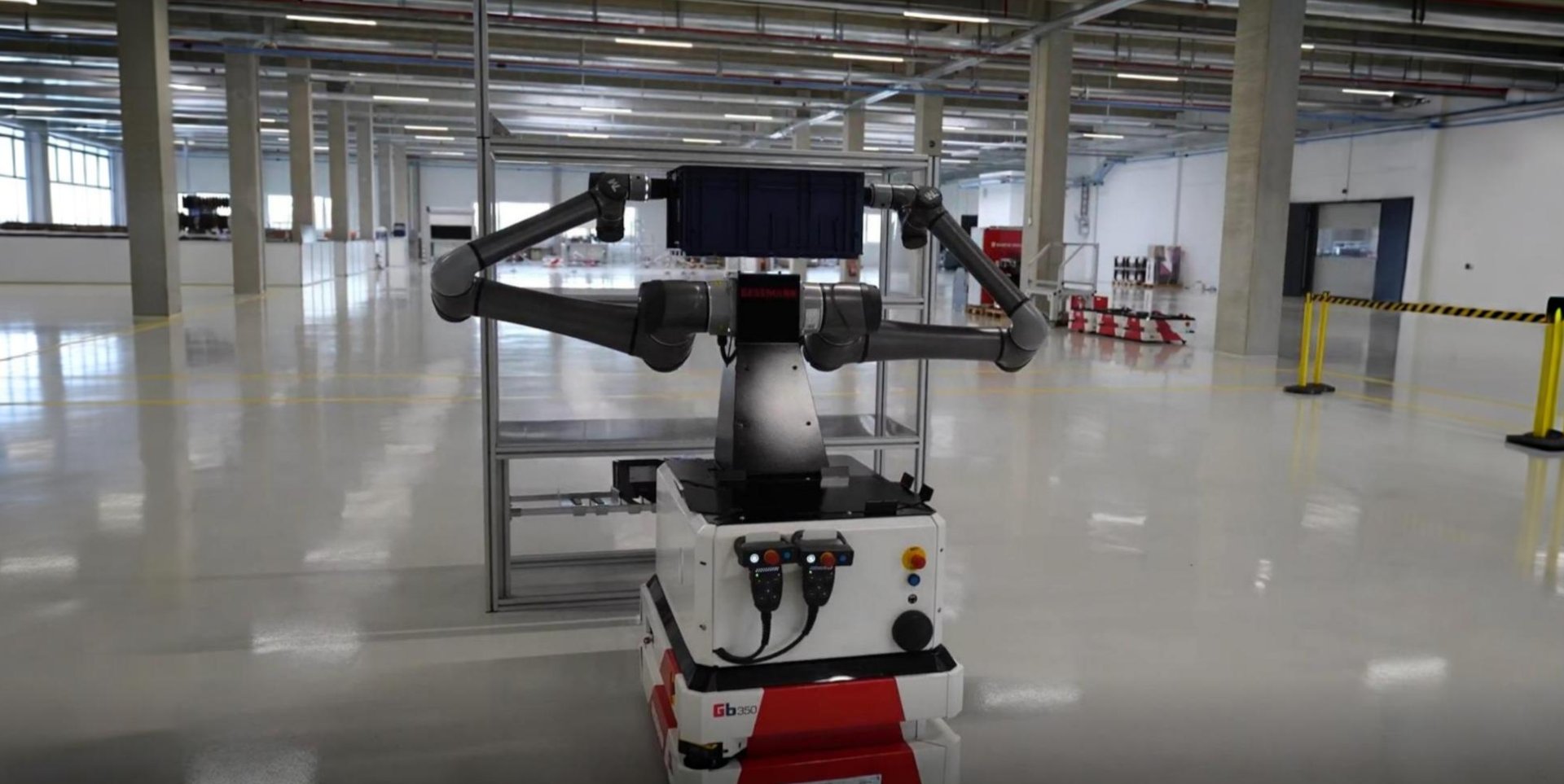
An AGV equipped with two cobot arms picks up and carries small load carriers (KLTs) as if using two hands. It independently detects where a container is located and how it is oriented. EVASIVE software automatically coordinates the movements of both arms, without teaching or lengthy AI training. The EncapsulatedAI technology also enables additional AI skills to be used in motion planning within secure capsules, providing flexibility when handling different containers and variants. The solution already enables safe, automated transport and handling between the storage rack and the workstation.
Product name and company
Dual-Arm AGV – EVASIVE ROBOTICS
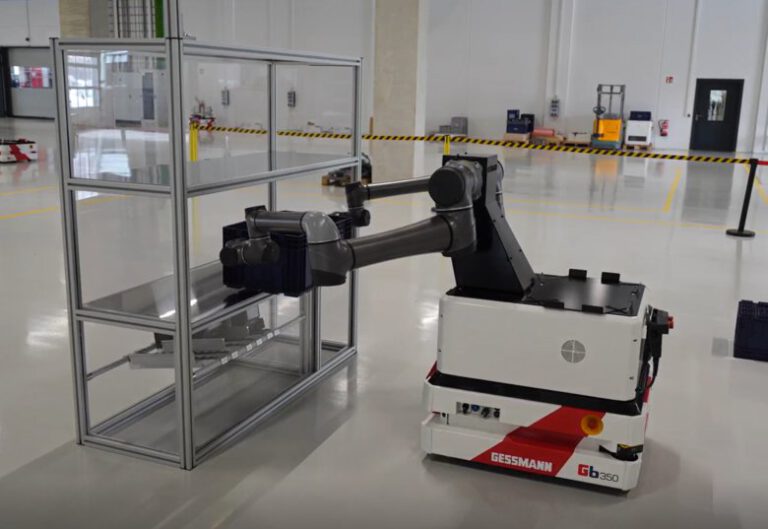
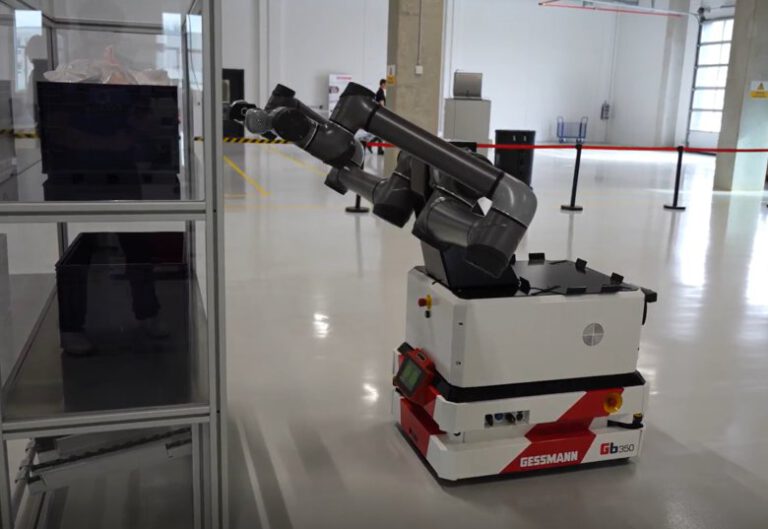
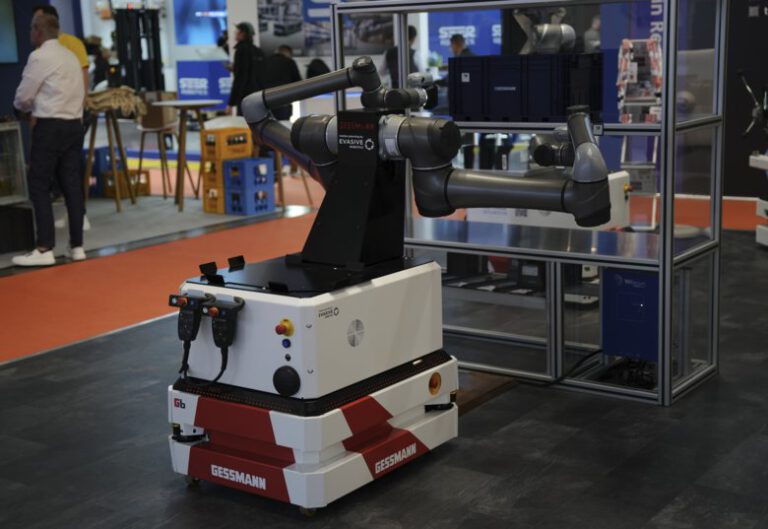
Retrieving small load carriers (KLTs) from storage racks, repositioning them, and delivering them to workstations or machines: fewer and fewer skilled workers are willing to take on this repetitive work, leaving positions vacant for long periods. The Dual Arm AGV takes over these tasks, combining transport and handling in a single vehicle, even in existing facilities with narrow aisles and existing storage racks. The arms have a reach of 1,300 mm and can carry a combined payload of up to 30 kg. One battery charge provides up to eight hours of operation. Safety laser scanners enable safe navigation without floor markings, even in aisles approximately 1.2 m wide, while protecting people in the working environment.
The intelligence comes from EVASIVE ROBOTICS GmbH: the task is defined once, and the system takes care of the rest. The vision system captures the storage rack and container, and the motion-planning software calculates safe movements for both arms. This allows the solution to adapt quickly to different racks, containers, and environments without requiring movement sequences to be taught, even when the surroundings change. Automated storage and retrieval of KLTs has already been implemented. Pick-and-place, order picking, and the supply of workstations and machines can be added as further capabilities tailored to individual requirements.
Mobile robots equipped with gripper arms usually have only one arm. When two robots operate in the same space, each is typically assigned a fixed area, and every movement is taught manually (teach-in). AI systems eliminate the need for teach-in, but require extensive training and their decisions remain difficult to trace. EVASIVE ROBOTICS GmbH combines the advantages of both approaches. Its motion-planning software calculates the movements of both arms directly from the dimensions of the robot, vehicle, and storage rack, coordinating them so that both arms can share the workspace and grasp and carry an item together. For users, this means getting up and running quickly, without collecting training data. When a task changes, the software automatically recalculates the movements. The robot executes identical tasks consistently, making acceptance testing and troubleshooting easier.
With EncapsulatedAI, AI modules are integrated into motion planning within secure capsules. Every AI-generated proposal is checked against physical and safety constraints before either arm moves. This enables EVASIVE to deploy AI skills in industrial applications with safety requirements today, for example to respond to disruptions or unforeseen situations. The robot remains predictable, and the safety control system remains untouched. The architecture is also open to different robot arms: if an application requires a higher payload or greater reach, the arm type can be changed while the software remains the same.
The intralogistics sector faces a shortage of workers. According to the German Federal Employment Agency, the number of applicants for vocational training as a warehouse logistics specialist recently amounted to just 72 per 100 vacancies, compared with an average of 93 across all occupations. Monotonous handling tasks are particularly difficult to staff: storing and retrieving small load carriers (KLTs), repositioning them, and supplying workstations and machines. AMRs have already automated transport, but handling at the start and end points generally remains manual or requires transfer stations, conveyor systems, and stationary robotic cells. Mobile manipulators close precisely this gap. According to Research and Markets, the global market is expected to grow from USD 748 million in 2025 to USD 1.49 billion in 2030, equivalent to an annual growth rate of 14.7%.
The Dual Arm AGV targets medium-sized industrial companies, automotive manufacturers and suppliers, and mechanical engineering companies. It is designed for established brownfield environments with existing storage racks, narrow aisles, and changing tasks, where rigid automation is not economically viable. Compared with single-arm systems, two arms expand the range of applications to include larger and heavier load carriers. The route to market is already in place: an established partner contributes a platform proven in series operation at its own plants, manufacturing in Europe, and service capabilities. EVASIVE ROBOTICS GmbH provides the software, which is also compatible with other types of robot arms. Well-known German industrial companies have already expressed interest in deploying the Dual Arm AGV.
With the Dual Arm AGV, a single vehicle handles both transport and material handling. Transfer stations, conveyor systems, and stationary robotic cells are no longer needed, and existing storage racks can continue to be used without modification. The robot takes over monotonous repositioning and handling tasks, freeing employees to focus on more demanding work. The robot executes identical tasks consistently, making acceptance testing and troubleshooting easier. If requirements increase, the arm type can be changed while the platform remains in place.
The key benefits:
The robot can be deployed quickly because the software calculates its movements. There is no need to teach each movement, nor is a preliminary training phase with data collection required, as is the case with many AI systems. If a storage compartment or drop-off location changes, the software automatically adapts the movements.
Two arms grip the KLT from both sides and carry it level. This also enables the handling of load carriers that would be too large or too heavy for a single arm.
With EncapsulatedAI, the robot arms can safely adapt to different storage racks and container types. Each AI module runs in a protected capsule and is checked before every movement. This enables AI modules to be used safely in mobile robots.
Ultimately, users need less infrastructure, achieve operational readiness faster, and invest in a system that grows with their tasks. This ensures reliable handling between storage racks and workstations, even when staff are in short supply.
Image/video credits: EVASIVE ROBOTICS
Finalists undergo the three-stage IFOY Audit as part of the IFOY Audit, which takes place during the TEST CAMP INTRALOGISTICS. This consists of the scientific IFOY Innovation Check, the IFOY Test and the jury test.
The bylaws set forth the core values and standards of the IFOY AWARD, which guide the organization’s actions. These include, among other things, governing bodies, the election process, evaluation criteria, and the Code of Conduct.
The International Intralogistics and Forklift Truck of the Year has three bodies: Jury, sponsors, and advisory board.