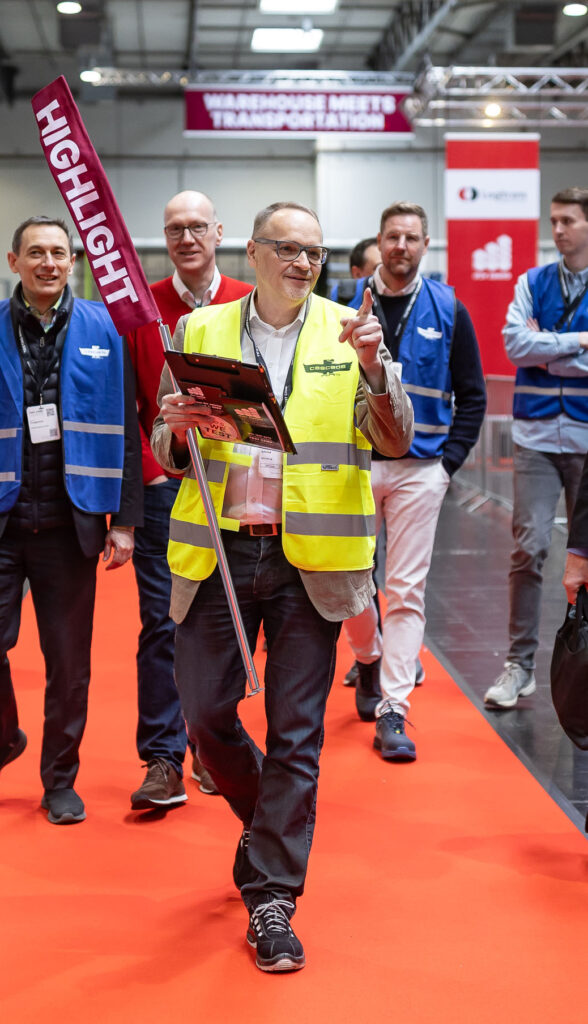
Where will intralogistics be in ten years’ time, Mr. Scholze?
Where will intralogistics be in ten years’ time?
A look into the crystal ball: over the next ten years, the economic situation, driven by factors such as energy costs, raw material shortages and staff availability, will hardly ease. As always, intralogistics will adapt quickly and resourcefully to changing conditions in order to continue to act as a reliable supply backbone. However, this will require undergoing extensive transformations and accepting significant technological upheavals. The relationship between man and machine must be understood in a new way – deep-rooted cooperation will be essential in the future.
The dissolution of physical and digital boundaries through the use of augmented and virtual reality – which create completely new levels of interaction and visualization in logistics – will contribute to this. Autonomous logistics systems form intelligent networks that adapt to current market requirements in real time – and ever new communication standards ensure consistent data exchange.
Bio-based materials and living microorganisms will be increasingly integrated into logistics systems – for example, biomaterials for shelving and vehicle construction, as a substitute for steel, bioenergy for lighting and drive technology, as electricity will be prohibitively expensive, or microorganisms that are used in biodegradable packaging materials or in product coding. Zero-emission logistics centers will then be the norm, powered by renewable energies, with a consistent focus on recycling materials, with a circular economy in practice and guided by deeply implemented energy management systems.
In ten years’ time, supply chain management will be the responsibility of the bits and bytes of AI 4.0 or, by then, AI 10.0 systems, which will turn intralogistics into a dynamic, constantly self-optimizing ecosystem.
How much has the focus on sustainability changed intralogistics?
The consideration of sustainability as an elementary parameter in system and process evaluations has led to significant changes in intralogistics. In the area of conflict between efficiency and sustainability, there has been a shift from performance-oriented solutions to those with a low ecological footprint. Emission-free industrial trucks are now increasingly being used in distribution centers, the development of new battery types is in high demand and practical fuel cells may already be the successor technology. In logistics facilities, energy consumption is being reduced further and further, culminating in “dark warehouse” concepts – which operate fully automatically but are unlit and only minimally heated. Traditional waste disposal is no longer an option – recycling and circular economy concepts focus on the preservation and reuse of recyclable materials. Sustainability is no longer a “nice” additional aspect, but is firmly anchored in the corporate strategy of many intralogistics companies.
Which trends are particularly striking in intralogistics at the moment?
There are currently clear trends towards digitalization and automation in intralogistics. Many intralogistics companies are also trying to simplify their complex processes by networking logistics systems and optimizing their control and analysis options through the use of AI. Furthermore, great strides have been made in the development of autonomous vehicles (AGVs) and mobile robots (AMR). Logistics center operators have recognized the value of these devices, which are now able to navigate autonomously and perform recurring tasks reliably in order to free up employees to carry out more important activities.
What do you expect from an IFOY applicant?
I expect an IFOY applicant to present an innovative, technically proven product, a new type of application or a well thought-out detailed improvement to an existing logistics system. The candidate applying for one of the coveted IFOY awards should either deliver a significant increase in performance, offer a noticeable increase in utility value for the user or further improve operational safety for operators – be it through the use of future-oriented technologies such as artificial intelligence (AI) or by using the latest developments from areas such as vehicle construction, warehouse logistics or information technology. In addition, the sustainability of the submission is an important aspect – this should contribute to reducing the ecological footprint, both during production and later in operation.