

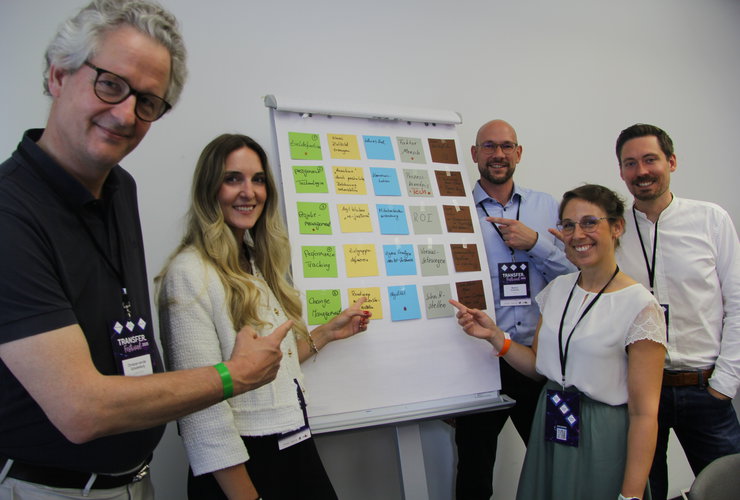
Successful automation: IFOY AWARD workshop at the TRANSFER.FESTIVAL
Automation is considered a key topic in intralogistics. However, while technological solutions are increasingly available and efficient, the real challenges often lie in the implementation of projects. This was the starting point for a workshop offered by the IFOY AWARD organization as part of the TRANSFER.FESTIVAL at the Fraunhofer IML in the run-up to the IFOY AWARD Gala 2025. Under the moderation of Thilo Jörgl from IFOY AWARD management, around 20 participants discussed which factors significantly influence the success of automation projects in practice – regardless of the technology used. The festival was organized by the Digitial Hub Logistics Dortmund, the Leistungszentrum Logistik und IT and the Fraunhofer IML in exclusive cooperation with Logistik.NRW, the IFOY AWARD and the innoclub.
Five small groups were formed to work on different focal points. Christian Ehlers (STILL) led a group that focused intensively on the importance of defining clear goals. The participants came to the conclusion that a common understanding of processes, measurable KPIs and realistic time planning is essential. The early definition of roles and responsibilities was also identified as a key success factor.
Dr. Jana Jost (Fraunhofer IML) moderated the group, which focused on the human factor. It became clear that how employees are treated can be a decisive factor in the success or failure of automation projects: The early involvement of employees, targeted training and transparent communication create acceptance and reduce resistance, which can slow down change.
Success through agile methods
Saskia Reuter (aluco) supervised the group with a focus on project management. The discussion showed that traditional approaches can reach their limits. Instead, agile methods such as Scrum, clear team structures and well thought-out stakeholder management were identified as effective for implementing projects in a flexible and targeted manner.
Christian von der Schulenburg (Siemens) accompanied the group, which dealt with the topic of agility. The participants came to the conclusion that an open error culture, flexible structures and the ability to react quickly to changes are crucial prerequisites for successfully designing complex automation projects.
Markus Schlotter (Exotec) led a group that focused on process and technology knowledge. He emphasized the importance of building interdisciplinary teams, conducting in-depth data analyses and continuously expanding expertise. Openness to new approaches and structured research were named as essential components of a successful project.
Finally, the most important findings of the workshop were prioritized and condensed across the group. The result: successful automation projects are based on a combination of clear objectives, good project management, an active employee culture, a high level of agility and sound process knowledge.