

IFOY AWARD announces 2027 finalists
21 products and solutions from 19 companies have reached the final of the IFOY AWARD 2027. Five companies are competing for the “IFOY Start-up of the Year” Award.
Independent tests, scientific Innovation Check and jury test: At the IFOY Audit in Dortmund, finalists from the fields of intralogistics and robotics face a market comparison.
TEST CAMP INTRALOGISTICS opens to trade visitors on January 26 and 27, 2027.
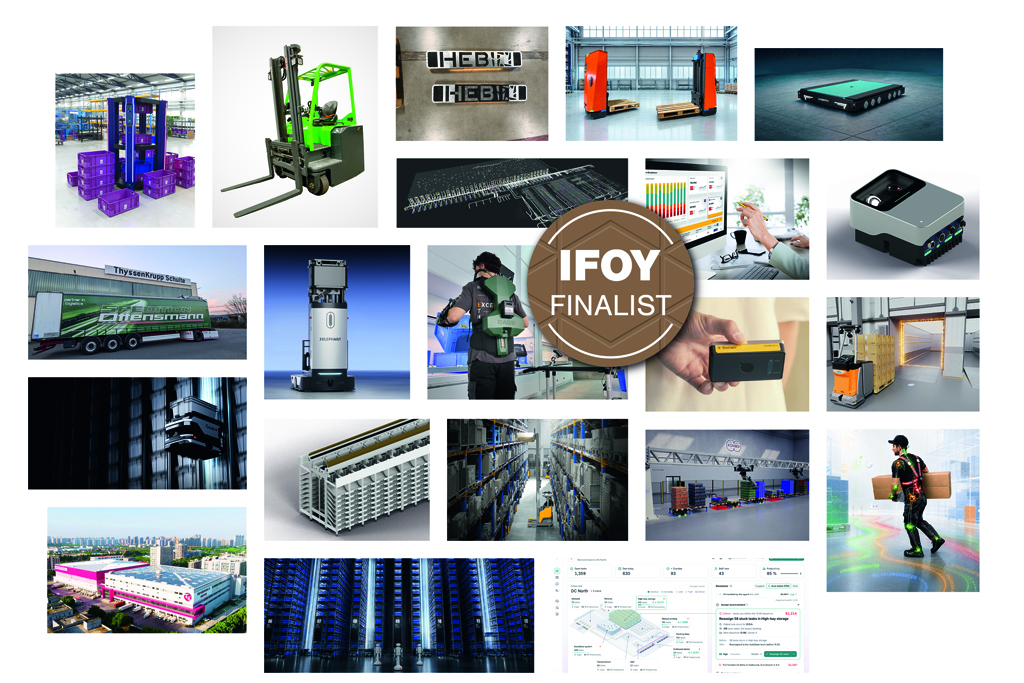
Ismaning near Munich, November 26, 2026. The finalists of the International Intralogistics and Forklift Truck of the Year (IFOY) AWARD 2027 have been selected. The jury has nominated 21 products and solutions from 19 companies for the IFOY Audit. The finalists are 3dvisionlabs, ANT Machines, ATOMIX (a DEXMAL Company), Combilift, EASE, EuroSort, Geekplus, HEB-IO, J-Elephant, Jungheinrich, Key Concept, Kompass360Grad, Körber, Logatik, PIKES, SIMOBOTICS, Sonair, STILL and ZS Robotics.
With five nominees, the IFOY Start-up of the Year Award final also has a strong field: Chaser Robotics, EVASIVE ROBOTICS, HolgerAI, InLoop Robotics and ToShift.
The preselection is now complete. The new developments must now prove their claim to innovation in the independent testing process. Lively debate is therefore guaranteed before the winner trophies are presented in Stuttgart on April 22.
“Intralogistics is automating tasks that have so far remained unsolved. Pallets and small load carriers will remain, but the way they are handled is changing fundamentally. This is precisely where many of the finalists come in: robots no longer just travel from A to B; they grip, store, pack and load. AI runs through almost all of the approaches. The solutions on the way to semi-humanoid and humanoid robots are particularly exciting. The IFOY Audit will show what added value these developments offer compared with the state of the art and what benefits actually reach the user,” says Anita Würmser, Chairwoman of the IFOY Jury.
Three new robot categories
One of the central changes in the IFOY 2027 cycle is the restructuring of the former Mobile Robot category. To reflect the state of technology, it has been divided into three specialised categories.
- “Transport Robot” covers AGVs, AMRs, automated and autonomous forklifts as well as other mobile transport robots.
- “Manipulation Robot” covers stationary and mobile robots for gripping, picking, loading and unloading, and palletising – including humanoid robots and mobile manipulators.
- “Storage Robot” covers robots operating within automated storage systems, including shuttles, cube-storage robots, rack robots and bin robots.
The finalists of the IFOY AWARD 2027
The finalist field focuses on flexible solutions for existing warehouses and production environments as well as tasks that have so far been difficult to automate – from loading and unloading at the truck dock to item-level handling. Digital twins, AI-supported recommendations and innovative sensor technology also provide the basis for more targeted process control and more informed investment decisions.
The finalists in the new Manipulation Robot category automate key tasks ranging from building mixed pallets to loading and unloading trucks: Körber combines layer and single-case picking with MixPal to create retail-ready mixed pallets. HEB-IO TwinX and STILL’s AXL iGo pursue two different approaches to autonomous truck loading and unloading.
In the new Transport Robot category, J-Elephant rethinks the forklift from the ground up as a robot with the Fork Robot JE-FK-65. SIMOBOTICS uses cognitive robotics in the autonomous BALABAN high-lift truck to enable situation-dependent decisions.
Storage with, and now also without, racks characterises the new Storage Robot category: with its Warehouse Anywhere AMR, PIKES turns free warehouse floor space into flexibly configurable pop-up storage locations for small load carriers, while ZS Robotics enables high-density pallet storage with the ultra-flat H125 Four-Way Shuttle.
In Warehouse Trucks, the focus is on more speed for the pallet: with the new Combi-CBC, Combilift combines multidirectional pallet and long-load handling, while Jungheinrich’s also brand-new ETV 4i offers higher lifting and lowering speeds for high-performance applications.
Three approaches to integrated warehouse automation are finalists in Robot Warehouse Systems: ATOMIX (a DEXMAL Company) combines several robotic picking levels with manual exception handling in its Multi-Agent Tiered Robotic Picking System; EuroSort achieves a high density of sorting destinations in a small footprint with E-Sort; and Geekplus combines climbing AMRs with buffered picking stations in RoboShuttle Hyper for high tote throughput in a compact warehouse footprint.
Digital twins and AI-supported recommendations shape the Intralogistics Software category: the Fleet Optimizer translates vehicle data into concrete optimisation recommendations and gives Jungheinrich a second final nomination. Key Concept combines process history, real-time monitoring and simulations in the Key Concept Digital Twin, while Logatik brings distributed operational data together in a shared digital warehouse model with the Warehouse Operating System.
Intelligent perception and ergonomic workplaces are the focus of the Special of the Year category: 3dvisionlabs combines pallet inspection in a single compact camera system with AI-Guided 3D Aiming, EASE supports arms, shoulders and back with the active LU 20 exoskeleton, KOMPASS360Grad combines productivity and employee health with SLEQHexcellence, and Sonair provides certified spatial safety monitoring for human-robot collaboration with ADAR One.
Fundamentally different projects, but both with high customer value, make up the final in Integrated Customer Solutions: ANT Machines automates truck-trailer transport in the yard at tk accelis with the ANT Yard Robot Project at tk accelis. ATOMIX (a DEXMAL Company) receives a second nomination for the combination of high-density frozen storage with flexible robotics implemented at restaurant group Yum China’s Supply Chain Operations Center in Shanghai.
The finalists of the IFOY Start-up of the Year Award
The approaches in the IFOY Start-up of the Year Award range from learning robotics to intelligent process control: Chaser Robotics automates changing handling tasks in existing warehouses with the Chaser Adaptive Picking System; EVASIVE ROBOTICS combines transport and two-handed small-load-carrier handling with the Dual Arm AGV. With the Vehicle Interface Board (VIB), HolgerAI is developing a hardware-secured retrofit for forklifts. InLoop Robotics uses InLoop Pro for packing, picking and kitting tasks and ToShift connects previously separate logistics systems and processes with ToShift OS.
A total of 48 valid applications were received and reviewed against formal and technical criteria over a six-week period. Based on this review, a shortlist was drawn up and submitted to the jury for assessment and nomination. For the nominated products and solutions, participation in the final is the decisive step on the way to the award: it provides access to the IFOY Audit, which examines this claim.
The market is the benchmark
The IFOY AWARD is one of the most highly regarded technology awards in intralogistics worldwide. Its value goes far beyond a winner’s trophy: products and customer solutions that reach the final undergo a multi-stage audit which, alongside various criteria, above all certifies innovation performance and customer benefit and provides buyers with an independent basis for decision-making.
One feature sets the evaluation scheme apart: the finalists in a category are not compared with one another, but are each measured against the relevant competing products on the market. Three components interact: the scientific Innovation Check assesses degree of innovation, customer benefit, market relevance and functionality. Scientists from the Fraunhofer Institutes IML and IPA and from the Technical Universities of Dresden, Hamburg and Munich place the results in a competitive context. Industrial trucks also undergo the standardised IFOY Test with more than 80 test criteria. The Dutch test team focuses in particular on functionality, cost effectiveness, energy efficiency, sustainability, safety and ergonomics and compares the results with a unique European test database. The third component consists of practical tests by the international jury and its accredited advisers.
IFOY finalists at TEST CAMP INTRALOGISTICS
At the end of January, nine testers and 24 jurors from 19 nations will travel to the IFOY Audit, which traditionally takes place as part of TEST CAMP INTRALOGISTICS at Messe Dortmund. The finalists and test teams present their results to the jury and provide insights in particular into criteria that the jurors cannot test themselves. At the same time, the jury forms its own first-hand impression of the finalists on site.
Who wins the IFOY AWARD remains secret until the award ceremony: the finalists learn the result of the jury vote only during the IFOY AWARD Night.
Trade visitors can also experience the finalists: on January 26 and 27, 2027, TEST CAMP INTRALOGISTICS, the curated event for new products and innovations in logistics and intralogistics, opens to B2B visitors. Up to 100 products can be tested in the central test arena and on exhibitors’ individual test areas. Alongside industrial trucks, robotics and software, the special Employee Health test area places a particular focus on exoskeletons and ergonomic solutions. The camp is complemented by the 34th German Material Flow Congress. Around 1,000 participants are expected.
IFOY AWARD: Finalists 2027
- 3dvisionlabs, AI-Guided 3D Aiming Technology for Intralogistics
- ANT Machines, ANT Yard Robot Project at tk accelis
- ATOMIX (a DEXMAL Company), Multi Agent Tiered Robotic Picking-System
- ATOMIX (a DEXMAL Company), Yum China Shanghai Smart Cold-Chain Warehouse
- Combilift, Combi-CBC
- EASE, LU 20
- EuroSort, E-Sort
- Geekplus, RoboShuttle Hyper (RS Hyper)
- HEB-IO, HEB-IO TwinX
- J-Elephant, Fork Robot JE-FK-65
- Jungheinrich, ETV 4i
- Jungheinrich, Fleet Optimizer
- Key Concept, The Key Concept Digital Twin
- Kompass360Grad, SLEQHexcellence
- Körber, MixPal
- Logatik, Warehouse Operating System
- PIKES, Warehouse Anywhere
- SIMOBOTICS, BALABAN
- Sonair, ADAR One
- STILL, AXL iGo
- ZS Robotics, H125 Four-Way Shuttle
IFOY Start-up of the Year Award
- Chaser Robotics, Chaser Adaptive Picking System
- EVASIVE ROBOTICS, Dual Arm AGV
- HolgerAI, VIB – Vehicle Interface Board
- InLoop Robotics, InLoop Pro
- ToShift, ToShift OS
The finalists in detail
Finalists in the Warehouse Truck category
In warehouse trucks, the focus is on more speed for the pallet. The Combi-CBC from Combilift and the ETV 4i from Jungheinrich are nominated.
Moving pallets and long loads with one vehicle: this is what the new Combi-CBC from Combilift in Ireland is designed for, a multidirectional electric counterbalance forklift with a three-tonne load capacity. Key features include the patented front and rear wheel drive, agile front-wheel steering and driver comfort. Batteries that roll out to the rear speed up battery changes, while the tilting cab facilitates maintenance.
With the ETV 4i from Jungheinrich in Germany, the jury has sent a high-performance reach truck unveiled only in September into the final. It reaches lift heights of up to 14 metres and a load capacity of 2.5 tonnes. The focus is on faster pallet handling: standard performance functions increase lifting and lowering speeds, the integrated lithium-ion battery enables short charging times, and assistance systems support safe operation.
Finalists in the Manipulation Robot category
The finalists in the Manipulation Robot category automate key tasks ranging from building mixed pallets to loading and unloading trucks: Körber combines layer and single-case picking with MixPal to create retail-ready mixed pallets. HEB-IO TwinX and STILL’s AXL iGo pursue two different approaches to autonomous truck loading and unloading.
With MixPal, Körber enters a fully automated solution for the direct conversion of single-SKU pallets into mixed pallets. The robotic gantry combines layer and single-case picking with AI-based stacking software and AMRs – without separate depalletising, buffering or fixed conveyor routes. Designed for medium throughput, MixPal assembles retail-ready mixed pallets on 600 square metres at up to 800 cases per hour.
Two autonomous forks instead of an automated forklift: with TwinX, HEB-IO relies on fork robots working in parallel as a swarm, designed to reliably unload a fully loaded truck in under five minutes and move up to 2,000 kg per pallet. The forks travel completely underneath the pallets, can also pick them up from the side and move omnidirectionally between truck and warehouse.utonomous AXL iGo low-lift truck from STILL, with a load capacity of up to 1,500 kg and a speed of up to 2 m/s, impressed during the nomination phase as the first market-ready, series-produced solution for automated truck loading and unloading without an additional Safety-at-the-Gate concept. In combination with a stationary AI camera, it meets two important customer requirements: automation at the dock and harmonisation of automated and manual processes.
Finalists in the Transport Robot category
Everything revolves around the pallet: the new Transport Robot category is also about moving pallets flexibly and making better use of warehouse space. A system change is beginning to emerge.
SIMOBOTICS is the first Bulgarian provider to reach the final. The fully electric, autonomous BALABAN high-lift truck, with a load capacity of up to 1,500 kg, recognises pallets without precisely predefined positions and approaches them. The core innovation is the KANSEI cognitive layer: using AI and 3D perception, it interprets objects and obstacles in context, enabling situation-dependent decisions as well as control by voice command.
The Fork Robot JE-FK-65 from J-Elephant in China rethinks the forklift: conceived from the ground up as a robot, its standardised chassis with differential drive integrates propulsion, power supply, control, perception and safety. Different mast configurations combine ground-level transport with rack servicing at lift heights of up to eight metres and enable existing warehouses to be converted into scalable, high-density robotic systems.
Finalists in the Storage Robot category
Storage with and, more recently, without racks: with the H125 from ZS Robotics and Warehouse Anywhere from PIKES, the jury has nominated two different approaches to automated pallet and bin storage.
A small-load-carrier warehouse in just five hours, without construction work and wherever floor space happens to be available: Warehouse Anywhere from PIKES requires no racks, conveyor technology or level warehouse floor. The omnidirectional AMR picks up to five small load carriers, each weighing up to 25 kg, directly from the floor and releases them in any order without restacking. The integrated warehouse and fleet software turns free floor space into flexibly configurable storage locations.
The H125 from ZS Robotics in China is a four-way shuttle just 125 mm high with a load capacity of 1,500 kg for high-density automated pallet storage. Its 20-wheel drive architecture distributes the load, while intelligent control coordinates warehouse processes. An integrated weighing system based on servo torque feedback measures pallet weights from 100 to 500 kg during lifting with an accuracy of three per cent.
Finalists in the Robot Warehouse System category
Two different approaches to integrated warehouse automation are in the final in the Robot Warehouse System category: the Multi Agent Tiered Robotic Picking System from ATOMIX (a DEXMAL Company) combines several picking levels, while E-Sort from EuroSort achieves a high density of sorting destinations in a small footprint.
With the Multi Agent Tiered Robotic Picking System from ATOMIX, the jury has selected a picking system combining different robot types, manual exception handling and coordinating software for the final. Standard items are handled by a gantry robot with 3D vision, while flexible and irregular items are handled by an AI-based dual-arm robot with a Vision-Language-Action model. The software assigns tasks to the appropriate execution level and integrates warehouse and transport systems; rare exceptions are handled by people.
Also in the final is E-Sort from Dutch provider EuroSort, a sorting system with automated distribution technology. It combines split-tray technology with the patent-pending SmartWall concept: lifts provide access to up to 16 destinations per outlet on multiple levels on both sides beneath the sorter. This creates up to 80 destinations over 2.5 metres of sorter length. Scalable to more than 10,000 destinations, the system processes up to 28,000 items per hour, depending on configuration, with an item weight of up to 5 kg – regardless of shape or packaging.
High throughput in a small footprint: RoboShuttle Hyper from Geekplus is a Tote-to-Person solution in the final that provides up to 6,000 totes per hour on 1,000 square metres of warehouse space. Climbing AMRs combine horizontal transport with vertical rack access; two robots per rack column serve double-deep storage locations. Buffers decouple tote delivery from picking and enable more than 800 totes per hour per workstation.
Finalists in the Intralogistics Software category
Digital twins and AI-supported recommendations shape the Intralogistics Software category: Jungheinrich with Fleet Optimizer, Key Concept with the Key Concept Digital Twin and Logatik with the Warehouse Operating System.
The Fleet Optimizer from Jungheinrich in Germany qualifies for the final as a digital fleet adviser. The AI-supported recommendation system combines real vehicle data with intralogistics expertise and provides concrete, prioritised and transparently justified recommendations for action. It identifies excess capacity, takes seasonal peaks and special deployments into account, and reduces analysis effort. In field tests, utilisation analysis showed an average savings potential of seven per cent.
A digital twin for ongoing warehouse operations: the Key Concept Digital Twin from Key Concept in Austria is also in the final. The software combines process history, real-time monitoring and simulations in a single system model. Operators can review processes in 3D in time-lapse, identify causes of disruptions and virtually test changes in advance. Customer projects achieved seven per cent more peak throughput and 25 per cent shorter shift times.
With the Warehouse Operating System from Logatik in Germany, the jury has selected software for the final that combines data from different warehouse systems into a reliable digital warehouse model. It shows goods movements in near real time in 3D, identifies bottlenecks and enables site comparisons using standardised KPIs – without additional sensors or changes to the warehouse management system. AI supports data integration and suggests measures; people approve interventions in operations.
Finalists in the Special of the Year category
Intelligent perception and healthier workplaces shape the Special of the Year category: 3dvisionlabs with AI-Guided 3D Aiming, EASE with the LU 20, KOMPASS360Grad with SLEQHexcellence and Sonair with ADAR One.
A camera system that sees, plans and reads selectively: with AI-Guided 3D Aiming, 3dvisionlabs from Germany qualifies for the final. Instead of elaborate scan gates, a compact device captures at least one complete side of a pallet with an effective resolution of more than 190 megapixels. AI recognises load carriers, labels and codes and plans the reading sequence. Mirrors and a liquid lens align the reading camera three-dimensionally with each target. The system checks the completeness of the read for incoming and outgoing goods inspection.
With the LU 20 from EASE in Germany, the jury has nominated an active exoskeleton that supports the arms, shoulders and back simultaneously. A motor unit transfers up to 20 kg of assistance via a cable system when lifting, carrying, holding and lowering. The six-kilogram system is designed for quick donning and high wearing comfort – including when scanning, opening cartons or operating pallet trucks. Replaceable standard batteries enable multi-shift operation.
During the nomination phase, SLEQHexcellence from KOMPASS360Grad in Germany impressed as a manufacturer-independent analysis solution for productivity and employee health. More than 100 measurement parameters reveal causes of time losses and physical strain in operations. They are used to derive prioritised measures with an economic forecast and subsequent impact monitoring. In one logistics project, productivity increased by 50 per cent while physical strain was reduced by 62 per cent.
Robots work in 3D, but their safety sensors often monitor only a 2D plane. The nominated ADAR One from Sonair in Norway closes this gap: the 3D ultrasonic sensor, certified to SIL 2 / PL d, detects people and obstacles spatially – an important prerequisite for flexible human-robot collaboration. It is already used in robots and is being tested by more than 100 manufacturers and integrators worldwide.
Finalists in the Integrated Customer Solutions category
Fundamentally different projects, yet both open up processes that have so far been difficult to automate and combine more efficient operations with better working conditions. ATOMIX combines high-density frozen storage with flexible robotics for Yum China, while ANT Machines automates trailer transport in the yard at tk accelis.
With the ANT Yard Robot Project at tk accelis, ANT Machines from Germany reaches the final. Compact, cabless electric yard tractors move trailers there, closing a gap in the logistics chain that was previously dominated by manual work. Instead of retrofitting trucks, the vehicles were conceived as robots: they turn in tight spaces, create additional parking capacity and require around ten per cent less energy per trip. The platform can be developed from remote control through teleoperation to limited autonomy. The robots, already in commercial use, support the “drop-and-hook” process: trucks drop off their trailers and leave earlier, while the robots take over the shunting movements locally with zero emissions.
ATOMIX (a DEXMAL Company) from China reaches the final with the integrated frozen-storage solution for Yum China’s Supply Chain Operations Center in Shanghai. Yum China is one of the country’s largest restaurant companies; frozen food for its restaurant network is stored there. At -20 degrees Celsius, the project combines high-density storage across seven levels with flexible picking on the ground floor. Twelve four-way pallet shuttles and four lifts handle storage and retrieval, while 70 AMRs handle ground-level pallet transport and supply to picking. Shared WMS/WCS software coordinates all processes. On 6,000 square metres, the facility provides 15,499 pallet locations at around 50 per cent higher storage density and a designed throughput of up to 950 pallets per hour. Yum China thus uses expensive cold-storage space more efficiently and reduces manual work at freezing temperatures. Storage and transport capacities can be expanded modularly without relying on rigid conveyor routes.
Five finalists for the Start-up of the Year Award
Learning robotics and intelligent process control shape the upcoming cycle of the IFOY spin-off award Start-up of the Year: Chaser Robotics with the Chaser Adaptive Picking System, EVASIVE ROBOTICS with the Dual Arm AGV, HolgerAI with the Vehicle Interface Board (VIB), InLoop Robotics with InLoop Pro and ToShift with ToShift OS.
The Chaser Adaptive Picking System from Chaser Robotics in Germany qualifies for the final as a mobile dual-arm robot for changing items and tasks in existing warehouses. It picks from standard racks, replenishes stock, kitts and repacks. The core innovation is a learning loop between reality and simulation: real warehouse scenes are recreated virtually, robot movements are trained there and transferred back. New assortments and layouts can thus be automated with less programming effort and without reconstruction.
During the nomination phase, the Dual Arm AGV from EVASIVE ROBOTICS in Germany impressed by combining transport and handling of small load carriers. Its cobot arms jointly carry up to 30 kg at a reach of 1,300 mm. Vision systems detect the position and orientation of the bins; the software coordinates both arms without teaching or prior AI training. Existing racks remain directly accessible, eliminating the need for additional transfer stations, conveyor lines or even stationary robot cells.
Retrofitting existing forklifts for autonomous operation: with the Vehicle Interface Board (VIB) from HolgerAI in Sweden, the jury has nominated a circuit board that only passes AI driving commands when independently cleared by the safety system. If that clearance is withdrawn, it physically interrupts the drive outputs – independently of the software. The planned retrofit kit can be installed without drilling or welding and is fully reversible. The principle has been demonstrated at model scale; initial forklift tests are planned for early 2027.
Also in the final is InLoop Pro from InLoop Robotics in Germany, a dual-arm robot for packing, picking and kitting tasks. Its semi-humanoid upper body on a lifting column covers existing workstations with a reach of 2.4 m without conversion. The AI learns from human assistance in exceptional cases; at byrd, the system already packs hundreds of orders autonomously every day. Billing per shift or order enables deployment without upfront investment.
ToShift from Germany reaches the final with ToShift OS: the logistics operating system coordinates previously separate systems. From document verification to unloading, it executes processes across systems without replacing existing warehouse, transport or yard systems. Departments adapt rules and workflows themselves; people make decisions in the event of deviations and on process changes. AI provides support where conventional data processing is insufficient.
IFOY AWARD WWW.IFOY.ORG
The International Intralogistics and Forklift Truck of the Year (IFOY AWARD) recognises the year’s best intralogistics products and system solutions. The aim of the organisation is to document the performance capability and innovative drive of the intralogistics, helping to boost competitiveness and raise the profile of the entire sector in the public arena. The winners of the IFOY AWARD are selected once a year by an independent jury of international trade journalists. The sponsors of the IFOY AWARD are the VDMA Materials Handling and Intralogistics Sector Association and the VDMA Robotics + Automation Sector Association. IFOY partners is Messe Dortmund. The IFOY logistics partner is LTG. The headquarter of the IFOY organisation is in Ismaning near Munich. The IFOY AWARD is under the patronage of the German Federal Ministry for Economic Affairs and Energy.
Members of the jury: Snejina Badjeva, editor-in-chief Logistika magazine (Bulgaria), Winfried Bauer, editor-in-chief f+h Fördertechnik (Germany), Cecilia Biondi, editor-in-chief Logistica Management (Italy), Alejandra Cabornero, editor-in-chief Logistica Profesional (Spain), Rosa Maria Cherubini, editor Il Giornale della Logistica (Italy), Charleen Clarke, editor-in-chief Focus on Transport and Logistics (South Africa), Theo Egberts, IFOY tester and owner of Buro Andersom / Andersom Testing (Netherlands, without voting rights), Michaela Holy, editor-in-chief dispo (Austria), Hilda Hultén, editor and publisher Dagens Logistik (Sweden), Klaus Koch, editor-in-chief LogisticsInnovation.org (Switzerland), Valeria Lima de Azevedo Nammur, editor-in-chief LogWeb Magazine (Brazil), Øyvind Ludt, editor-in-chief Tidsskriftet Logistikk / Logistikk Inside (Norway), Bernd Maienschein, specialist editor MM Logistik (Germany), David Maloney, editorial director DC Velocity and CSCMP’s Supply Chain Quarterly (USA), Marilena Matei, editorial director Tranzit / Tranzit Logistica (Romania), Matthias Pieringer, editor-in-chief Logistik Heute (Germany), Szilvia Rapi-Jaubert, publisher and editor-in-chief Supply Chain Monitor (Hungary), Sascha Schmel, managing director association materials handling and intralogistics in the VDMA (Germany, without voting rights), Christoph Scholze, editor-in-chief dhf Intralogistik (Germany), Heiner Sieger, editor-in-chief e-commerce Magazin (Germany), Sebastian Śliwieński, editor-in-chief Warehouse Monitor (Poland), Michal Štengl, editor-in-chief Transport a Logistika (Czech Republic), Jarlath Sweeney, editor-in-chief Fleet transport (Ireland), Peter de Weerd, editor-in-chief Warehouse Totaal (Netherlands), Ying (Crystal) Xu, representative Editor-in-chief, China Industrial News Network (China). The executive chairperson of the jury is Anita Würmser, logistics journalist and managing partner of impact media projects.
Follow us on Social Media
LinkedIn: linkedin.com/showcase/ifoy-award
Youtube: https://www.youtube.com/@ifoyaward
Presseansprechpartner
Stefanie Nonnenmann,
stefanie.nonnenmann@impact-mp.de,
T +49 (0)89 215384613
Downloads
Downloads
| Title | Description | Size | Download |
|---|---|---|---|
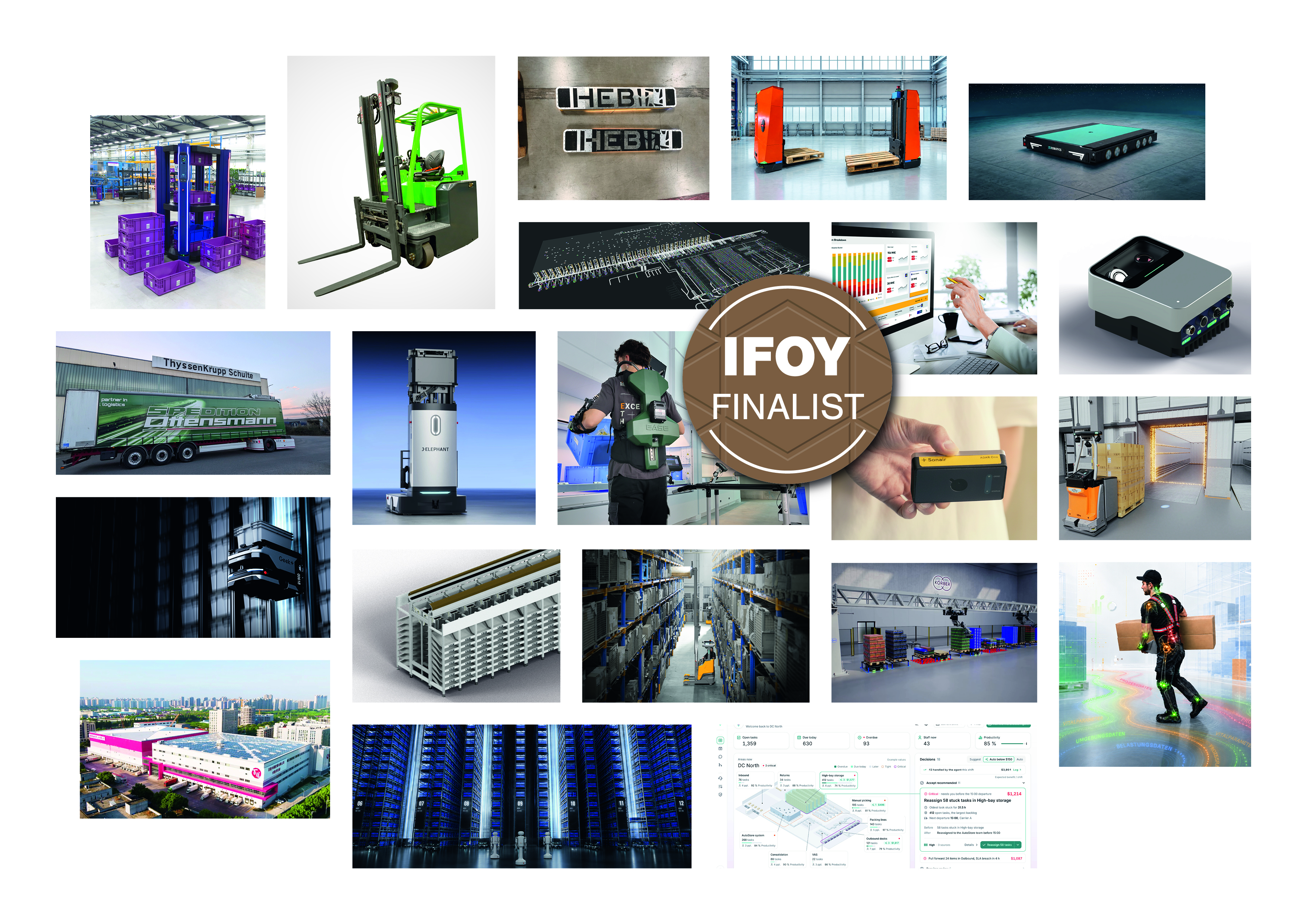 IFOY2027_Finalists_landscape_CMYK | Die Finalisten des IFOY AWARD 2027 kommen aus zehn Ländern. Best of the Best in Intralogistics: Beim TEST CAMP INTRALOGISTICS im Januar werden sich die IFOY Finalisten nicht nur dem Urteil der Jury und der Test-Teams stellen, sondern können auch von B2B-Besuchern getestet werden. The finalists of the IFOY AWARD 2027 come from ten countries. Best of the Best in Intralogistics: At TEST CAMP INTRALOGISTICS in January, the IFOY Finalists will not only face the verdict of the jury and the test teams, but can also be tested by B2B visitors. (Querformat/Landscape format) | 8.36 MB | DownloadPreview |
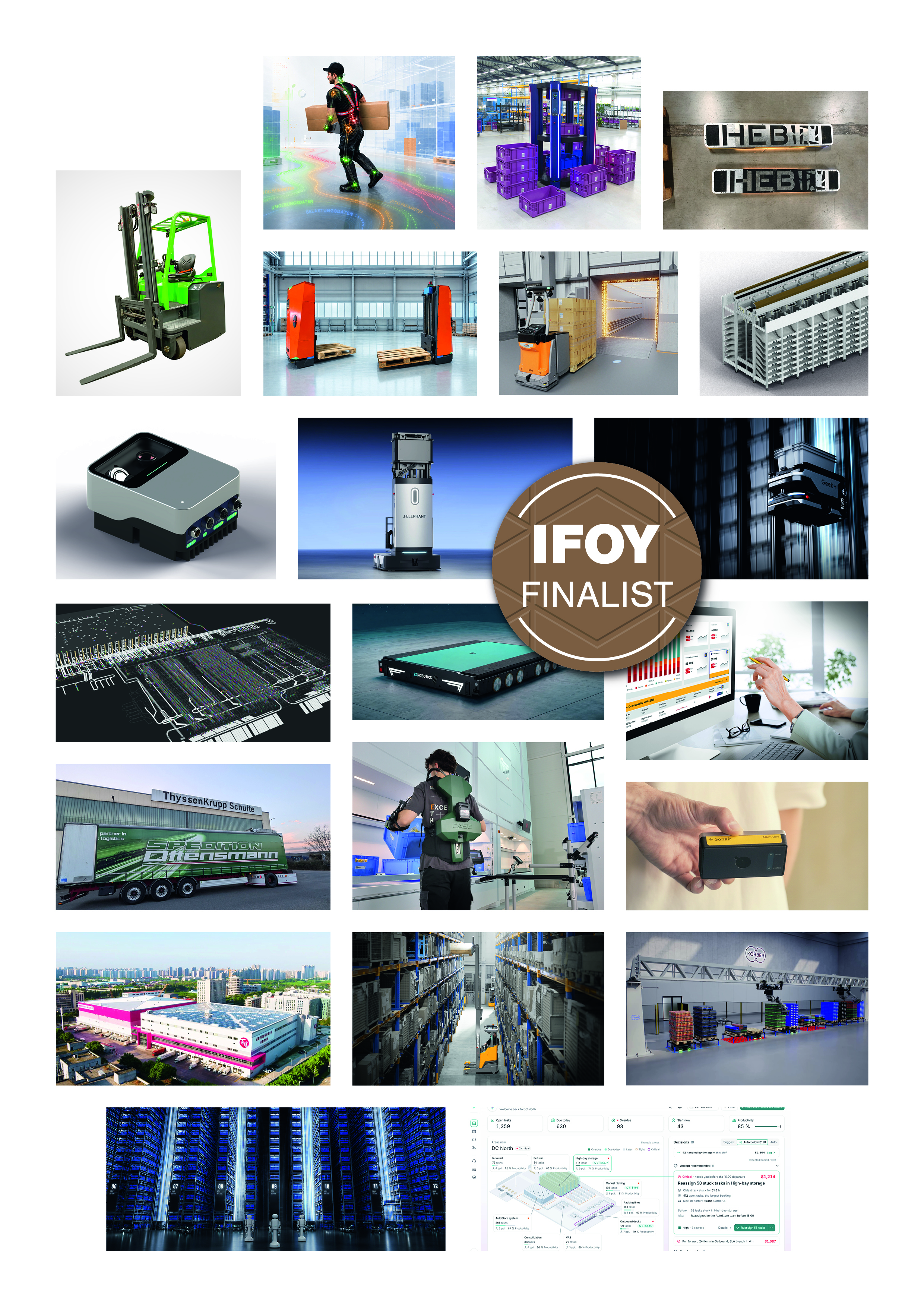 IFOY2027_Collage_Finalists_high_CMYK | Die Finalisten des IFOY AWARD 2027 kommen aus zehn Ländern. Best of the Best in Intralogistics: Beim TEST CAMP INTRALOGISTICS im Januar werden sich die IFOY Finalisten nicht nur dem Urteil der Jury und der Test-Teams stellen, sondern können auch von B2B-Besuchern getestet werden. The finalists of the IFOY AWARD 2027 come from ten countries. Best of the Best in Intralogistics: At TEST CAMP INTRALOGISTICS in January, the IFOY Finalists will not only face the verdict of the jury and the test teams, but can also be tested by B2B visitors. (Hochformat/High format) | 8.55 MB | DownloadPreview |
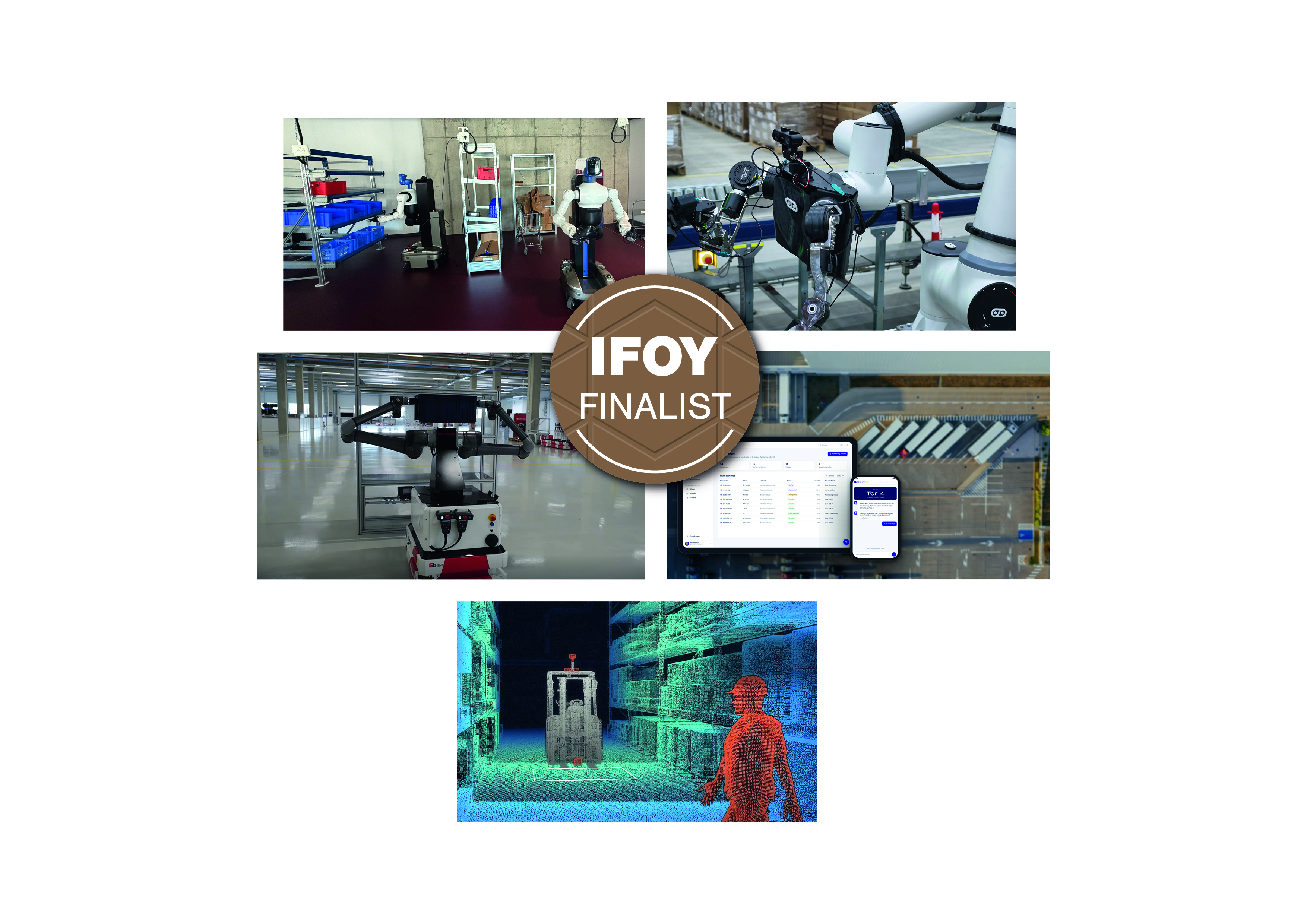 IFOY2027_Finalist_IFOY-Startup-of-the-Year-Award | Finalisten des IFOY Start-up of the Year Award 2027. Finalists of the IFOY Start-up of the Year Award 2027. | 6.44 MB | DownloadPreview |