Panel Discussion: Automation by Default
In intralogistics, automation is rapidly evolving from an optional add-on function to a strategic necessity – driven by labor shortages, rising customer expectations and increasingly complex supply chains. However, the participants in the TEST CAMP discussion agreed that automation is not about replacing people at all costs, but about solving operational problems.
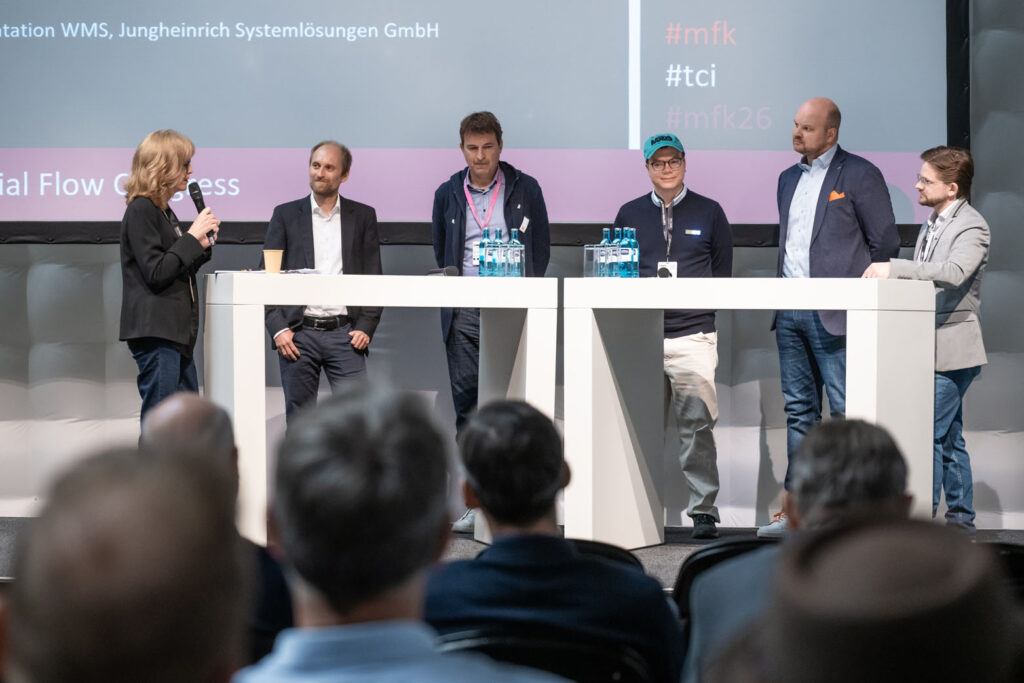
The panel discussion “Automation by Default”, moderated by Charleen Clarke, member of the IFOY Jury and editor-in-chief of FOCUS on Transport & Logistics, was attended by Richard Bormann from Fraunhofer IPA, Baret Davidian from Wiltsche Fördersysteme, Emil Hauch Jensen from The Mobile Robot Company, Michael Malik
from STILL and Immanuel Mark from Jungheinrich.
For many companies, the labor shortage is now one of the main reasons for automation. Davidian cited the German confectionery manufacturer Reber as an example. “They were running out of workers. Although they employed people from the region, they had great difficulty finding new employees,” he explained. The company ultimately invested millions of euros in robot-assisted packaging systems. Davidian warned that demographic changes are exacerbating the problem. “The ageing workforce poses a significant challenge. In five years, almost all baby boomers will be retired.”
However, automation means much more than just installing robots.
Mark emphasized that companies must first standardize their processes and improve data quality. “The master data must be correct.
The processes must be clearly regulated,” he said. Mark emphasized that automation can significantly improve consistency and reduce errors. “An automated system doesn’t get under stress, it doesn’t start to improvise and it doesn’t make mistakes.”
The panelists agreed that the cost of automation is falling rapidly, even if the return on investment remains crucial. “There are some entry-level solutions that are much more accessible in terms of cost,” said Malik. However, he warned against focusing solely on the purchase price. “You have to look at the big picture – the entire operation, the entire business, the processes.”
Jensen believes that competition and economies of scale are changing the market. “The cost of automation is falling dramatically,” he said. “The Chinese have come to Europe in a big way in the last five years and this has put enormous price pressure on the robot market.” He also noted that deployment times are shrinking rapidly. “We’re talking about one day here.” Despite the progress made, the introduction is still relatively slow.
Clarke noted that currently only around three to five percent of
of the forklift trucks are automated. Bormann believes that flexibility is still a major obstacle: “You need structured processes so that automated forklift trucks can work efficiently.”