

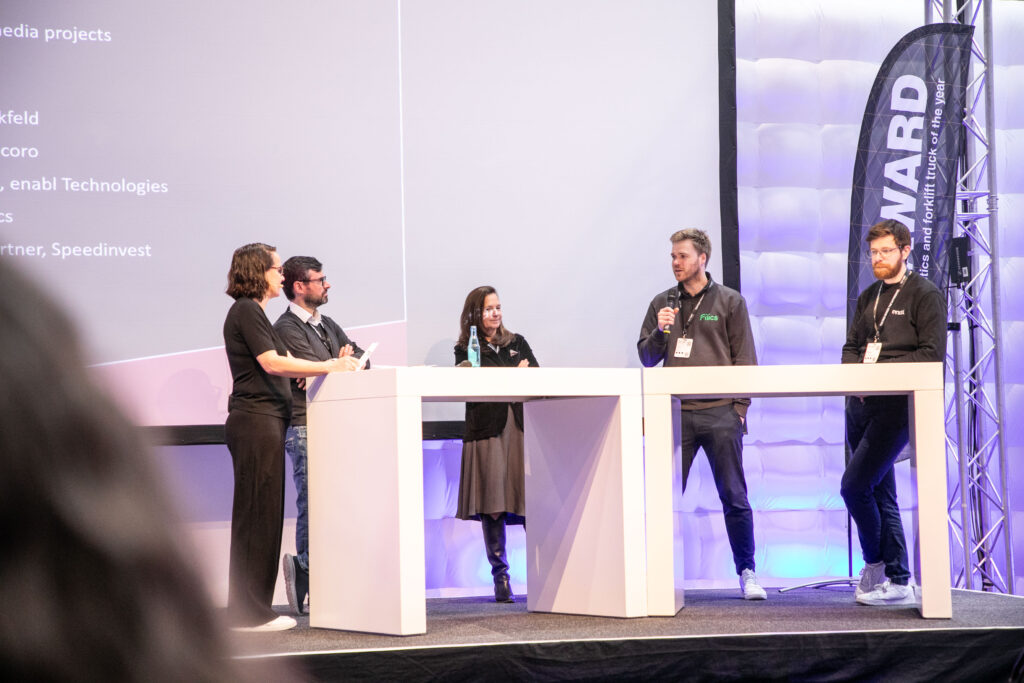
Innovations, investors and the path to the market
Four innovative founders, one investor: As part of a panel moderated by Stefanie Nonnenmann (impact media projects), Mathias Müller (Founder & CEO, Blickfeld), Christoph Tullius (Managing Director, ecoro), Julian Wadephul (Co-Founder & CEO, enabl Technologies) and Julius Lutzer (Co-Founder & CPO, Filics) discussed with Marie-Helene Ametsreiter, General Partner at Speedinvest, all about the topics that move start-up companies today. All four start-ups are finalists for the IFOY Start-up of the Year Award and are setting new standards in intralogistics with their technologies.
Mathias Müller emphasized how important it was to identify a clear problem: “We had a technical problem that drove us to find a solution. The challenge was then to bring this solution to the market.” However, the path there was accompanied by doubts, as Julian Wadephul from enabl Technologies confirmed: “Doubts are healthy. But we were always convinced that we were creating something that offered real added value.”
Financing a start-up is often a major hurdle. Investor expert Marie-Helene Ametsreiter explained the typical mistakes that founders make when looking for investors: “Many focus too much on the highest valuation instead of strategic aspects. An investor is like a spouse – you can’t get rid of them so quickly.” She also warned against raising capital too quickly: “Without a solid foundation, a company can collapse under the pressure of too rapid growth.”
The founders present confirmed these assessments. Julian Wadephul emphasized: “We deliberately chose investors who think long-term and work with us towards one goal.” Julius Lutzer from Filics also emphasized the importance of a solid network: “The best investments are not made within days, but over months of getting to know each other.”
In an industry such as intralogistics, which is still very conservative, it is often difficult to establish new technologies. “If a problem is big enough and really causes the customer pain, then we have a chance,” explained Julian Wadephul. Nevertheless, patience is required, as decision-making processes are often lengthy: “Large companies have structures, compliance requirements and many decision-making bodies. Sometimes a project doesn’t fail because of interest, but because of internal processes.”
Julius Lutzer sees scaling as one of the biggest hurdles: “We initially worked with pilot phases, but now it’s about bringing the technology to an industrial scale.” The biggest challenge is to optimize a mature product for mass production.
Christoph Tullius from ecoro then emphasized the importance of dialogue with other players in the industry: “Here at TEST CAMP INTRALOGISTICS, we not only have the opportunity to present our technologies, but also to exchange ideas with other companies and gain valuable insights. Direct contact with potential partners and customers is crucial for us to move in the right direction and develop further,” he added.
TEST CAMP INTRALOGISTICS offered the start-ups a valuable platform for networking and learning. “We take away a lot of feedback here – from customers, from other founders and from the industry as a whole,” said Julian Wadephul. Mathias Müller added: “We need to understand exactly what the market needs and where we need to make adjustments.”
Marie-Helene Ametsreiter concluded by advising the founders to seek direct contact with industry: “Many start-ups develop technologies in the laboratory, but direct contact with customers and partners is essential to make a product truly market-ready.”