

IFOY Audit
Finalists undergo the three-stage IFOY Audit as part of the IFOY Audit, which takes place during the TEST CAMP INTRALOGISTICS. This consists of the scientific IFOY Innovation Check, the IFOY Test and the jury test.
IFOY CATEGORY
IFOY
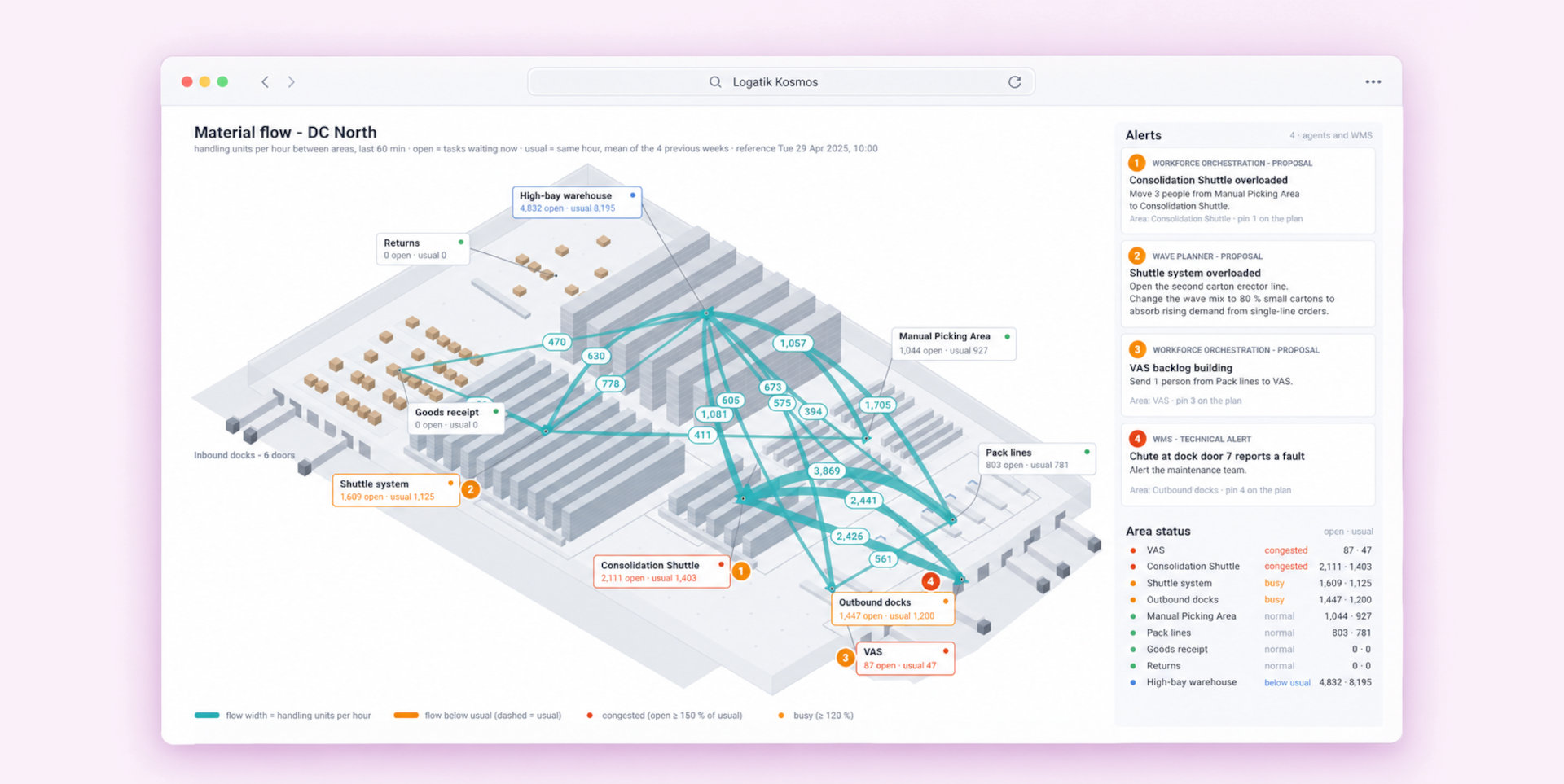
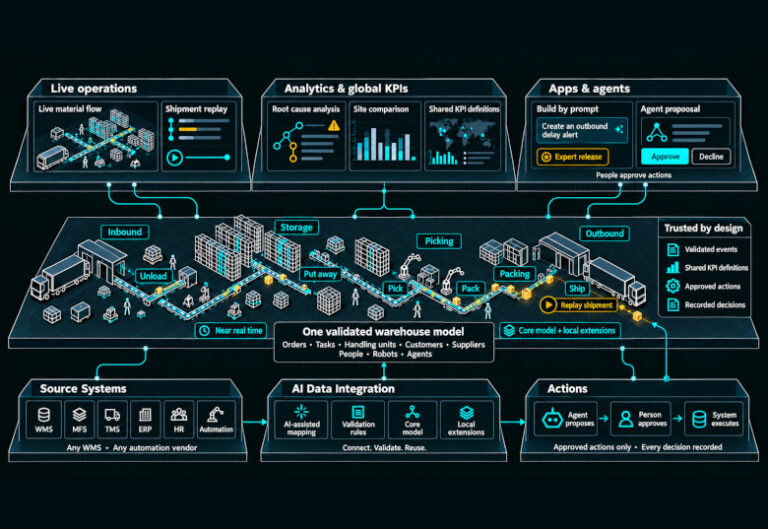
Warehouse Kosmos by Logatik is one validated, system-agnostic model of the entire warehouse (orders, tasks, handling units, customers, suppliers, people, robots and agents), built from events your WMS, MFS, TMS, ERP and HR systems already record. Control rooms stop firefighting, shop-floor teams own their performance, Analysts pinpoint the biggest inefficiencies, Management steers on one global KPI basis, IT scales one blueprint and Agents act on trusted data within approved rails. Kosmos starts before your WMS migration and pays off through ramp-up and optimization.
Warehouses are getting harder to run: demand swings, automation from several vendors and now AI agents. Every warehouse records what happens, every order, task, confirmation and movement, across WMS, material flow control, TMS, ERP and HR. But the data is scattered. Control rooms firefight from lists, and every new site relearns its processes after go-live. As one control room told us: “We were just blind.”
Warehouse Kosmos brings order to that world. It turns the events from every system into one validated, object-centric model of the entire warehouse: orders, tasks, handling units, customers, suppliers, people, robots and agents, mapped to the real layout and refreshed in near real time. AI-assisted mapping connects new source systems, and validation rules from years of warehouse projects check the data before anyone relies on it.
Built once, it serves every role. Control rooms see the live material flow in 3D and act on risks before they hit a truck. Shop-floor teams see their part of the flow. Analysts find the inefficiencies that matter most. Management steers every site on one global KPI basis. Staff build the dashboard or alert they need by prompt, released by an expert. IT rolls out one blueprint to every site and WMS. Agents work on the same model and propose actions within approved rails; a person approves before anything is written back.
Today every new tool, robot and agent brings its own data logic, and AI runs on whatever data it gets. Warehouse Kosmos answers with six innovations.
Warehouse complexity is rising on three fronts.
Automation: Gartner expects 50 percent of new warehouses in developed markets to be robot-centric by 2030, often with mixed fleets. Fragmentation: only 23 percent of surveyed operations report fully integrated systems (Kardex/Modern Materials Handling, n=127, 2025). AI: 56 percent of chief supply chain officers call integrating AI with legacy systems a major challenge (Gartner, n=140, 2026). On top, over half of DACH logistics companies rate themselves as not adaptable enough to ongoing disruption (BVL, 2023/24). Warehouse groups rarely run one WMS, one layout or one KPI definition, and every new site, WMS change or migration repeats the learning curve after go-live. Network operators ask: “in which facility are we the most effective in receiving?”
Target group: Manual, semi-automated and highly automated warehouses on any WMS, from single sites to networks with hundreds of locations.
Reuse instead of projects: core model, KPI definitions, validation rules and approved actions are reused; only mapping, layout and local extensions are site-specific. Low entry barrier: no hardware, no sensors, no change to the WMS or automation; a cloud service with standard connectors.
Why now: networks are moving to new WMS and adding robots and AI agents at the same time. Warehouse Kosmos provides the validated model once per site, and every new app and agent builds on it.
Image/video credits: Logatik
Finalists undergo the three-stage IFOY Audit as part of the IFOY Audit, which takes place during the TEST CAMP INTRALOGISTICS. This consists of the scientific IFOY Innovation Check, the IFOY Test and the jury test.
The bylaws set forth the core values and standards of the IFOY AWARD, which guide the organization’s actions. These include, among other things, governing bodies, the election process, evaluation criteria, and the Code of Conduct.
The International Intralogistics and Forklift Truck of the Year has three bodies: Jury, sponsors, and advisory board.