

IFOY Audit
Finalists undergo the three-stage IFOY Audit as part of the IFOY Audit, which takes place during the TEST CAMP INTRALOGISTICS. This consists of the scientific IFOY Innovation Check, the IFOY Test and the jury test.
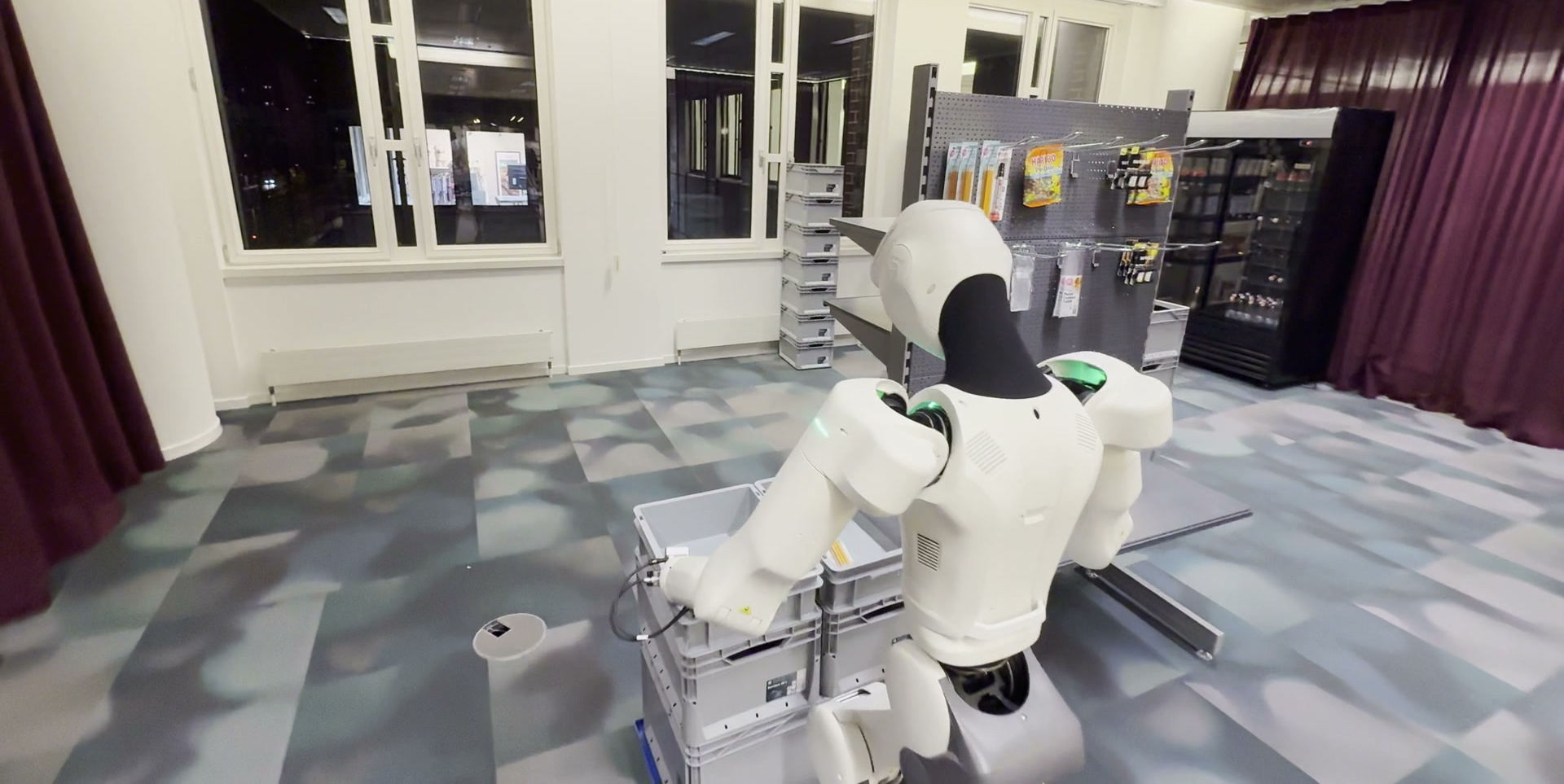
The shelf-restocking robot for the last 30 metres of retail logistics. Warehouses are automated; supermarket shelves are not. Shelfie is a wheeled, two-armed robot that moves goods from the back-store cart to the shelf overnight: it drives to the aisle, picks each product and places it in the facing, with a remote operator on call for edge cases. No store retrofit, no IT integration to start, sold as a monthly service.

Product name and company
Shelfie – Theseus Robotics Group
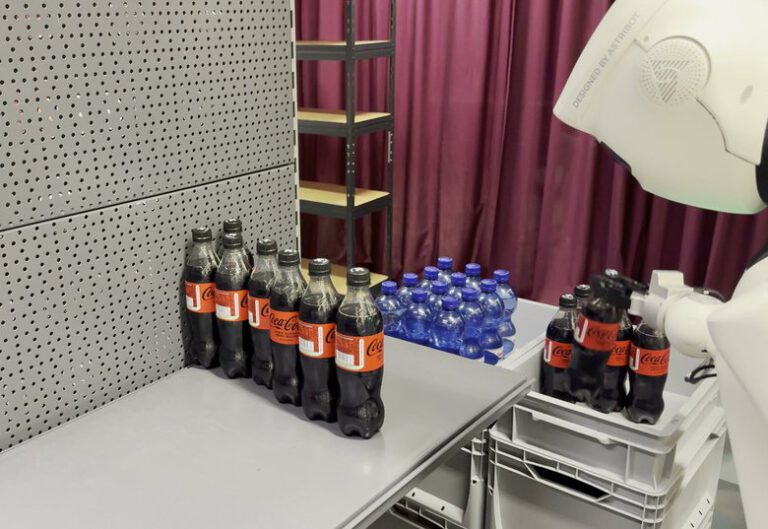
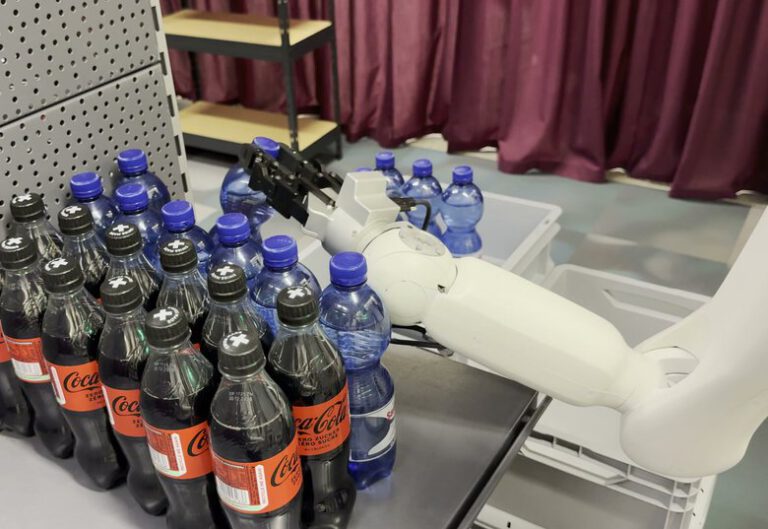
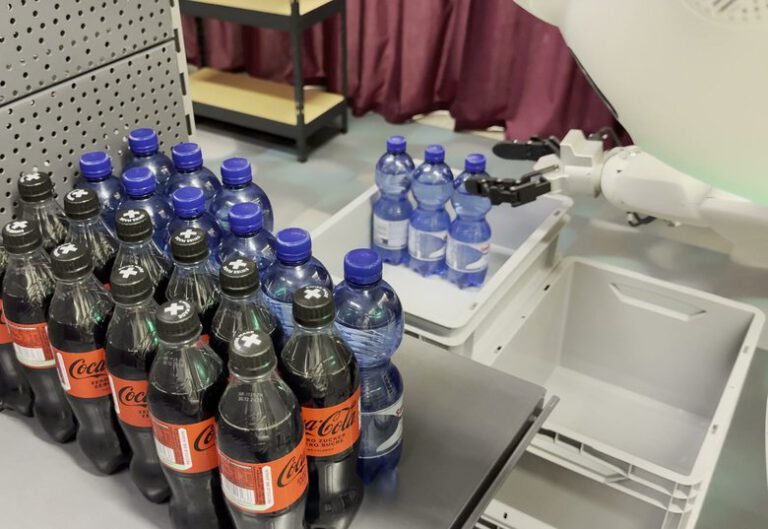
Shelfie automates the last step of the retail supply chain: moving goods from the back store onto the shelf, work that supermarkets still do by hand, mostly at night.
Shelfie is a wheeled robot with two 7-axis arms, a camera head and 360° LiDAR. It works in the closed store (22:00 to 06:00). Each shift:
A vision-language-action (VLA) model, fine-tuned by Theseus on its own demonstration data, drives manipulation; classical robotics handles navigation, docking and safety. For edge cases a remote operator takes over, and every intervention becomes training data. Theseus builds the software and runs it on commercial two-arm platforms (Astribot S1; Rokae as second platform) through its own hardware-abstraction layer.
Status, September 2026: in the Zürich demo store, Shelfie autonomously tows carts, navigates and restocks rigid products (bottles, cartons, bags of flour, rice, sugar), correcting its own placement errors.
Shelf restocking is one of grocery retail’s largest labour costs: more than USD 50 billion a year in Western Europe and North America (Theseus market analysis; total addressable market USD 59.7 billion). Retail floor staff turn over at about 25% a year and the night shift is increasingly hard to staff. European grocery labour costs rose 5.1% against 4.0% food inflation, with EBIT margins near 2.8% (McKinsey, State of Grocery Europe). Around 8.3% of products are out of stock on average, and industry studies attribute most out-of-stocks to in-store replenishment, not to the upstream supply chain (ECR Community, IHL Group, Gruen & Corsten).
Distribution centres and warehouses are highly automated; the step from the store backroom to the shelf is not. That gap, the last 30 metres of the retail supply chain, is where out-of-stocks happen.
Theseus starts in Switzerland, where grocery labour costs are the highest in Europe and payback is fastest, then scales to Germany and the United States. We are in active discussions with leading Swiss and German grocery and drugstore chains, retailer visits to our demo store are scheduled from October 2026, and we are allocating Q1 2027 pilot slots. The same system applies to drugstores, pharmacies and e-grocery dark stores.
Illustrative economics (Theseus model, French retail labour costs): ten stores with two robots each, each robot automating six labour hours per night, save about EUR 60,000 a month in labour against EUR 50,000 in fees: EUR 10,000 net savings per month, EUR 120,000 per year, before recovered sales.
Image/video credits: Images and video: © Theseus Robotics Group AG
Finalists undergo the three-stage IFOY Audit as part of the IFOY Audit, which takes place during the TEST CAMP INTRALOGISTICS. This consists of the scientific IFOY Innovation Check, the IFOY Test and the jury test.
The bylaws set forth the core values and standards of the IFOY AWARD, which guide the organization’s actions. These include, among other things, governing bodies, the election process, evaluation criteria, and the Code of Conduct.
The International Intralogistics and Forklift Truck of the Year has three bodies: Jury, sponsors, and advisory board.