

IFOY Audit
Finalists undergo the three-stage IFOY Audit as part of the IFOY Audit, which takes place during the TEST CAMP INTRALOGISTICS. This consists of the scientific IFOY Innovation Check, the IFOY Test and the jury test.
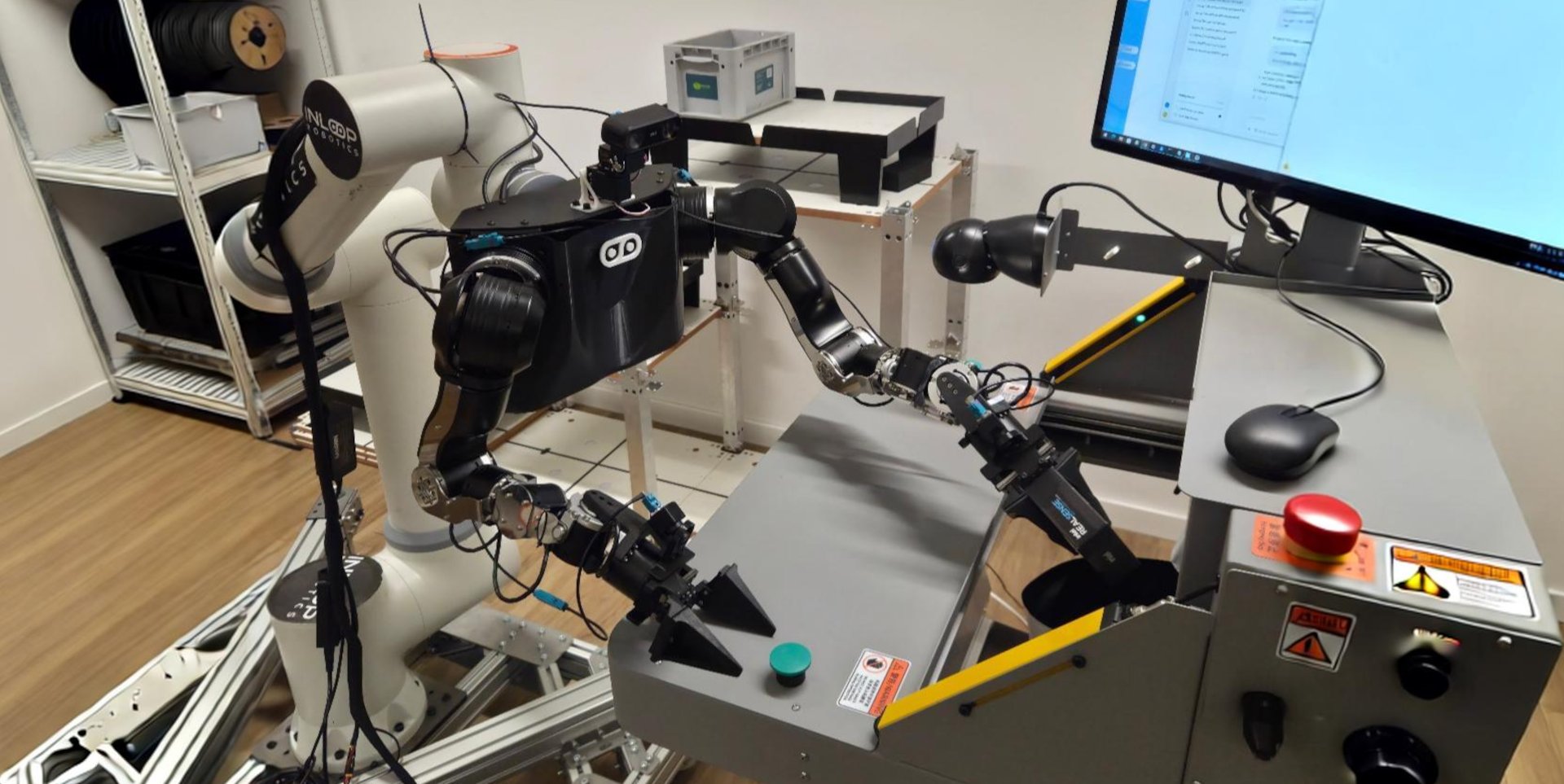
InLoop Pro is an AI-powered, dual-arm robot designed for fulfillment tasks such as packing, order picking, kitting, and palletizing. Its upper body, “Loopy,” is mounted on a lift arm with a reach of 2.4 m and can be integrated into existing workstations without modifications. Exceptions are handled by remote operators, and every intervention generates training data, allowing the robot to continuously learn on the job. Customers pay per shift or per order rather than making an upfront capital investment. At fulfillment service provider byrd, the system is already autonomously packing hundreds of orders per day.
Product name and company
InLoop Pro – InLoop Robotics
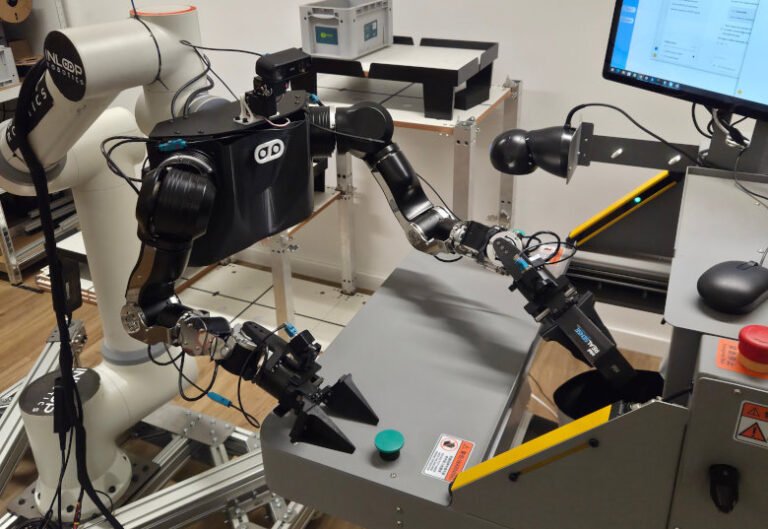
InLoop Pro is already in operation: At fulfillment service provider byrd, the system autonomously packs hundreds of orders per day. Over the next three months, 20 more robots will be installed at byrd, Noyes, and FHB Group, the largest 3PL provider in Eastern Europe.
InLoop Pro is a stationary, dual-arm robotic worker designed for packing, order picking, and kitting stations. It handles the entire workflow at the station: scanning totes, picking items, reading barcodes, recording transactions in the warehouse management system (WMS), placing items in bags or boxes, sealing packages, and handing them off, including exception handling. It operates fully autonomously in real time, without teleoperation.
The robot consists of a semi-humanoid upper body with two arms, each with seven degrees of freedom and a 5.5 kg payload capacity, mounted on a lift column. With a reach of 2.4 m, it covers a 4.8 m diameter workspace from floor level to the top shelf, encompassing everything a human worker can reach at a station. It connects to existing autobaggers, packing tables, and the WMS. Integration takes less than 30 minutes, with no modifications, anchoring, or safety fencing required.
InLoop Pro is controlled by a learning AI model that is continuously retrained at each station using real-world items. A safety layer monitors progress and task completion. If the robot gets stuck, it stops and requests human assistance. Every intervention generates training data.
Customers pay per shift or per order instead of making a capital investment. This frees up employees to focus on work that companies are currently struggling to staff.
Around 1.44 million people in Germany work in warehousing occupations, with more than two-thirds employed as warehouse helpers at packing and order-picking stations (Federal Employment Agency employment statistics, BALM). The work is physically demanding: warehouse workers record nearly twice as many sick leaves due to musculoskeletal disorders as the average across all occupations, at 76 cases per 100 insured employees (AOK Absence Report 2025). Filling these positions is correspondingly difficult: in early 2026, nearly one in three transportation and logistics companies reported labor shortages (ifo).
The solution was developed specifically for these workstations. Automation already exists, but it is expensive: a typical system integrator cell requires a capital investment of €120,000 and months of project work. Software-only picking systems require operators to build the cell themselves. InLoop Pro is affordable for any operation: it replaces one person’s work at a station on a one-to-one basis, at the cost of a single shift, with no upfront investment.
The market is enormous. Across the EU and the US, we estimate there are around 5.4 million stationary workstations in warehouses. The goal is to equip one-fifth of them with InLoop Pro by 2030. We are entering the market through three channels that are already open: 3PL networks (byrd, FHB), warehouse automation manufacturers (Noyes, with a robot-ready workstation at every installation), and industrial intralogistics.
One robot, multiple shifts. InLoop Pro operates two or three shifts a day, including nights and weekends, saving employers more than half the labor costs associated with staffing a workstation.
Pricing tailored to the use case. Options include Robotics-as-a-Service (RaaS) priced per shift, per-order billing, or hardware purchase with a maintenance contract. With RaaS, there are no upfront capital costs, licensing fees, or integration projects. Maintenance, spare parts, and remote monitoring are included. Customers pay for the work the robot performs, measured against their WMS records.
No more staffing headaches at the workstation. Absences due to illness, employee turnover, onboarding, night-shift premiums, and temporary staffing to cover peak demand are eliminated. Every pick is verified by barcode, reducing picking errors and returns. Employees are relieved of monotonous, physically demanding packing work and freed up for tasks that are currently difficult to staff.
Up and running in hours. The workstation is simulated before delivery. On-site integration takes less than 30 minutes, and the station is operational on installation day. No modifications or floor anchoring are required.
Faster with every week. The AI models are trained and continuously improve in operation. Throughput increases significantly over the first few weeks, and the system adapts to changes in the product mix rather than needing to be replaced whenever the assortment changes.
Image/video credits:
Finalists undergo the three-stage IFOY Audit as part of the IFOY Audit, which takes place during the TEST CAMP INTRALOGISTICS. This consists of the scientific IFOY Innovation Check, the IFOY Test and the jury test.
The bylaws set forth the core values and standards of the IFOY AWARD, which guide the organization’s actions. These include, among other things, governing bodies, the election process, evaluation criteria, and the Code of Conduct.
The International Intralogistics and Forklift Truck of the Year has three bodies: Jury, sponsors, and advisory board.