

IFOY Audit
Finalists undergo the three-stage IFOY Audit as part of the IFOY Audit, which takes place during the TEST CAMP INTRALOGISTICS. This consists of the scientific IFOY Innovation Check, the IFOY Test and the jury test.
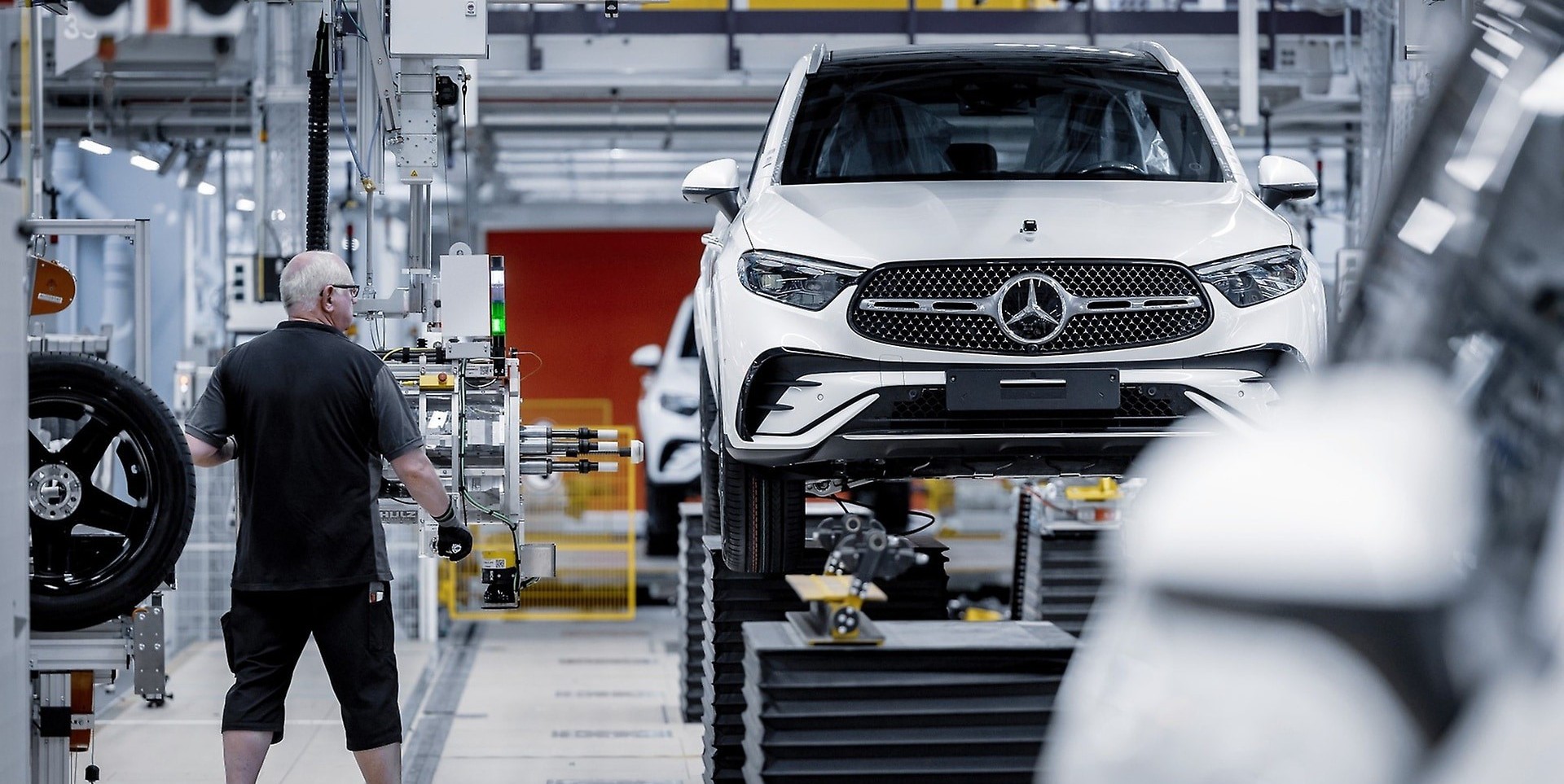
Conversion and modernisation of an assembly hall for the production of the E and GLC-Class series at the Sindelfingen site. Following the construction of the Factory 56 , work continued here on the future vision of the Mercedes-Benz production system. In the SC (SupplyChain) as a key component of this production, the focus was on the networking and complete transparency of all intralogistics supply as well as the necessary data collection, evaluation and adaptation.

Product name and company
The supply chain ecosystem in the context of digitalization – SAFELOG
Category
Integrated Customer Solution
Customer
Implementation period
From:
Until:
08/31/2023
Investment volume
€

Innovation and customer benefits
An in-house Mercedes-Benz development enables as a self-service platform transparent real-time and historical monitoring of AGV fleets and data-supported monitoring of AGV processes. The use of the system increases the efficiency of troubleshooting and supports the sustainable optimisation of supply processes. As a digital twin, the real-time monitoring system makes it possible to monitor the location and status of the AGVs at any time and to the second. The system collects defined data and displays this information graphically: the shop floor becomes digital and transparent – in the event of malfunctions or problems, an alarm is automatically sent to a defined terminal of the maintenance team.
The so-called IoT data from the AGV-live driverless transport system is made available as data products on the MO360 Data Platform and for cross-domain data analyses. They thus make an SC contribution to the data-driven company.
Defined “heat maps” can be used to identify problem patterns and suitable measures can be derived at an early stage – keyword: predictive. The efficiency is increased and the stability and productivity of the system enhanced.
The “ghost track function” is a tool that allows you to look back – a historical image of the shop floor at any point in the past. Analysing past data, identifying bottlenecks and inefficient processes- fast, systematic and automated support for analysing countless data volumes (LOGin entries) – so that the cause of line stoppages can be quickly recognised and explainable.
The system combines a standardised user interface for automated guided vehicles with a maintenance and control system. This made it possible to implement a continuous optimisation and improvement process during the ramp-up phase, including:
AGV LIVE ensures that from now on all subsequent starts are realised in a much more structured way and with significantly less disruption.
Proven partners
In this complex interaction of software and hardware, the SupplyChain of Mercedes-Benz AG relies on proven suppliers. Pick-by-light systems and AGVs from Safelog GmbH in Markt Schwaben are used both for subsystems such as the picking of shopping baskets and for transport to the assembly lines to be supplied. New technical solutions were jointly developed and standards implemented in close co-operation.
A networked mini PC with a Linux operating system is used for order picking. It controls the pick-by-light systems, which signal to the employees in the pick zones which parts belong in the shopping basket and in what quantity. However, it also enables a combination of the pick and AGV processes. Cost-intensive implementation processes are a thing of the past. The software can be customised and installed “over the air”. Everything is automated and the processes no longer require paper. Of course, this is also good for the environment.
A fully networked AGV fleet is responsible for transport and supply. Over 350 AGVs in various circuits transport the parts and components in the assembly hall to the production lines “as if by magic”. Over 3,000 of these standardised robots are in use across MBC, serving a wide variety of supply processes.
In intralogistics, the AGVs transport the loaded shopping baskets from the picking area to the defined sections of the assembly lines. However, pre-assembled components such as wheels and seats are also delivered directly to the installation site.
To ensure that the AGVs find their destination, they are guided via a hybrid navigation system consisting of magnetic tape and virtual guidance. To be able to execute the necessary commands on the course, the AGVs have the same mini PC as the Pick by light systems.
Equipped with their own intelligence, the AGVs are able to make decisions independently. At critical points, e.g. intersections with other circuits, a conveyor system or before entering a mechanisation system, the higher-level control system developed in-house regulates the traffic.
Conclusions: The assembly hall for the Mercedes-Benz AG E- and GLC-Class model series stands for the consistent further development of a digital and technical transformation in the automotive industry – complexity is becoming manageable. Success factors are the development and support of in-house software and control systems in order to operate independently of licence models and to be as flexible as possible in the event of errors, changes and adjustments.
During the conversion and modernization of an assembly hall for the production of the E and GLC-Class series at the Sindelfingen site, SAFELOG worked with the car manufacturer to implement the future vision of a Mercedes-Benz production system that includes the networking and transparency of all intralogistics supply processes as well as the necessary data acquisition and evaluation. New technical solutions were developed and standards implemented in close cooperation. Pick-by-light systems and around 350 AGVs from SAFELOG in Markt Schwaben are used for subsystems such as the picking of bins and transportation to the assembly lines to be supplied. A total distance of 15 kilometers was involved. SAFELOG also supplies the car manufacturer with its entire system in Europe and the USA, which adds up to a total of 3500 AGVs.
The family-run company SAFELOG, which currently employs 260 people, actually comes from the picking technology sector and is now known not only for its mobile robotics expertise, but also for its philosophy of “German devices at a Chinese price”. The solution nominated for an IFOY AWARD is the final stage of years of collaboration between Mercedes-Benz and SAFELOG. The main asset is that the 350 AGVs communicate with each other as a swarm. At Factory 46, where the new E-Class is produced, Mercedes-Benz is responsible for the software, while SAFELOG is responsible for the hardware and project implementation. At Mercedes-Benz, Factory 46 stands for the consistent further development of digitalization and transformation in the automotive industry.
Downtimes and cycle times are critical factors in the automotive industry. When an appliance has to be delivered every 90 seconds, perfection and standards are required. In addition, the AGVs must operate in such a way that the employees in the plant interact harmoniously with the AGVs on the way to and from their break and no panic or uncertainty reactions occur. To achieve this, the entire hall is networked via statistical pattern recognition using artificial intelligence (AI). The data generated here can be used to predict disruptions in the near future; we are talking about minutes here.
As a digital twin, the real-time monitoring system developed by Mercedes-Benz offers the opportunity to monitor the location and condition of the AGVs used there to the second at any time. It collects defined data and displays this information graphically, making the store floor digital and transparent. In the event of malfunctions or problems, an alarm is automatically sent to a defined maintenance terminal. The IoT data from the AGV LIVE automated guided vehicle system is made available as data products on the MO360 Data Platform and for cross-domain data analyses. In this way, they make a supply chain contribution to the data-driven company.
The use of the SAFELOG AGVs at Mercedes-Benz may not be highly innovative, but it offers considerable customer benefits in a highly complex environment. This starts with the low price and the simple and robust implementation, and extends to the software ecosystem developed together with Mercedes and an availability of over 99.7 to 99.9 percent. In practice, this means 40 hours less downtime. The cost of one hour of downtime in the automotive industry is estimated at between 1.0 and 1.5 million euros. The fact that Mercedes develops and maintains the software and the master control system itself enables the company to act independently of licenses and to be as flexible as possible in the event of errors, desired changes and adjustments.
A concept was developed between the project partners for the automated assembly line delivery of the final assembly of the Mercedes E-Class at the Sindelfingen plant, which consists of Safelog underride AGVs and various load carriers that can be driven under. In particular, the load carriers also include pick-by-light racks, which were also provided by Safelog.
Ready-picked baskets of goods are delivered from a picking area to the conveyor belt via largely predefined paths using the AGVs and racks. Buffering is carried out on the way there, with the vehicles waiting in a row with their respective loads.
The AGVs are linked to a control system developed in-house at Mercedes, which performs control and analysis tasks.
The project is very similar to the previous project, in which the S-Class final assembly line was equipped with an automatic conveyor delivery system. Compared to this project, the main change is the control system. This collects data from the AGVs and stores it to be able to make historical analyses and forecasts for the future. As a result, it was possible to achieve a higher availability of the entire fleet of 99.5 percent and a 25 percent increase in transport performance per vehicle compared to the previous project.
Furthermore, a notification system was developed that informs the people in the picking area about the necessary working speed using the forecasts from the control system to keep the buffer length constant.
Another interesting aspect of the AGV hardware is the concept of simultaneously lifting and pulling load carriers. This makes it possible to transport two racks with one vehicle and works very robustly in this case.
The customer benefits from the automation of the supply of a complete vehicle final assembly line using simple hardware and IT components and interfaces. Despite the enormous project scope of 350 vehicles and 200 pick-by-light racks, a good overview is ensured.
Furthermore, a high proportion of the technical know-how is held by the customer or was developed and shared with the automation supplier, thus ensuring a high level of transparency between the partners.
The relevance of the project for other market participants can be assessed as cautiously positive. The number of use cases of a similar size is very limited, but the forward-thinking control system is particularly interesting, as the resulting efficiency gains could also be used in AGVs of a smaller size.
A very individual project that impresses with the close cooperation between supplier and customer and the increase in efficiency achieved with less complex means compared to the previous project.
| Functionality / type of implementation | + |
| Novelty / Innovation | + |
| Customer benefits | ++ |
| Market relevance | + |
| ++ very good / + good / Ø balanced / – less / — not available | |
Finalists undergo the three-stage IFOY Audit as part of the IFOY Audit, which takes place during the TEST CAMP INTRALOGISTICS. This consists of the scientific IFOY Innovation Check, the IFOY Test and the jury test.
In den Statuten sind die Grundwerte und die Standards des IFOY AWARD festgelegt, nach denen die Organisation handelt. Dazu gehören unter anderem Gremien, Wahlomodus, Bewertungskriterien sowie der Code of Conduct.
The International Intralogistics and Forklift Truck of the Year has three bodies: Jury, sponsors, and advisory board.