

IFOY Audit
Finalists undergo the three-stage IFOY Audit as part of the IFOY Audit, which takes place during the TEST CAMP INTRALOGISTICS. This consists of the scientific IFOY Innovation Check, the IFOY Test and the jury test.
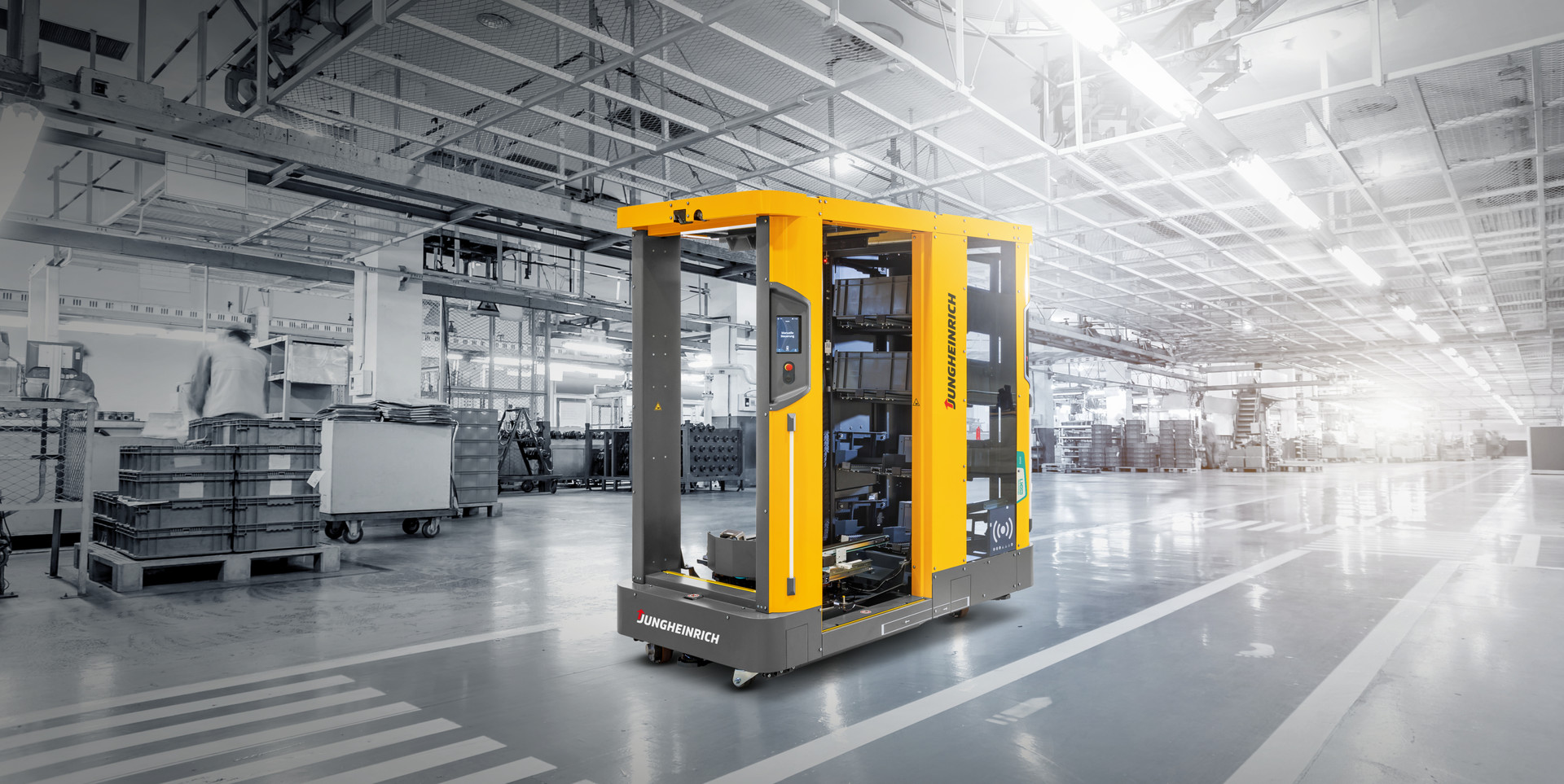
The fully autonomous mobile robot SOTO from Jungheinrich represents an innovation in the field of industrial material supply. SOTO is specialised in independently picking up small load carriers (SLCs) of various sizes, transporting several small load carriers autonomously and placing them precisely in the flow racks of production and assembly lines. Thus, the SOTO offers a fully automated solution for material supply and disposal processes that were previously carried out manually.
The SOTO was developed by the Jungheinrich company Magazino.

Product name and company
SOTO – Jungheinrich
Category
Mobile Robot
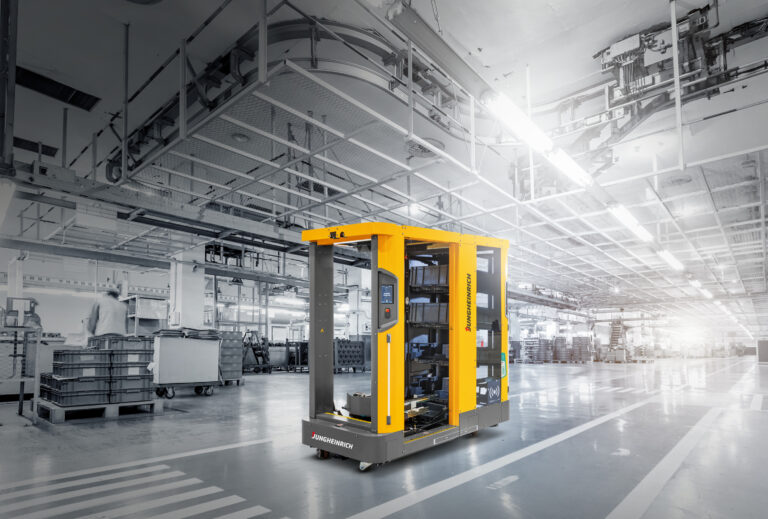
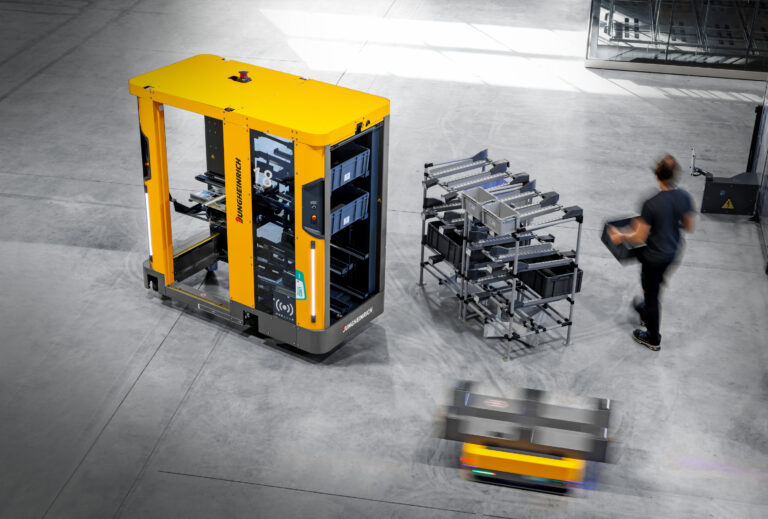
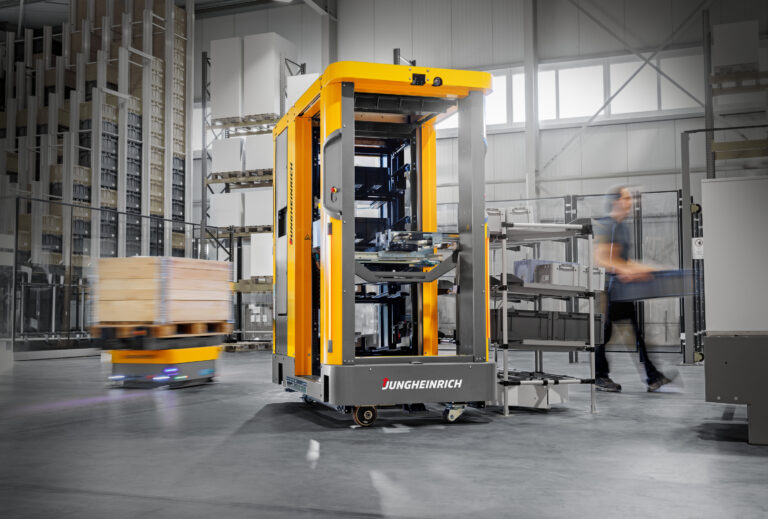
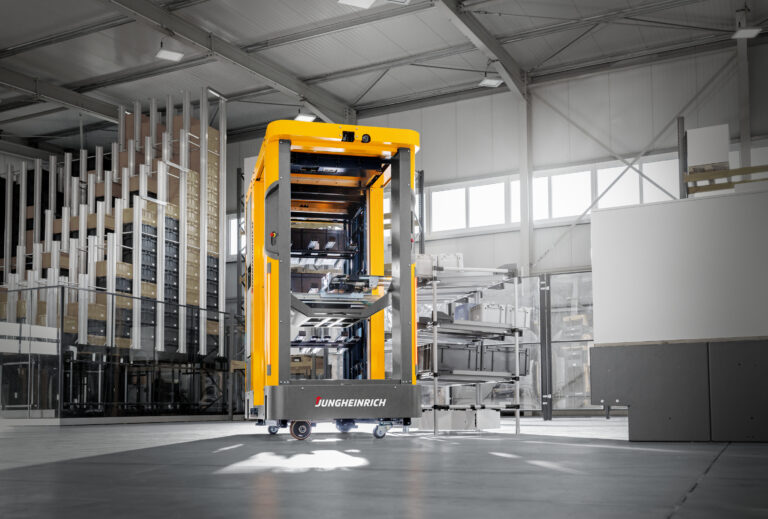
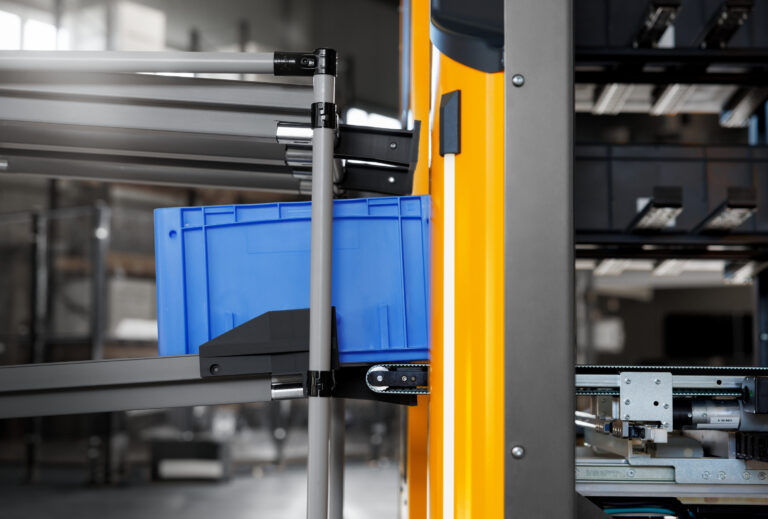
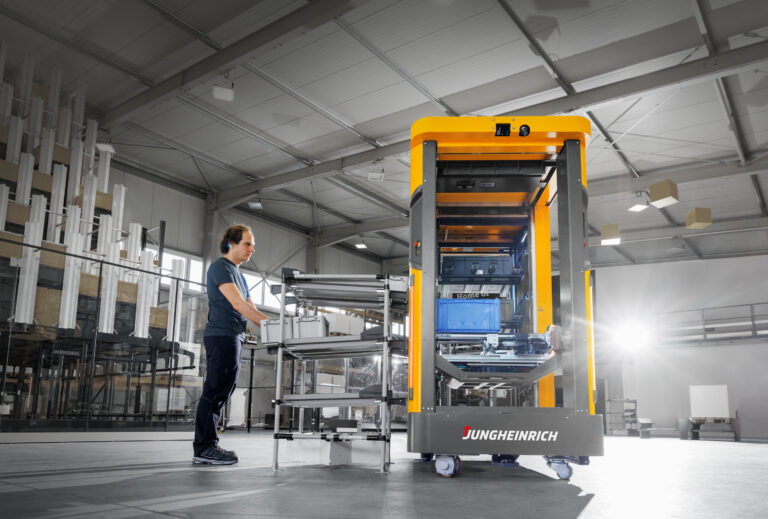
SOTO is an innovative robotic system that has been specially developed to pick up small parts warehouses completely autonomously from storage areas such as automated miniload warehouses and transfer them directly to the production line. The robot thus closes the gap between material buffer and production line, which was previously reserved for a manual supply process. This ensures that the right material is available at the right time at the right place.
The main goal of SOTO is the end-to-end automation of material replenishment with SLCs (“Supply-by-Robot”). Special features of SOTO are its ability to handle variable loading and discharge heights, to transport several SLCs at the same time, to flexibly design material flows and to move safely next to people. In addition, it impresses with its autonomy, free navigation, and reliable handling of various SLC types and sizes.
SOTO uses artificial intelligence (AI) and can therefore handle complex transport tasks autonomously and react to changes in the environment or changing needs. It can handle containers autonomously, replacing traditional tugger trains or working effectively with them. Before SOTO starts operations, it uses sensors to detect its surroundings and creates an orientation map. Changes to the environment can be made by the customer in a user-friendly manner during operation.
SOTO, the world’s first mobile robot of its kind, represents a significant step forward in the development of mobile robots. Its remarkable properties distinguish it from other products on the market and offer a clear added value for industrial automation.
A standout feature of SOTO is its ability to transport up to 24 SLCs simultaneously, which means up to a tenfold increase in capacity compared to conventional solutions. This significantly improves performance and reduces the number of vehicle movements required.
In addition, SOTO has a flexible working area ranging from 0.4 to 1.6 meters in height and does not require any active elements on the flow racks. This versatility opens up new possibilities for various industrial applications and allows the use of existing racks. Furthermore, it can pick up and rotate the SLCs in three directions, which makes it also flexible and allows the SLCs to be picked up/delivered in the desired orientation (length-/crosswise).
SOTO’s autonomous and responsive navigation allows it to adapt to changing production environments and requirements in real-time, without relying on rigid routes or external guidance systems. Artificial intelligence makes SOTO capable of learning. SOTO’s easy-to-use tools and interfaces make it easy to deploy and operate in existing production environments.
SOTO is therefore a technological innovation that can increase efficiency and productivity in industrial plants worldwide.
The relevance of SOTO for the market is very high. In view of the future manufacturing landscape, which requires increased complexity in material supply and decentralized self-organization in real time, SOTO represents a crucial solution module.
With an estimated market potential of 1,000 robots per year, it primarily addresses industries such as automotive OEM, automotive, electronics and white goods as well as injection molding industry.
SOTO’s ability to autonomously pick up SLCs and place them precisely on production lines is revolutionizing industrial material supply. This autonomy, combined with state-of-the-art computer vision and sensor technology, positions SOTO as a smart link between warehouse areas and production and assembly lines. Especially in dynamic environments, SOTO offers companies an efficient and reliable solution to optimize their material and production flows.
SOTO is primarily a mobile gripper robot that focuses on automotive and injection molding production. Companies such as MAN, Miele, ZF, Wago, Bosch and ABB now rely on SOTO. According to Jungheinrich, 30 SOTO robots are currently in use, with a further 20 on order. At MAN alone, twelve SOTOs have been in use for one and a half years. The focus is always on the transportation of small load carriers by the mobile robot.
This fully autonomous mobile robot from Magazino, which is now wholly owned by Jungheinrich (the Hamburg-based company had already acquired a stake in the Munich-based company in 2021), has been available for purchase since 2023. It is obvious that the SOTO benefits from the expertise of Jungheinrich. The company provides reliable hardware and engineering, while Magazino takes care of the operating system. Jungheinrich makes a confident statement about the moving “robot cabinet”: “That device doesn’t have a competitor!”
Intralogistics insiders have been familiar with Magazino for more than ten years – at the latest when the robotics pioneer made a name for itself with its intelligent warehouse robot TORU, which was used in warehouse of Zalando and continues to be sold under the Magazino label. Jungheinrich has now launched a sophisticated SOTO on the market, which is primarily used in production logistics. SOTO handles intelligent line feeding, i.e. the supply of assembly and production lines, for example in the automotive industry.
But what exactly can SOTO do? The robot has a new and sophisticated gripping technology and presents itself like a moving closet. Jungheinrich customers can independently model and expand the environment in which the robot is used. Thanks to artificial intelligence, the robot can handle complex transportation tasks autonomously and react flexibly to changes in the environment. In the IFOY test, the SOTO proved to be reliable in terms of safe gripping technology. Commissioning is simple and a visual fault diagnosis is carried out in the event of a fault. Training courses with graphical user guidance on the display support the operation of SOTO.
As far as the hard facts are concerned: According to Jungheinrich, the return on investment (ROI) of SOTO is “less than three years”. In three-shift operation, where the mobile robot can show its strengths, the ROI can even be less than one year – a respectable figure for an investment of this size. SOTO can autonomously pick up up to 24 small load carriers, transport them to their destinations on the assembly lines and place them in flow racks, tasks that were previously carried out manually. This is one of the reasons why Jungheinrich estimates the market potential of its mobile robot at 1,000 units per year, particularly in the automotive, electronics and white goods industries as well as in injection molding production.
The ability to flexibly transport up to 24 small load carriers, depending on the size of the containers, makes SOTO unique. Jungheinrich states that the increase in productivity due to higher supply speed and efficiency is 60 percent. The newly developed gripper concept enables the robot to adapt to different container sizes and forgives errors during loading and unloading. Like all Jungheinrich machines, SOTO is powered by lithium-ion batteries and has individual charging stations.
The SOTO can be used to pick up, transport and deliver KLT (3 sizes). The KLT are picked up with a gripper (rotated if necessary) and stored in the mobile transport robot (up to 24 KLT depending on their size). There is a range of troubleshooting functions so that, in the event of a fault, staff can rectify the fault without a great deal of training. Some possible faults, e.g. twisting of the KLT during removal, can be rectified by the vehicle itself thanks to design features.
The vehicle looks well thought out for industrial production throughout. All functionalities are well implemented (camera with image processing replaces classic sensors, among other things). Commissioning (route planning etc.) is intuitive. The vehicle is VDA5050 compatible. Integration into existing logistics systems (flow racks can be retained) is possible.
There is no comparable technology on the market. The SOTO closes the automation gap between the miniload and the point of consumption with an intelligent automation solution. The design is also outstanding. However, the SOTO has been available as a Magazino product for some time and has already been presented at various trade fairs. Most recently, the SOTO underwent a significant redesign of the entire handling technology.
Competitive KLT handling: A factor of 0.7 is achieved compared to human handling (SOTO handling: up to 60 KLT, human handling 80 – 100 KLT. Economical, especially from a 2-shift operation.
Automation is becoming an increasingly important factor in securing competitiveness. SOTO closes the gap between the miniload and the point of consumption. The relevance can only be further increased through higher handling rates compared to humans.
A well-known innovative start-up product has reached a higher technology readiness level. The technology and design are coherent, the market relevance and the customer benefit can be classified as particularly high.
| Functionality / type of implementation | + |
| Novelty / Innovation | + |
| Customer benefits | ++ |
| Market relevance | ++ |
| ++ very good / + good / Ø balanced / – less / — not available | |
Finalists undergo the three-stage IFOY Audit as part of the IFOY Audit, which takes place during the TEST CAMP INTRALOGISTICS. This consists of the scientific IFOY Innovation Check, the IFOY Test and the jury test.
In den Statuten sind die Grundwerte und die Standards des IFOY AWARD festgelegt, nach denen die Organisation handelt. Dazu gehören unter anderem Gremien, Wahlomodus, Bewertungskriterien sowie der Code of Conduct.
The International Intralogistics and Forklift Truck of the Year has three bodies: Jury, sponsors, and advisory board.