

IFOY Audit
Finalists undergo the three-stage IFOY Audit as part of the IFOY Audit, which takes place during the TEST CAMP INTRALOGISTICS. This consists of the scientific IFOY Innovation Check, the IFOY Test and the jury test.
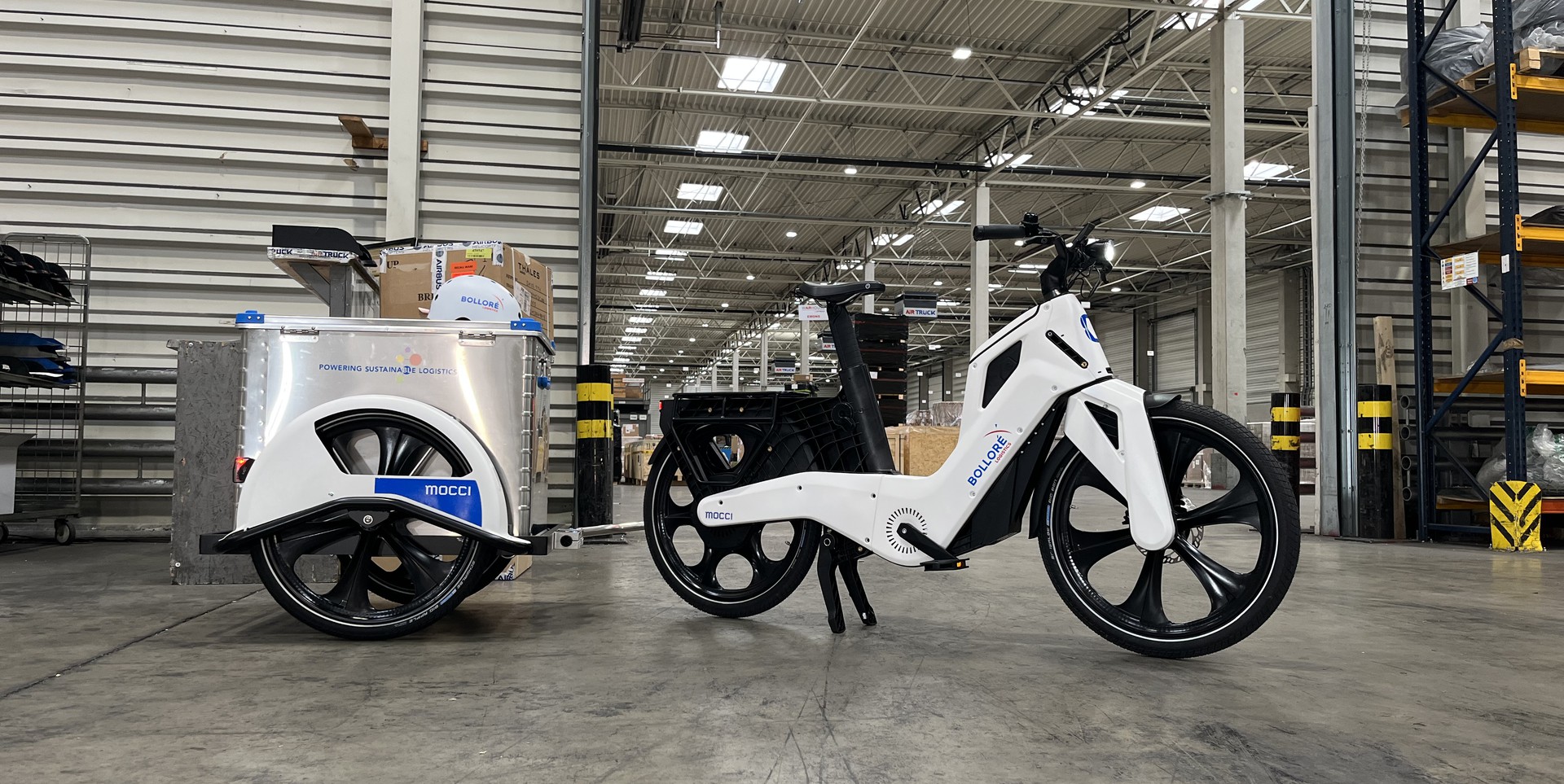
A completely new approach to micro mobility: The mocci work and cargo bike is ideal for companies that want to operate efficiently, smoothly and sustainably in urban areas, as well as on company premises or in their intralogistics. Produced by and equipped with ground-breaking technological innovations, the “Smart Pedal Vehicles” (SPV) enable urban mobility and logistics on a completely new level.

Product name and company
mocci Smart Pedal Vehicle – MOCCI
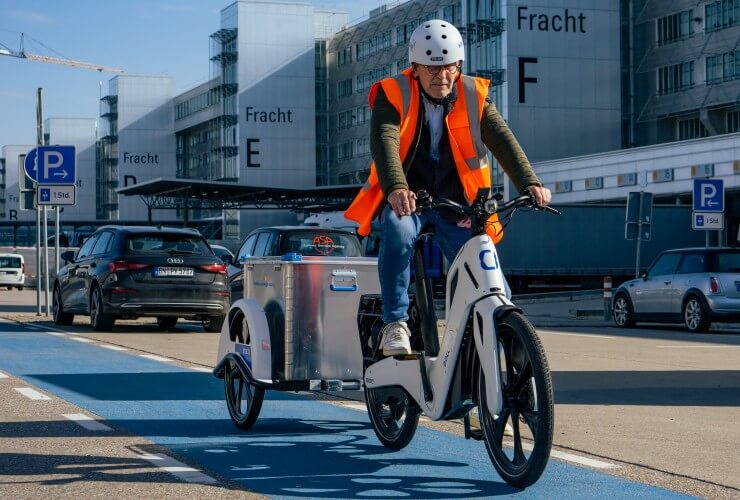
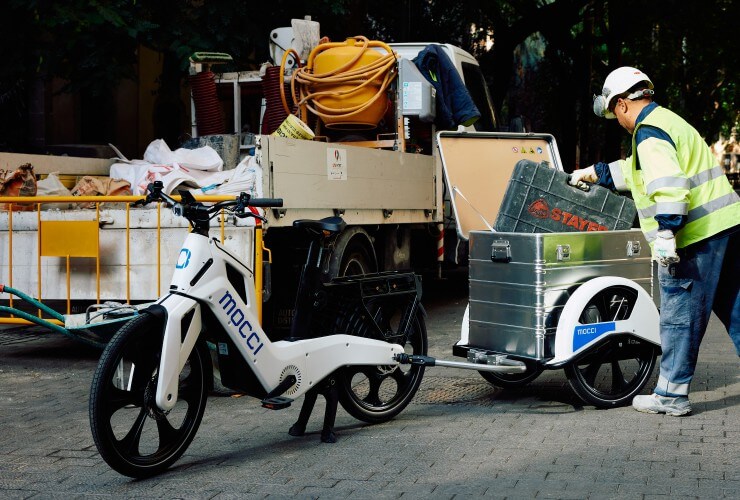
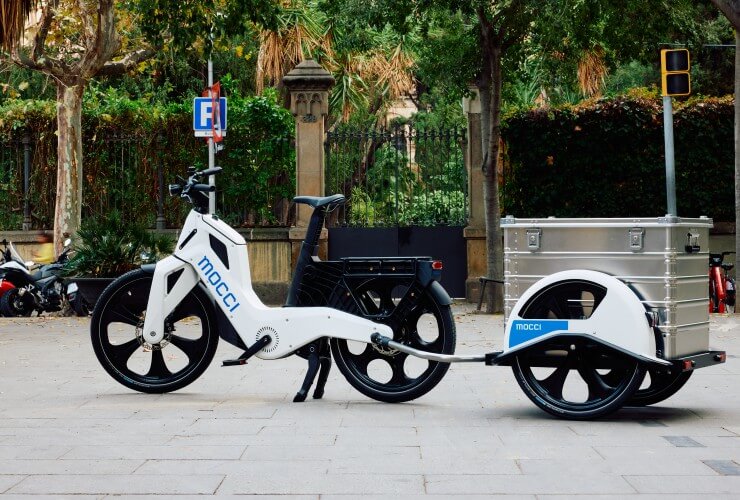
In vibrant metropolitan areas, the question of a more livable future is becoming increasingly urgent. Every day we realize that cars and combustion engines in general are rapidly reducing the quality of life in large cities and that companies cannot guarantee the reliable transport of people and goods. Unnecessary costs also arise in intralogistics scenarios due to the ineffective transportation of small goods in excessively large means of transport. In order to make urban life more livable and improve business processes, the last mile must be filled with new solutions. Promoting alternatives to cars and vans can already lead to less traffic congestion, fewer parking spaces and less air pollution. This is where cargo bikes, such as the mocci Smart Pedal Vehicle, come into play. However, the conventional bicycle is not robust enough and inefficient without groundbreaking innovation. Therefore, the mocci Smart Pedal Vehicle has been optimized for commercial processes and equipped with the latest technology to offer a true alternative for businesses. Designed for last-mile logistics, the SPV prioritizes sustainability while helping businesses not compromise on efficiency in their day-to-day operations. Our mission spans the key areas of digitalization, environment, and human well-being with the clear goal of making urban life more livable.
mocci redefines the e-bike for commercial customers with groundbreaking innovations. The digital drive system uses pedals to drive a generator that produces energy for the electric motor in the rear wheel – without having to rely on chains or belts. Comparable cargo bikes on the market still rely on wear-prone mechanical power transmission. The core innovation, the maintenance-free “Ride-By-Wire” system, combines hardware and software and thus opens the door to the digital future of the connected city. Many previous models failed to embed the bike in the context of the connected city. Furthermore, mocci relies on recyclable, robust plastic instead of steel or aluminum, which means that the wheels and frame, for example, consist of just one component. Vulnerable components such as conventional spokes are not used in the endurance talent. The main structural parts are made of recyclable high-performance plastic and save around 68 percent CO2 emissions during production compared to conventional aluminum components. In addition, conscious manufacturing processes ensure that a recycling rate of 95 percent is achieved. While many cargo bike manufacturers follow outdated production approaches, mocci uses the injection molding process, which guarantees high quality in large quantities and can be applied locally. These innovations create a customizable, low-maintenance and connected riding experience.
mocci is aimed at companies that want to operate efficiently, smoothly and in an environmentally friendly manner in the city and on company premises. By using smart pedal vehicles in intralogistics, companies can reduce their costs, handle the internal transport of goods and materials more reliably and make a decisive contribution to environmental protection. Companies that want to reduce their dependence on motorised vehicles and suboptimal framework conditions will find mocci to be a real alternative to conventional bicycles or even delivery vans. Potential applications for mocci can be found in various sectors such as logistics and warehouse mobility, campus mobility, food delivery, commercial transport of goods and tools, as well as in the provision of services.
The market for e-bikes has seen enormous growth in recent years. More and more people, companies and institutions are looking for efficient, environmentally friendly transport alternatives. This trend is being fuelled by regulatory and technological developments. Industry experts and market analysts are observing strong growth in interest and are therefore forecasting rapid, positive development in the coming years. Around 17 Million e-bike purchases will be recorded in 2030, 3 million of which will be in the B2B sector. In Europe, this means growth of around tenfold. mocci will play a key role in shaping this trend with its SPVs.
mocci offers its customers a wide range of benefits that go beyond creating a more livable urban environment. The integration of state-of-the-art technology enables efficient, smooth, and sustainable processes over the last mile. In numerous successfully completed Friendly User Tests, the bike optimized for commercial processes helped companies to achieve outstanding performance. mocci contributes significantly to sustainable processes by not only transforming transportation but prioritizing environmental protection in all processes and contributing to a significant reduction of CO2 emissions for the company. Companies also benefit from lower total cost of ownership (TCO reduced by up to 60 percent) thanks to lower wear and tear costs and higher uptime. With a powerful 800 Wh battery & motor with 1300 W peak power, mocci is an endurance talent for heavy loads and long operating times. The replaceable battery with a range of 60 to 80 kilometers ensures that everyday deliveries are not interrupted. Over ten variants of customization of the design contribute to the visibility of the companies that can use the mocci as a “moving billboard”. Smooth functionality and high availability thanks to scalable production enable a trouble-free everyday life in the last mile. Connectivity and fleet management make intralogistics and the last mile more networked and efficient than ever.
With the mocci Smart Pedal Vehicle (SPV), the manufacturer MOCCI offers a radical new approach to micromobility. This solution is particularly attractive for companies looking for an efficient and sustainable solution for the last mile in urban areas. In addition, the mocci Smart Pedal Vehicle also offers numerous advantages on company premises or in intralogistics.
The work and transport bike has been optimized for commercial processes and is equipped with state-of-the-art, innovative technology. The digital drive system uses the pedals to drive a generator that produces energy for the electric motor in the rear wheel. This eliminates the need for wear-prone mechanical power transmission components such as chains or belts. As soon as the mocci is in motion, the lithium-ion battery takes over the power supply and supports the rider during the ride if required.
The most important innovation is the maintenance-free “ride-by-wire” system, which combines hardware and software and thus opens the door to the digital future. MOCCI also uses recyclable, robust plastic instead of steel or aluminium. For example, the wheels and frame are made from just one part, eliminating fragile elements such as conventional spokes and emphasizing the striking design.
The SPV is equipped with a powerful 800 Wh battery and a drive motor with a peak output of 1300 watts. According to MOCCI, the replaceable battery offers a range of 60 to 80 kilometers.
Environmentally friendly alternatives to trucks and vans, such as the SPV, contribute to less traffic congestion, reduced parking space requirements and lower air pollution. The use of intelligent pedal vehicles in intralogistics also significantly reduces costs. According to the manufacturer, the total cost of ownership is reduced by up to 60 percent, partly due to lower wear and tear costs and longer operating times. In addition, companies make an important contribution to environmental protection. For companies that want to reduce their dependence on motorized vehicles, MOCCI offers a real alternative to conventional bicycles or vans. The IFOY test team found that the SPV is not only visually attractive, but can also be seamlessly integrated into local distribution traffic and internal company tasks.
The mocci Smart Pedal Vehicle is robust, smooth-running and easy to track thanks to its digital connection. The ride-by-wire system may be unfamiliar at first, as it lacks the direct drive of a chain or belt drive. After the first few meters, however, it is easy to get to grips with and impresses above all with its appearance and ease of maintenance.
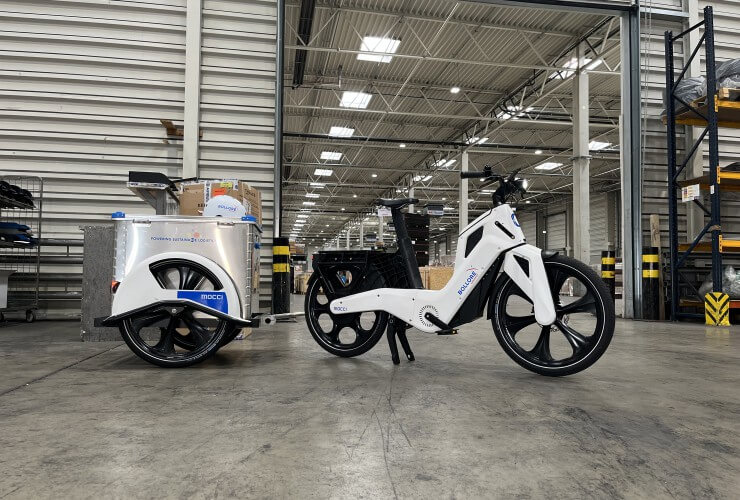
As a cargo bike with electric pedal assistance, the functionality consists of low-emission inner-city transportation. The payload is 160 kg and a trailer can also be towed.
In contrast to conventional bicycles, the frame of the bicycle consists of only a few parts made of glass fiber-reinforced polyamide. The power transmission from the pedals and the battery to the rear wheel is purely electric. A generator is installed on the pedals for this purpose.
Electric power transmission using power electronics is new in the two-wheeler sector, whereas it is already established in the railroad and commercial vehicle sector, for example as a diesel-electric drive. Its efficiency is around 15 percent lower than that of a conventional bicycle derailleur.
Another new feature is the almost complete absence of metal in the bicycle frame. Light and stable plastic parts can provide the necessary mechanical properties through injection molding. This choice of material and production technology is intended to save energy in production and increase recyclability. However, the reuse, repair and refurbish methods are even worse than for conventional bicycles due to clipped housing parts, while material recycling, i.e. melting down, is restricted by the glass fibers contained in the frame material.
Another innovation is the cloud system, which allows fleet management of several bikes. This makes it possible, for example, to limit the maximum speed depending on the location.
Maintenance of the bike is significantly simplified as the drive has far fewer moving, wearing parts.
The motor power is average, the battery size above average. In contrast to conventional electric bikes, energy can be recovered when riding downhill, which increases the range.
The product is particularly interesting for Q-commerce and CEP service providers, who benefit from the good maintainability and cloud-based fleet management. The price is comparable to other cargo bikes with similar performance data.
The motivation behind the choice of material is questionable, but the improved maintainability is unique. There are hardly any new functionalities, but there is already a high degree of maturity.
| Functionality / type of implementation | Ø |
| Novelty / Innovation | ++ |
| Customer benefits | + |
| Market relevance | + |
| ++ very good / + good / Ø balanced / – less / — not available | |
Finalists undergo the three-stage IFOY Audit as part of the IFOY Audit, which takes place during the TEST CAMP INTRALOGISTICS. This consists of the scientific IFOY Innovation Check, the IFOY Test and the jury test.
In den Statuten sind die Grundwerte und die Standards des IFOY AWARD festgelegt, nach denen die Organisation handelt. Dazu gehören unter anderem Gremien, Wahlomodus, Bewertungskriterien sowie der Code of Conduct.
The International Intralogistics and Forklift Truck of the Year has three bodies: Jury, sponsors, and advisory board.