

IFOY Audit
Finalists undergo the three-stage IFOY Audit as part of the IFOY Audit, which takes place during the TEST CAMP INTRALOGISTICS. This consists of the scientific IFOY Innovation Check, the IFOY Test and the jury test.
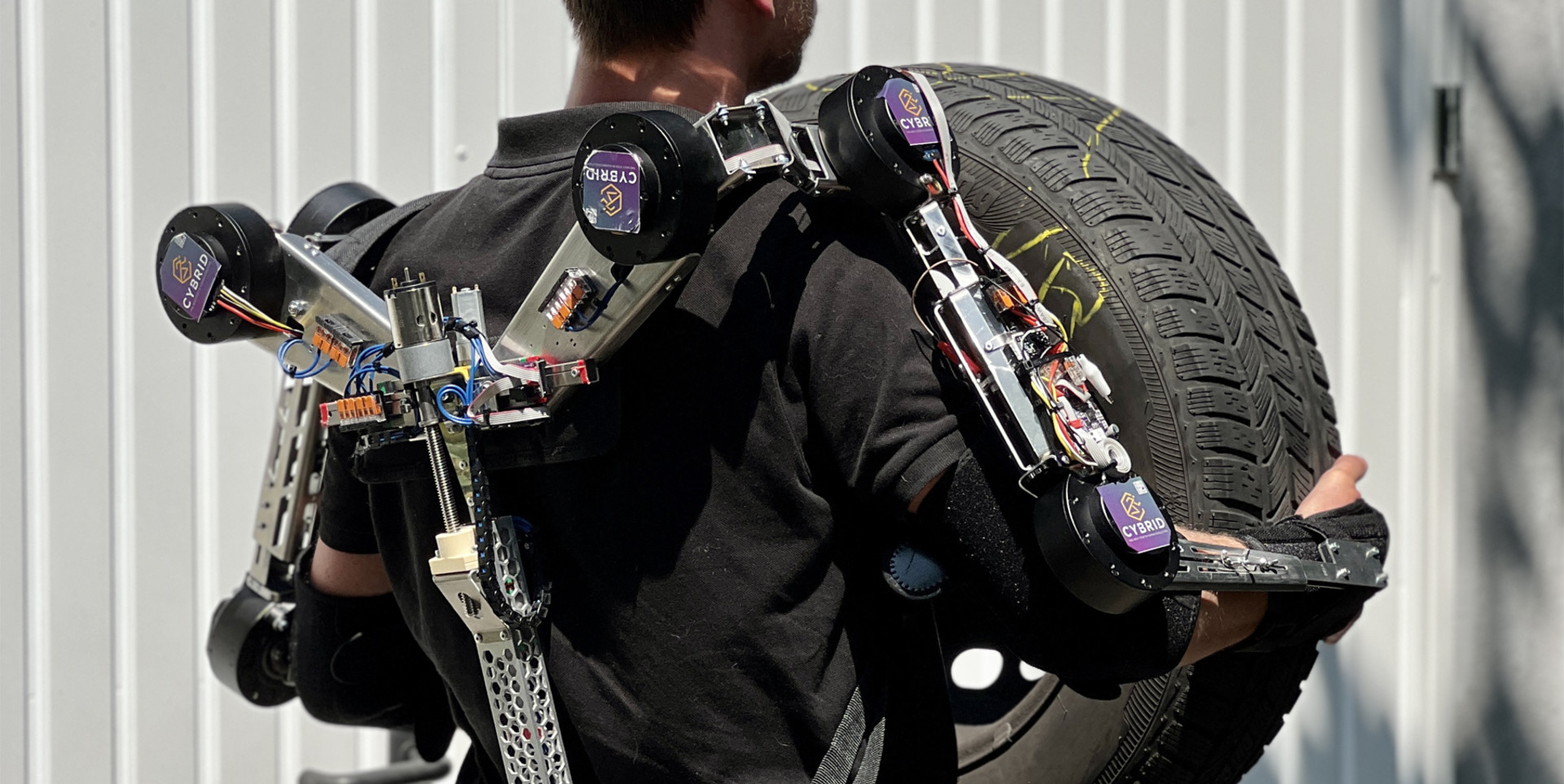
CYBRID is developing an active exoskeleton. The mechanical suit is worn close to the body and relieves the user, enabling healthier and more productive work. The load around the stressed areas of the back, shoulders and joints is absorbed through the hips to prevent musculoskeletal disorders, while simultaneously enhancing the user’s capacity by up to 20 kilograms.

Product name and company
CYBRID exoskeleton – CYBRID
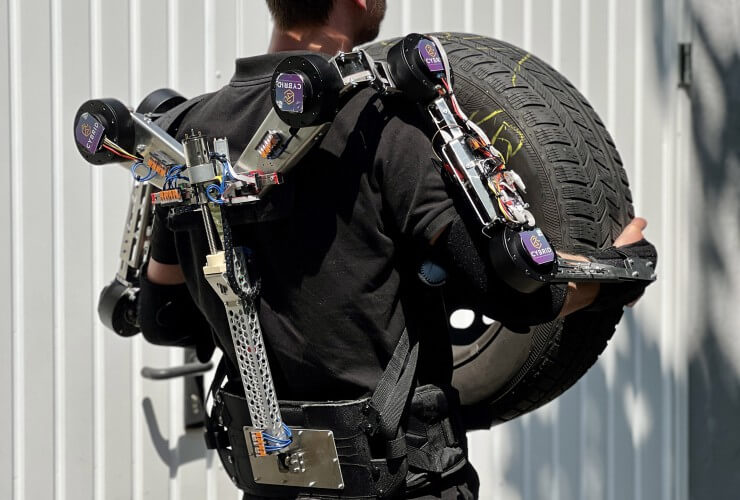
CYBRID is developing an active exoskeleton to prevent musculoskeletal disorders (MSDs) and make work easier for people who are already affected. The exoskeleton is a mechanical suit worn close to the body. Motors support the user’s upper body and relieve stressed areas. The exoskeleton literally reaches under the user’s arms, providing relief of up to 20 kilograms. This allows the user to carry objects of up to 20 kilograms weightlessly, without own strength. Additionally, the weight is absorbed through the hips rather than the back or arms, avoiding high-stress areas. Thanks to this support, employees don’t get tired as quickly, work more productively, and stay healthier.
In principle, the exoskeleton can assist anyone exposed to physical strain. The initial focus has been on the manufacturing industry and logistics. In these sectors, there’s a significant gap between manual labor and automation, forcing people to perform heavy tasks and making them more susceptible to MSDs. An example of such an application is a company that manually reconfigures its coating equipment every week, a process that takes four to five hours per unit. During this task, individuals have to remove and replace up to 25 kilograms copper plates in awkward positions. This example can also be applied to healthcare and other fields.
The CYBRID exoskeleton will be the first adaptive supportive suit for the entire upper body (shoulder & elbow joints) available on the market. In the future, the system will be extended to the complete body by adding exoskeleton elements for hip and knee joints. Adaptive support means that the exoskeleton adapts in real time to the (additional) weight to be compensated, the posture and the action of the user to implement the desired level of support. This technology enables the user to be supported with significantly more power support and offer a wider range of applications.
The software developed in-house for the CYBRID exoskeleton automatically detects the user’s movements and recognizes without contact the additional weight to be compensated for with the help of the motor currents. This leaves the user’s hands free, so that, for example, the handling of tools or complex objects is possible. It follows the user’s movements fully automatically and supports the user when necessary. In addition, the modularity enables the exoskeleton to be adapted to customer requirements.
The market for exoskeletons is still a very young one. Nevertheless, market growth is enormous, as evidenced by studies from International Federation of Robotics (IFR, 2016), ABI Research (2018), Statista Germany (2016), International Data Corporation (IDC, 2021), and the European Patent Office (EPO, 2022). According to Statista, sales of exoskeletons will grow to 110,000 units sold per year by 2025, while ABI Research estimates a result of approximately 150,000 active and 50,000 passive exoskeleton sales per year. IFR does not forecast sales figures, but rather market volume, estimating this to grow from $96 million in 2016 to approximately $4.3 billion per year by 2026, with a 40 percent annual growth rate. This is also confirmed in more recent studies by IDC (2021) and articles by the EPO (2022).
In addition, however, the losses in production in the USA and EU-28 due to MSDs amount to approx. 300 billion dollars, which allows a significantly larger market to be tapped, since the exoskeleton not only avoids these losses, but the companies also benefit from an increase in productivity.
ll in all, the exoskeleton enables a measurable increase in productivity as well as considerable health benefits for customers and operators. Customers benefit directly from the increased performance of their employees in the form of increased strength and endurance.
increased strength and endurance.
By redirecting concentrated stress from critical areas, such as the shoulders or discs, to broad initiating contact surfaces, such as chest straps and hip belts, these areas are relieved in a manner similar to a hiking backpack, reducing the risk of musculoskeletal disorders. Additionally, improved work quality leads to increased employee satisfaction and, at the same time, enhances the company’s attractiveness in the increasingly competitive job market.
In the future, within the framework of data protection regulations, the collected sensor data and AI can be used to create extensive statistics about user movements. As attested by interested parties, these statistics can provide valuable information for health promotion, such as the detection of improper lifting, and for productivity analysis. A development partner has expressed a specific interest in using the exoskeleton to better monitor truck loading processes.
Together with Fraunhofer IML based in Dortmund, exoskeleton specialist CYBRID is making efforts to research exoskeleton ergonomics and biomechanics. While established providers of passive or active exoskeletons focus either on the lifting zone from the floor to the hip or above the shoulder, CYBRID is tackling the space in between: From the hip to the head, nothing exists yet. With the CYBRID exoskeleton, objects weighing 20 kilograms feel as light as a feather. Planned market launch: first quarter of 2025, when the exoskeleton will be available to buy, but leasing models are also planned. Maintenance will be carried out at regular intervals and training for new employees and software adaptations are also planned.
Despite all the advances in robot technology, there are areas that cannot be fully automated: High costs, limited space, the variety of products and the complexity of automation are obstacles. At the same time, the shortage of skilled workers is increasing, while the workforce is getting older, which can lead to increased stress and downtime. This is where mechatronics and robotics come into play, and an exoskeleton is nothing more than a robot that you wear on your body. CYBRID aims to combine the best of both worlds: the combination of human intuition and the power of a robot.
How the exoskeleton works: it literally supports the wearer under the arms, allowing the user to carry objects weighing up to 20 kilograms virtually effortlessly without using their own strength. The weight is transferred via the hips instead of the back or arms, which protects high-stress areas. A one-kilogram battery is sufficient for one hour of use. For workplaces that require a relatively fixed location for several hours, the lifting aid can also be powered via a cable. On construction sites, for example, where there is no fixed power supply, batteries weighing up to 2.5 kilograms can be used, which last correspondingly longer. In principle, the use of exoskeletons always depends on the specific application, with the configuration being adapted individually. In any case, employees tire less quickly, work more productively and stay healthier.
Exoskeletons are available in passive and active form. Passive exoskeletons function purely mechanically, while active exoskeletons have a battery system. The active exoskeleton from CYBRID not only relieves the human body during work, but also “completely redefines human performance”, as it says in a video from CYBRID. The active exoskeleton increases the user’s strength so significantly that the difference is clearly noticeable. The reason why there is not yet a comprehensive application of exoskeletons for the midsection of the body, from the hips to the head, is obvious: this midsection is extremely complex. Interestingly, however, around 50 percent of applications take place precisely in this area.
Artificial intelligence (AI) has now also found its way into the world of exoskeletons: The system learns when people move in an unergonomic way (keyword: back training). CYBRID sees this as an opportunity to enter the service market with the aim of preventing the well-known musculoskeletal disorders (MSDs).
The current focus of CYBRID is on production and logistics, where the gap between manual work and automation is particularly wide. As the exoskeleton was still in the prototype phase at the time of the IFOY TEST DAYS, no test series were possible. CYBRID is also planning to extend its exoskeletons to the entire body by adding elements for hip and knee joints. This provider’s exoskeleton would then be the first adaptive support suit. This means that the exoskeleton will adapt in real time to the (additional) weight to be compensated, the user’s posture and actions.
The device is currently unable to prove its usefulness either at the Innovation Checker or with end users, as it has not yet been developed and certified at an industrial level.
The exoskeleton shows many characteristics of existing exoskeletons. The prototype gave the impression of well-executed engineering work. The adaptability of the exoskeleton, which was emphasized as an innovation, could not be identified during the demonstration.
The few available independent tests already show that the use of exoskeletons is not yet widespread, but that they are still often designed specifically for certain tasks and are not suitable for use in all working environments. Effectiveness can vary depending on the requirements and conditions of the workplace. In the Innovation Check, it was not apparent that CYBRID’s exoskeleton could overcome this limitation in terms of universal usability, which would be particularly desirable in logistics with its varied and changing working conditions.
CYBRID’s exoskeleton aims to relieve people of heavy loads, which is an important function. Exoskeletons can help to reduce the risk of injury and strain in the workplace. Especially in logistics, where heavy loads have to be lifted or repetitive stressful movements are necessary, exoskeletons can reduce the physical strain on workers and minimize the risk of injury. Exoskeletons can help older employees in particular to work longer by providing them with physical support and reducing the risk of injury. On the other hand, it should be noted that exoskeletons can also restrict workers’ freedom of movement, especially when performing complex tasks or in narrow work areas, for example when loading and unloading transportation equipment. This can impair efficiency or even create new safety risks. Overall, the relevance of the development for the market segment can therefore be rated as good.
The chosen technological approach and the implementation as a prototype is very promising, but cannot yet be rated as a finished innovation.
| Functionality / type of implementation | + |
| Novelty / Innovation | Ø |
| Customer benefits | Ø |
| Market relevance | ++ |
| ++ very good / + good / Ø balanced / – less / — not available | |
Finalists undergo the three-stage IFOY Audit as part of the IFOY Audit, which takes place during the TEST CAMP INTRALOGISTICS. This consists of the scientific IFOY Innovation Check, the IFOY Test and the jury test.
In den Statuten sind die Grundwerte und die Standards des IFOY AWARD festgelegt, nach denen die Organisation handelt. Dazu gehören unter anderem Gremien, Wahlomodus, Bewertungskriterien sowie der Code of Conduct.
The International Intralogistics and Forklift Truck of the Year has three bodies: Jury, sponsors, and advisory board.