

IFOY Audit
Finalists undergo the three-stage IFOY Audit as part of the IFOY Audit, which takes place during the TEST CAMP INTRALOGISTICS. This consists of the scientific IFOY Innovation Check, the IFOY Test and the jury test.

Loady provides standardized, reliable requirements for loading and unloading at industrial sites for the first time. Trucks are no longer rejected at gates or loading points, because equipment and document to be brought along or processes to be known are communicated reliably and comprehensibly. A higher planning acurracy of transport services means savings of millions of euro to the industry and logistics service providers – and the constant troubleshooting on all sides finally comes to an end. Loady is fundamental to further digitize and automatize logistics processes.

Product name and company
Loady – Loady



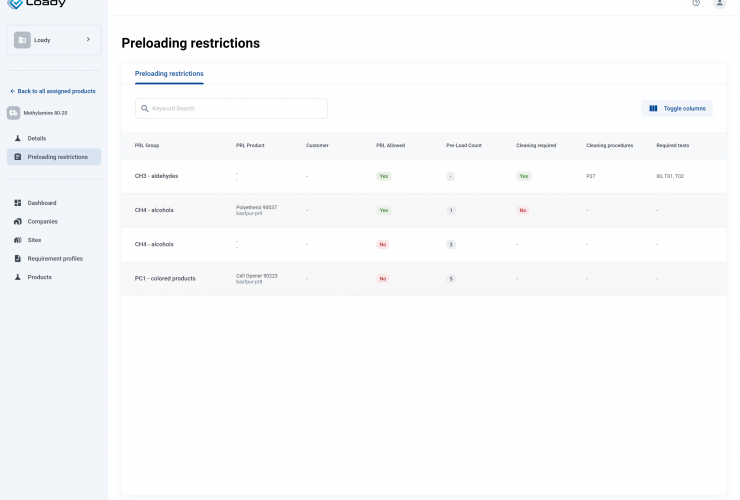


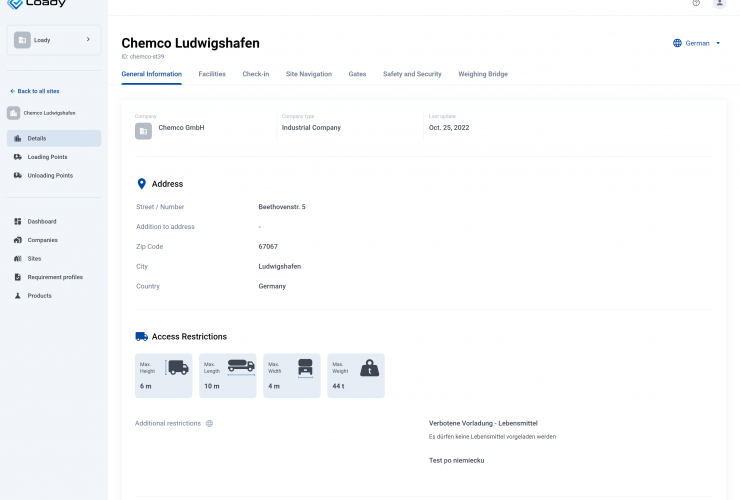

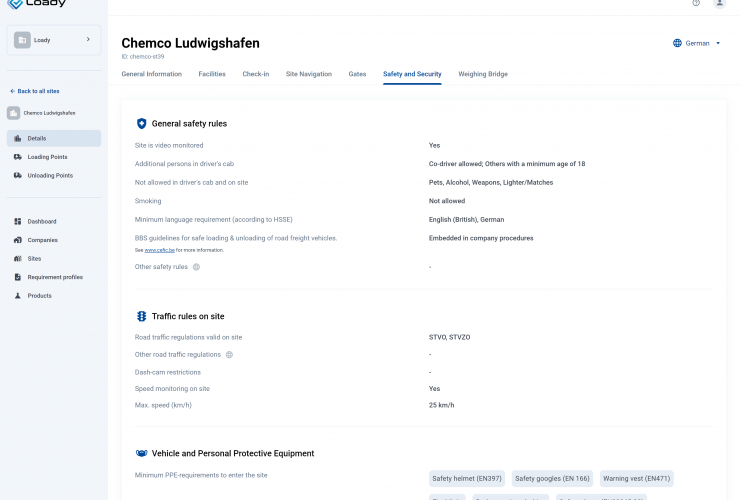
Loady is a SaaS solution and industry-wide reference source (single source of truth) for loading and unloading requirements that all logistics partners in the supply chain can refer to.
There is no predecessor, only a decades old break point that is solved by Loady. Loady is the first solution on the market to maintain loading and unloading requirements in a structured data model and the first reliable source for all logistics partners. Loady is also the first central pre-product database.
Loady thus offers a meaningful alternative to free-text fields, where companies currently laboriously and almost always incorrectly try to maintain their requirements for loading at their sites – but also for unloading at their customers’ locations. Usually, this is done at the moment in unstructured continuous text format. E.g. in the case of SAP, this mainly involves the fields G12 and G14 in the forwarding orders. Loady also replaces manually compiled Excel files for logistics tenders, cleaning requirements and pre-product restrictions.
Loady is relevant for all companies in industrial supply chains and their logistics service providers, Europe-wide and globally. This means a market volume of more than 60,000 medium-sized to large industrial companies and more than 20,000 logistics service providers worldwide. Average service costs are €20,000 per year and the potential market is of €1,600 million.
This is how Industrial companies and logistics service providers benefit from Loady:
Loady is a Software as a Service (SaaS) solution and industry-wide reference source (single source of truth) for loading and unloading requirements that all logistics partners in the supply chain can refer to. For the first time, shippers and consignees can enter all the information and requirements that need to be considered for loading and unloading a truck at their location and for specific products into a standardized data structure.
The software includes a modular data model that can be used for complex, large sites and hazardous goods, as well as smaller and simpler goods deliveries. By assigning transport lanes, data can be shared with business and logistics partners for the respective operational processes. Data changes are tracked in the software, and there is a data history. This means that it is always possible to see which data status was valid at which point in time. Authorized business and logistics partners can be informed directly in the event of changes to relevant data fields. The data is used in the company applications via API, and there is also a mobile, multilingual interface for drivers.
There is no predecessor, just a long-standing breaking point that can be overcome with the software. Loady is the first solution on the market to manage loading and unloading requirements in a structured data model and be a reliable source for all logistics partners. The software is also the first centralized pre-product database.
Loady thus offers a meaningful alternative to free-text fields, in which companies currently try to track their requirements for loading, but also for unloading at their customers, in continuous text format, laboriously and sometimes incorrectly. In SAP, this mainly concerns the fields G12 and G14 in the forwarding orders. The software can also be used to replace manually compiled Excel files for logistics tenders, cleaning requirements and preliminary products.
Loady is relevant for all supply chain companies and their logistics service providers, Europe-wide and globally. This means a market volume of over 60,000 medium to large industrial companies and more than 20,000 logistics service providers worldwide.
Industrial companies and logistics service providers benefit from Loady by providing reliable master data that is used along the processes. Responsibilities for relevant information are clearly defined. This is ensured by established data management roles with clear data governance rules. As a result, the risk of trucks being rejected at the loading or unloading point is also a thing of the past. In this way, the software helps to avoid extra or empty kilometers (reduction of carbon dioxide emissions). The effort required for problem solving, root cause clarification, data maintenance and mutual verification of information is reduced. Relevant changes are automatically communicated to business and logistics partners. This is associated with increased responsiveness, which leads to better understanding among all parties involved. Overcoming language barriers through a multilingual interface with direct translation for data managers, drivers and freight forwarders also contributes to this.
Chemovator’s (LOADY) product named Loady product addresses the enormously important issue of standardized data exchange in the awarding and execution of transport orders in the forwarding environment, both in the industrial and the commercial environment. It thus provides “standardized and reliable requirements for loading and unloading at industrial sites” – undoubtedly a highly relevant problem for an extremely high number of companies today. There is almost no manufacturing company or trading company that is not affected by the issue.
Standardized data storage and maintenance are already an enormous lever for error prevention. If necessary, this data is then also exchanged automatically and standardized on a case-dependent basis. This eliminates significant causes of errors and significantly increases process reliability. This does not only offer an advantage when all contractual partners of a process use the system, but already when one of the contractual partners has it in use, the first important advantages already become usable, through the then as free text, but nevertheless structured and standardized as well as previously checked provision of the data.
The problem, which is actually of far-reaching relevance, has simply not been addressed to date; it is the first solution of its kind. The market behavior regarding the acceptance of data handling has not yet been fully clarified. The usability on the basis of different clients allows the product to be quickly implemented and accepted by users. The standard must be accepted as such by those responsible for the company.
The product is implemented with a convincing architecture, which also provides suitable clients with easy-to-use functionalities for the different user groups. Particularly is the conception, which already makes a significant advantage convertible also with initial few users. This makes a possible successful implementation profitable even in the initial phase for individual customers – a topic that is unfortunately often neglected in many products.
At the interface between supply chain and intralogistics, this start-up is positioned in the area of loading. “The future standard” (own statement) offers a structured linking of data to optimize the overall process of freight from tendering to ramp approach. In addition, there is an architecture of applications up to an app for the driver. The challenge here is whether the proposed structure will actually be accepted as a new standard by stakeholders. However, the product can also function on its own, without another company being connected, and then outputs the data as free text, but in an optimized structure.
| Functionality / type of implementation | + |
| Novelty / Innovation | + |
| Customer benefits | ++ |
| Market relevance | ++ |
| ++ very good / + good / Ø balanced / – less / — not available | |
Image/video credits: Loady
Finalists undergo the three-stage IFOY Audit as part of the IFOY Audit, which takes place during the TEST CAMP INTRALOGISTICS. This consists of the scientific IFOY Innovation Check, the IFOY Test and the jury test.
In den Statuten sind die Grundwerte und die Standards des IFOY AWARD festgelegt, nach denen die Organisation handelt. Dazu gehören unter anderem Gremien, Wahlomodus, Bewertungskriterien sowie der Code of Conduct.
The International Intralogistics and Forklift Truck of the Year has three bodies: Jury, sponsors, and advisory board.