

IFOY Audit
Finalists undergo the three-stage IFOY Audit as part of the IFOY Audit, which takes place during the TEST CAMP INTRALOGISTICS. This consists of the scientific IFOY Innovation Check, the IFOY Test and the jury test.
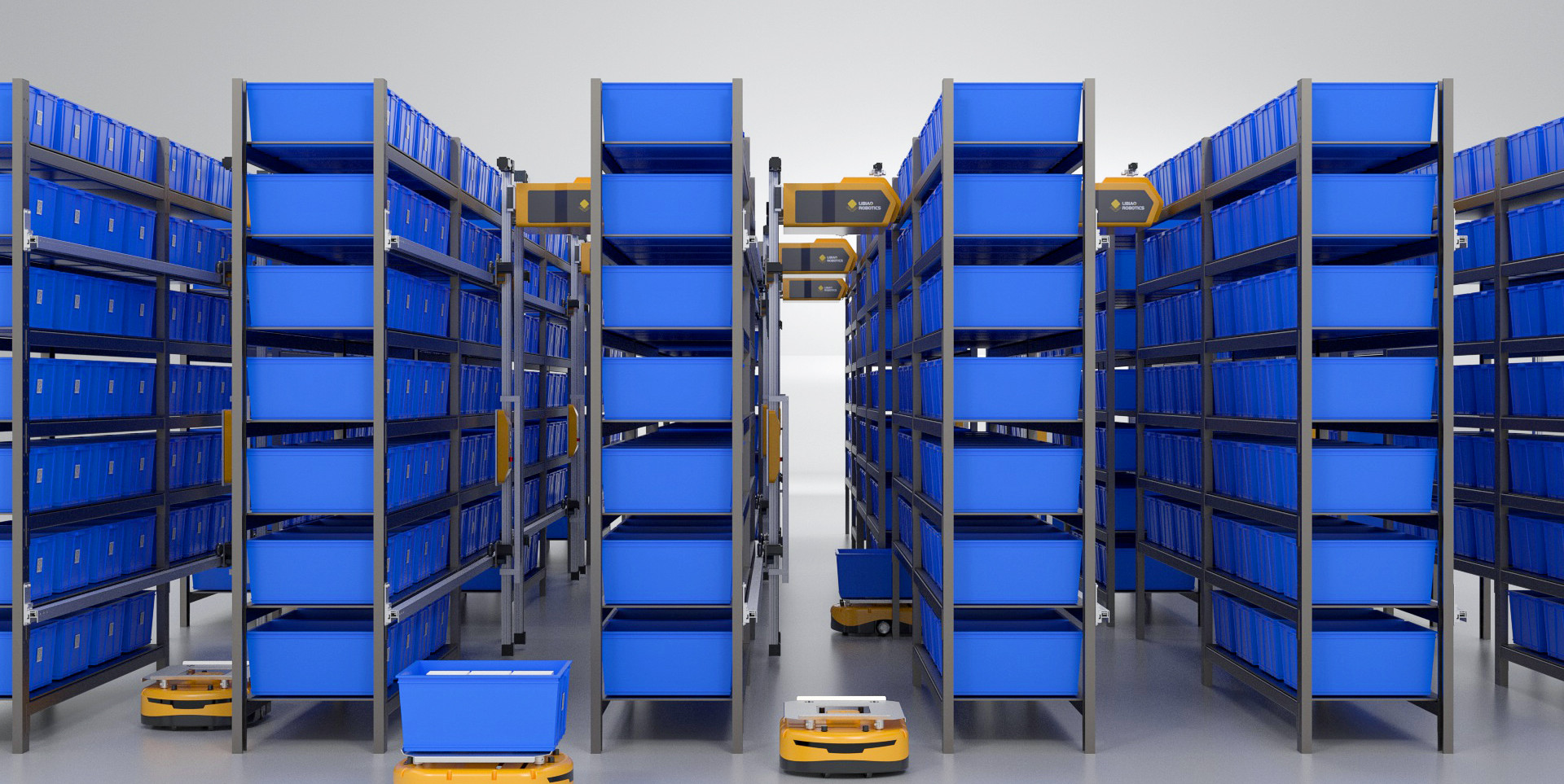
Zhejiang Libiao Robots invented the world’s first sortation robots five years ago, now they created another new robotic system named Airrob container handling robotic system to the world. The robots can climb the racks, and storing, picking, sorting, and moving the plastic containers, the climbing robot can move vertical and horizontal direction freely. It is a simple, efficient and flexible system for the fulfillment center or the work-line-side storge system. A better choice compared to Exotec and Squid and other ACR system in the world, according to Libiao Robots. The maximum capacity is 35 kg.

Product name and company
Airrob container handling robotic system – Zhejiang Libiao Robots
Category
Stationary Robot / Robot Warehouse System
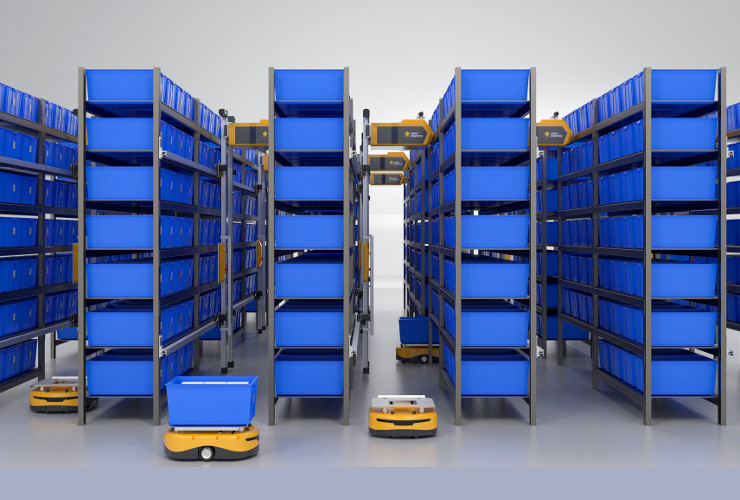
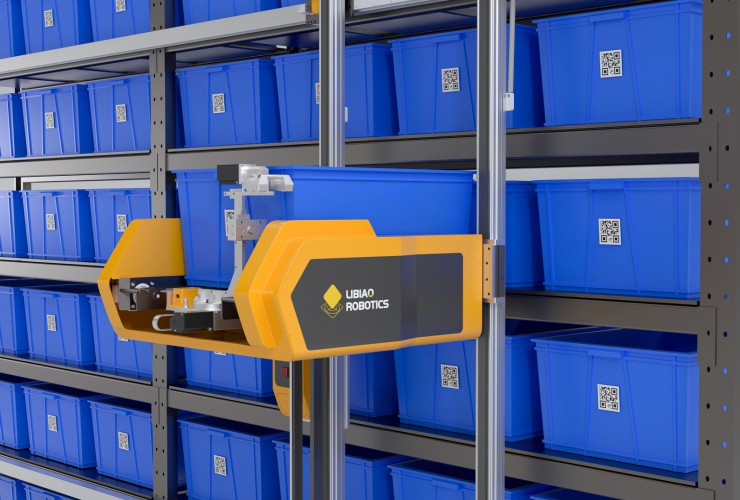
The Airrob container handling system consists of four main parts:
Two steel rails attached horizontally to the racks.
The pick robot is equipped with an upright column, it can climb the column vertically. The horizontal moveof the robot is done together with the column on the two steel rails.
A carrier robot is located on the floor to move the container to the work station.
One steering system controls the whole system.
It is an easy way to install micro-fulfillment centers, cost-effective, scalable, fast and moving, and the robot on the rack runs linearly for even more efficiency.
At the moment there are two customer applications in use, one is cross-bond e-commerce at Shein, the other is ITOCHU.
Airrob is a solution for any sorting or storage application. It can be used in e-commerce, footwear, apparel, cosmetics and pharmaceuticals, as well as for intensive storage of production parts.
Advantages are:
Libiao’s first innovation product was the T-sorting robot (MMH 2018 reader’s choice) and the second is the 3D vertical sorting system (2022 RBR50 innovation award). The Airrob container handling robotic system is expected to become another important product.
Competitors are: Locus Robotics, Exotec skypod system, Hai Robotics ACR system, Squid by Bionichive.
The Libiao Airrob case/container handling robotic system will set a new standard for mobile robots and fundamentally change existing solutions, according to Libiao Robots.
The design logic of the system is relatively simple, as is the implementation at the customer site, yet there is a lot of knowhow behind it. There are more than ten patterns of this product, which have been tested and proven for more than a year.
It is considered a billion dollar product for the potential market, strategic customers and distributors such as Tompkins Robotics in the U.S., Koerber Logistics in Europe, and end customers such as Shein, ITOCHU, Walmart, Sketchers, China Post, and Greece Post.
In the future, the Airrob case/container handling robotic system can also be used in the manufacturing industry, further increasing its market relevance.
The Airrob container handling robotic system is suitable for both new installations and retrofits of existing warehouses.
Benefits for customers:
Libiao Robotics has been nominated for an IFOY AWARD with its Airrob, a “climbing” container robot. Its maximum load capacity is 25 kilograms.
The system is suitable for the vast majority of all containers in this weight class, about 95 percent according to the manufacturer, and virtually all racks. It allows a quick and easy installation, even when retrofitting existing warehouses. Adjustments to the floor are not required. However, horizontal rails must be attached to the rack, over which the Airrob travels along the rack. The maximum speed of the robot is 2 m/s.
The Airrob is attached to a lightweight frame that moves along the horizontal rails through the aisle. This design allows the robot to “climb” up the shelves and store or retrieve the correct container on the shelf at any desired location. Each bin is thus directly accessible at all times.
The frame is flexible and automatically adjusts to the position of the robot. This ensures high reliability and fast, trouble-free and stable transport of the boxes.
The system is suitable for racks up to 12 meters high. In this case, however, Libiao mounts two Airrobs on top of each other, as this requires less adjustment.
A unique feature is the hook system used to move the crates in and out of the racks. The hook moves within the contours of the robot, which does not penetrate the shelves. This allows the boxes to be stored extremely compact. The hook system is suitable for handling totes on both sides of an aisle. This limits the aisle width to about 85 centimeters.
The concept is lighter than a miniload, a multishuttle or an autonomous case robot (ACR). This is one of the reasons why energy consumption is low. Consumption could not be measured by the IFOY test team, but according to the manufacturer, the savings compared to competing solutions is more than 30 percent.
The battery built into the Airrob is maintenance-free and is charged when the tablet is switched on and off; according to the non-sliding touch charging principle. The rack on which the Airrob is mounted is powered by mains electricity.
In the Pick&Go setups during IFOY TEST DAYS, the Airrob worked with the manufacturer’s AMRs, but other configurations are also conceivable.
The concept is particularly suitable for micro-fulfillment centers and can also be used in ambient temperatures as low as -20° Celsius, for example in cold stores.
The Libiao Airrob container handling system can set a new standard for mobile robots and fundamentally change existing solutions. The Airrob is cost-effective, scalable, and efficient. The system saves space and labor. The unique hook system guarantees high storage density.
The Airrob solution addresses manually operated warehouses that are to be automated cost-effectively using existing racking infrastructure and potentially inhomogeneous container systems. With an ROI of 1 to 2 years for the 10 installations currently on the market, the Airrob system is an attractive option for brownfield automation in diverse industries such as warehouse logistics, e-commerce, or manufacturing. Airrob can be used for rack heights between approx. 2 m and 14 m and is already economical in smaller warehouses starting at 100 square meters. The market potential is high due to the high flexibility of the system, the comparably low costs, the wide range of applications as well as worldwide marketing partners.
The greatest benefit of Airrob is its flexibility and adaptability for use in existing warehouses without replacing existing infrastructure. This also results in manageable investment costs, which should be a fraction of fully automated systems. Set-up and commissioning are in the range of 1 to 4 weeks. Due to the modularity, additional robots can be temporarily integrated for more throughput at peak times. Compared to similar solutions on the market, Airrob is said to consume 30 percent less energy. In addition, the system is easily reusable in other operating environments.
Airrob stands out for its simplicity of design, which enables high efficiency and robustness at low cost. Nevertheless, several innovative details have been implemented for the applicability in a wide range of manually operated warehouses. The vertical guide is flexibly mounted on two horizontal rails on the rack, so that even inclined shelves can be approached with the appropriate inclination. A simple hook mechanism allows access to various standard containers from two parallel shelves. Unlike comparable solutions, a fast-charging mechanism ensures 24/7 operation of the pick robot, so fewer pick robots are needed overall.
The pick robot, a type of stacker crane, is designed to be simple and practical, enabling a rapid access time of about 30 seconds to the totes weighing up to 25 kilograms. The throughput of containers can be scaled flexibly by dividing the tasks between the pick robot on the rack and the mobile transport robots. With a temperature range between -20 °C and 50 °C, freezer applications are also possible.
With Airrob, existing rack storage systems for any standard containers can be automated very cost-effectively. The easily retrofittable and technically minimalist solution for removing totes from heights of up to 14 meters, in conjunction with a fleet of mobile transport robots, enables significant efficiency gains compared to manual warehouse management. Technical highlights include the simple but universal gripper for crate removal and return, adaptivity to typical real-world conditions such as sloping shelf laye
| Functionality / type of implementation | ++ |
| Novelty / Innovation | + |
| Customer benefits | ++ |
| Market relevance | ++ |
| ++ very good / + good / Ø balanced / – less / — not available | |
Image/video credits: Zhejiang Libiao Robots Co., Ltd
Finalists undergo the three-stage IFOY Audit as part of the IFOY Audit, which takes place during the TEST CAMP INTRALOGISTICS. This consists of the scientific IFOY Innovation Check, the IFOY Test and the jury test.
The bylaws set forth the core values and standards of the IFOY AWARD, which guide the organization’s actions. These include, among other things, governing bodies, the election process, evaluation criteria, and the Code of Conduct.
The International Intralogistics and Forklift Truck of the Year has three bodies: Jury, sponsors, and advisory board.