

IFOY Audit
Finalists undergo the three-stage IFOY Audit as part of the IFOY Audit, which takes place during the TEST CAMP INTRALOGISTICS. This consists of the scientific IFOY Innovation Check, the IFOY Test and the jury test.
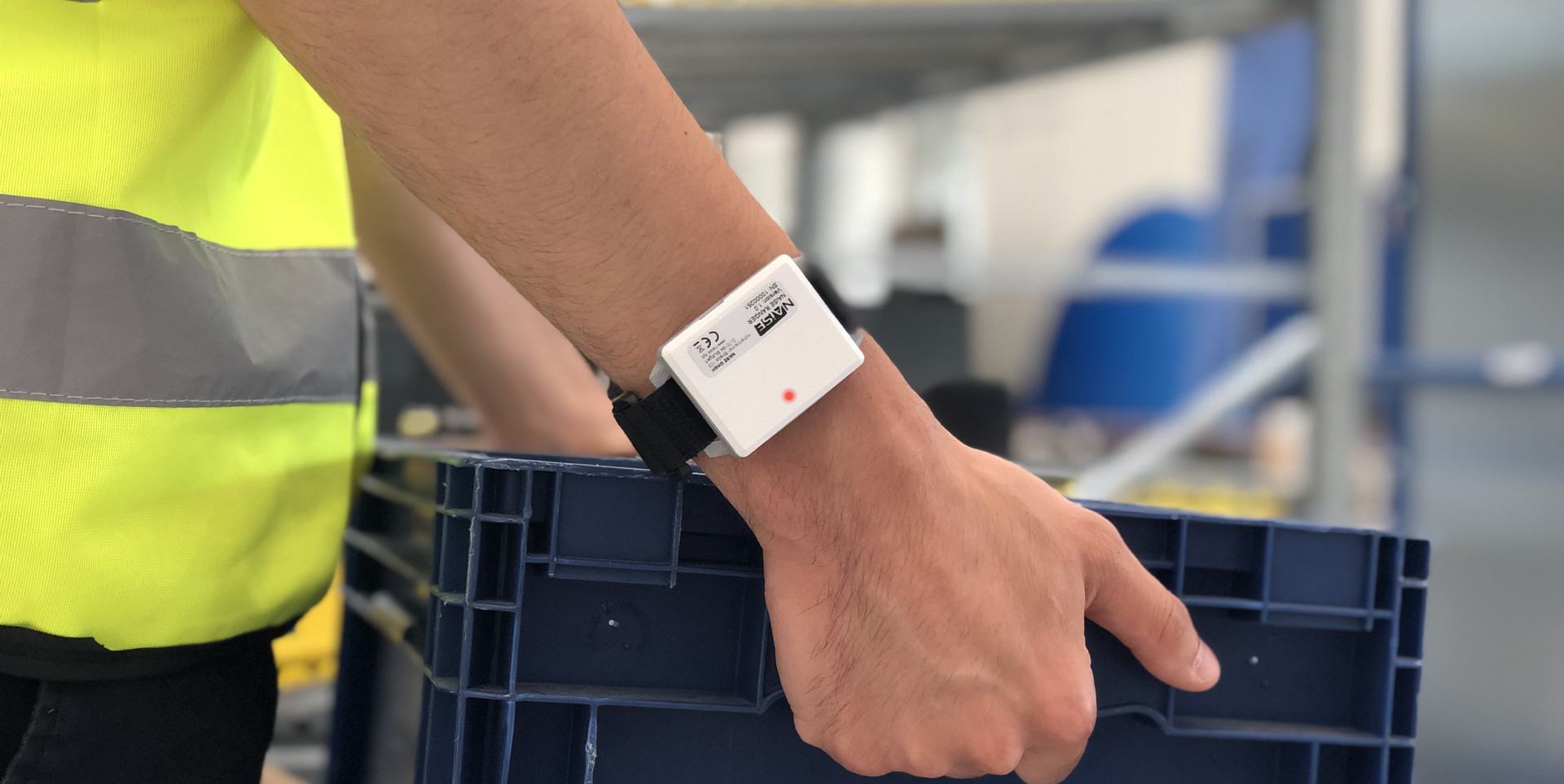
NAiSE TRAFFIC is the world’s only traffic and order management software for all participants in intralogistics. An elementary feature is that through the patented localization network (NAiSE RTLS) the entire mixed operation, consisting of people, forklifts, tugger trains and also AGVs/AMRs, is included in the traffic control and thus a more efficient and safer material flow in the warehouse and in production can be ensured.

Product name and company
NAiSE TRAFFIC – NAiSE
Category
Special of the Year
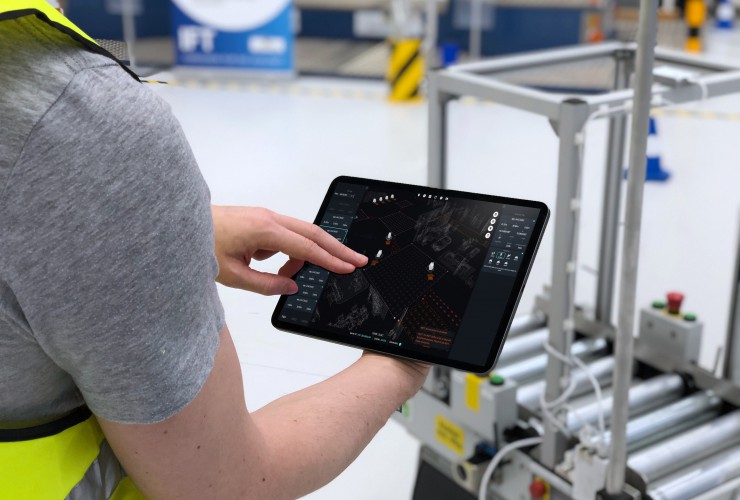
The NAiSE solution is essentially a manufacturer-independent control system for AGVs/AMRs with the unique feature that the entire intralogistics mixed operation is included in both traffic control and order distribution. This is made possible by the NAiSE RTLS localization network, which was developed and patented in-house: Radio sensors in the hall infrastructure enable precise localization and simultaneous near-real-time communication of and between the traffic participants (people, forklifts, tugger trains, AGVs/AMRs), using ultra-wideband technology that enables robust and reliable localization even in difficult industrial environments. The transparency gained from this enables the central software to do much more than the essential guidance control of AGVs/AMRs: due to past localization data, traffic analyses can be carried out on a regular basis, making conflict zones recognizable to the user, e.g. by means of heat maps. The bottlenecks and traffic jams in the flow of goods resulting from the conflict zones can then be solved playfully in the software by creating traffic zones. For seamless integration into the environment, gates are also controlled and fire alarm systems are integrated. Through the generic order interface, the integrated order manager receives the transport orders and transmits them to the appropriate participants as configured by the operator.
In most cases, the master control solutions available on the market focus on the control/regulation of AGVs/AMRs from a single manufacturer. The communication standard for AGVs/AMRs “VDA 5050” initiated by the associations VDMA/VDI has created a solution approach that enables the integration of different AGV/AMR types from different manufacturers. Persons (in the form of forklift drivers, tugger drivers or pedestrians) have not yet been included in the traffic control in any way. This circumstance is very critical, since pedestrians, tugger trains and forklifts are indisputably far more present in the warehouse or production than AGVs/AMRs: Constant bottlenecks, traffic jams and even accidents are the result, especially when it comes to the previously unfamiliar encounter between AGVs/AMRS and non-AGVs/AMRs. But this is exactly where the NAiSE solution comes in and differs significantly from the competition by including all road users in the traffic control – this is made possible in particular by the patented localization hardware NAiSE RTLS. NAiSE coordinates on three levels: Transport orders are intelligently transmitted to the most suitable transport participants, regardless of whether they are autonomous or manually guided (ORDER-MANAGER), traffic conflicts are avoided during transport on the basis of user-definable traffic zones, and in the event of danger, the assistance system (NAiSE SAFETY) prevents accidents.
Thanks to its modular design, NAiSE TRAFFIC is also suitable for customers in intralogistics who are not (yet) considering the use of autonomous transport systems. Warehouses or production halls with classic material flow, which is carried out using manually guided industrial trucks, can already benefit by increasing the transparency and digitization of their transport processes. The corresponding intralogistics area in Germany where NAiSE hardware (NAiSE RTLS) could be deployed is 590 million square metres, which corresponds to a revenue potential of € 5.16 billion from hardware sales alone. In addition to hardware sales, recurring revenue can be achieved through the sale of software licenses. Licenses are calculated on a per employee, per industrial truck and per mobile robot basis, which means that the German intralogistics sector, with 7.56 million employees, 2.02 million industrial trucks and 260.000 mobile transport robots, has a revenue potential of up to € 1.35 billion per year.
With NAiSE TRAFFIC, the user can analyze and subsequently optimize the entire transport processes within intralogistics. However, every operation is constantly changing, which is why new bottlenecks and problem areas are constantly emerging, which should be responded to as quickly as possible so that the intrinsic flow of goods does not suffer as a result. The NAiSE solution not only provides a one-time solution for a unique scenario, but also supports the operations manager in iteratively adapting the material flow to the ever-changing circumstances. At any time, the user can get a bird’s eye view of what is happening in the software tool, giving him a better understanding of his own processes. In addition, analysis options support the early detection of problem zones, which can be solved directly by the user in the next move based on corresponding traffic zones. However, it is elementary that the entire mixed operation is included for this, which is indispensable in order to be able to effectively coordinate the entire intralogistic traffic.
NAiSE Traffic is the world’s only software for traffic and order management that includes all participants in the intralogistics process. The patented Real-Time Localisation System (RTLS) network includes all “traffic participants” in the traffic control and thus ensures the safe, efficient flow of materials in logistics and production.
To demonstrate its software, NAiSE is switching live from the test hall in Dortmund to the future factory “Arena 2036” at the Stuttgart headquarters. MAiSE will clearly demonstrate the functionality, added value and philosophy of its manufacturer-independent control system for industrial transport robots in material flow using diagrams, dashboards and heat maps. In contrast to VDA 5050, which is currently very popular and makes life easier for master controllers in particular, NAiSE follows a completely different way of thinking when it comes to traffic control. The Stuttgart-based company also integrates non-robots: people, forklifts, the pallet trucks – regardless of whether they are VDA-5050-compliant or not. NAiSE emphasises that it does not want to draw a line under VDA 5050, because the hybrid state, i.e. humans and robots, will still exist in warehouses and production for a long time to come. In addition, they do not want to take away the manufacturers’ intellectual property (IP), as they put it, that is their USP. At the manufacturer Omron, for example, this is the high degree of autonomy of the robots.
Despite all the really well-designed screen displays, NAiSE cannot do without “grounding”. In the perhaps 50 square metre test field we enter, there are three areas: In one, an AMR from Omron drives around, then there is an encounter zone, and in a third area, a VDA-5050-compliant transport robot, which is not specified in more detail at first glance, acts. And to make matters worse, a colleague with his sack truck keeps getting on my nerves, venturing into the area frequented by several participants for demonstration purposes. The tester also gets mixed in.
But how exactly does the guidance system work? In the self-developed, patented localisation network NAiSE RTLS, radio sensors in the hall infrastructure enable precise localisation and near-real-time communication of and between the traffic participants. Ultra-wideband technology (UWB) is used here, with the help of which objects can be located robustly and reliably even in difficult industrial environments.
The highlight of this is that regular traffic analyses can be carried out using localisation data from the past, which, for example, show conflict zones on the basis of heat maps. One can then resolve the bottlenecks and congestion in the flow of goods resulting from the conflict areas almost playfully by creating traffic zones. For seamless integration into the environment, gates are also controlled and fire alarm systems are integrated. Through the generic order interface, the integrated order manager receives the transport orders and transmits them to the appropriate participants as configured by the operator.
NAiSE also already has something to show: At Continental in Ingolstadt, for example, the material flow could be increased by 30 per cent, according to the company. But the system is also in productive use in China, in Germany still in Schwenningen am Neckar and at the automotive supplier Vitesco in Rheinböllen, a division of Continental.
NAiSE Traffic is not only interesting because of the integration of really all potential “participants” in the warehouse, i.e. not only AGV or AMR, but also people and hand pallet trucks in mixed operations: the traffic and order management software also shines with the USP that it iteratively supports the person responsible for operations in adapting the material flow to the ever-changing circumstances. In the software tool, a bird’s eye view of the processes can be taken at any time and problem areas can be identified at an early stage with the help of analysis options.
The NAiSE TRAFFIC software handles traffic and order management for various conveyor systems in intralogistics. Especially against the background of VDA 5050, the use of different vehicle systems at one location is on the rise. The software claims to be able to control the joint use of traffic areas by employees, industrial trucks with drivers, driverless transport vehicles and also autonomous mobile robots (AMR) within buildings, especially with localisation elements based on UWB technology. This task of traffic control is of outstanding importance for the efficient and safe realisation of transport processes for intralogistics, so that the market relevance of the solution is to be assessed as high
The benefit for the user results from the possibility of being able to use different vehicle systems, whether manually guided or classically automated or autonomously controlled, on mixed-use routes. This makes it possible for the user to avoid conflicts in vehicle operation even with little effort. In particular, NAiSE TRAFFIC should be able to reliably prevent unsolvable mutual obstructions, so-called blockages, at intersections and at pick-up or drop-off points. NAiSE TRAFFIC cannot be used to further optimise the use of routes, as the respective decisions regarding the movements of the individual road users only become visible to the software through localisation.
The consistent independence from individual providers is attractive, but is already offered by other software providers. In combination with the own UWB localisation system, however, a degree of novelty is achieved, as any vehicles and persons can be localised, provided they are each equipped with a UWB device.
The functionality could be well understood on the simple test setup. The updating of the localised road users appears to be quite fast. Nevertheless, it has to be evaluated that the functionality is only given if all participants are equipped with a UWB localisation device and that this requirement can be safely realised in the daily operational routine. Compared to conventional software solutions for traffic and order management, the graphical user interface with the layout representations based on point clouds is solved differently. For regular users, however, this implementation does not appear to be suitable for ergonomic reasons, as intuitive orientation is not easy.
Even against the background of VDA 5050, both the market relevance and the customer benefit are to be rated as high. The technologies used and the associated innovation, together with the implementation, can be described as good.
| Functionality / type of implementation | Ø |
| Novelty / Innovation | + |
| Customer benefits | + |
| Market relevance | ++ |
| ++ very good / + good / Ø balanced / – less / — not available | |
Image/video credits: NAiSE GmbH
Finalists undergo the three-stage IFOY Audit as part of the IFOY Audit, which takes place during the TEST CAMP INTRALOGISTICS. This consists of the scientific IFOY Innovation Check, the IFOY Test and the jury test.
In den Statuten sind die Grundwerte und die Standards des IFOY AWARD festgelegt, nach denen die Organisation handelt. Dazu gehören unter anderem Gremien, Wahlomodus, Bewertungskriterien sowie der Code of Conduct.
The International Intralogistics and Forklift Truck of the Year has three bodies: Jury, sponsors, and advisory board.