

IFOY Audit
Finalists undergo the three-stage IFOY Audit as part of the IFOY Audit, which takes place during the TEST CAMP INTRALOGISTICS. This consists of the scientific IFOY Innovation Check, the IFOY Test and the jury test.
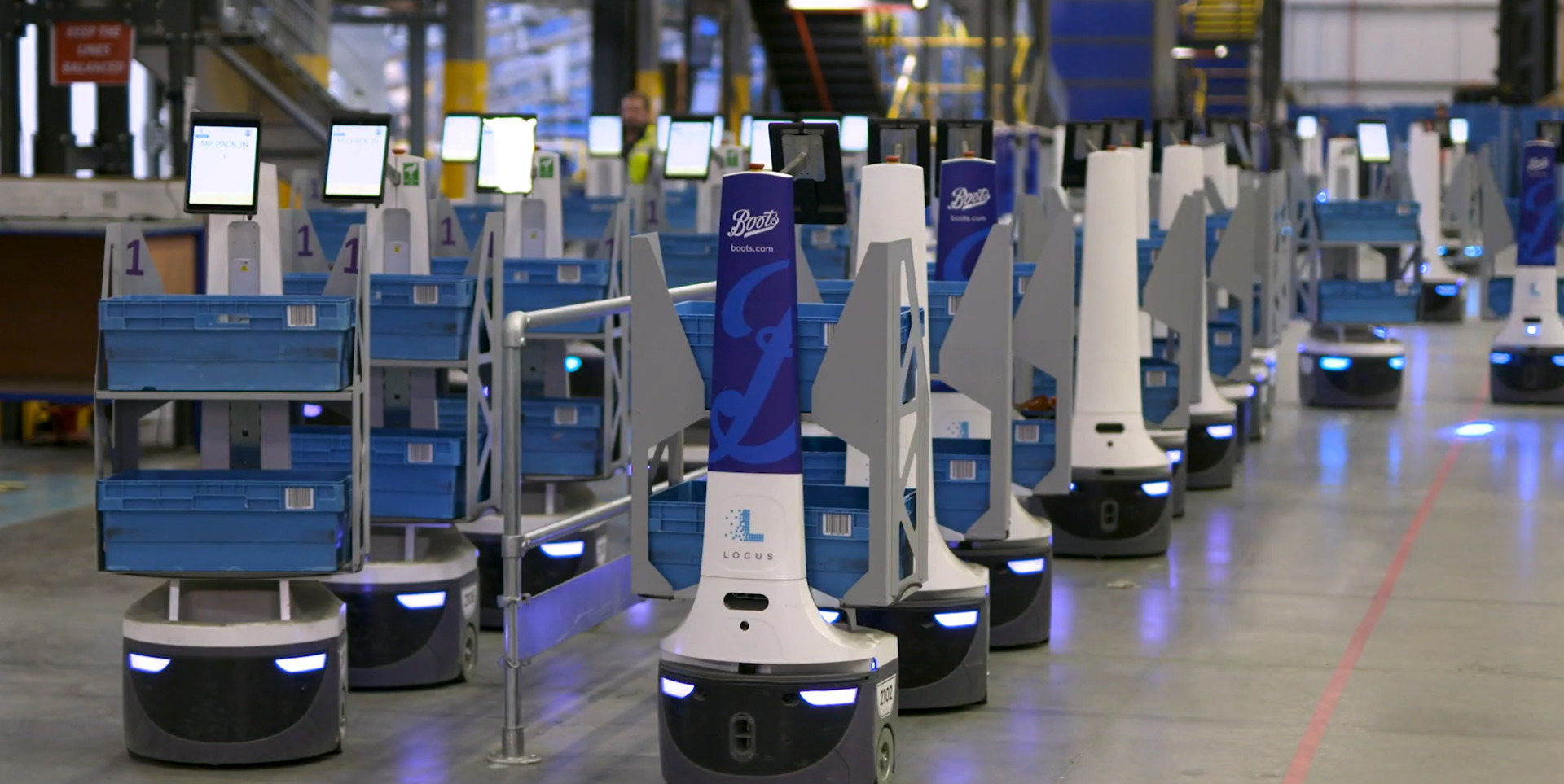
Locus Robotics is a leading provider of intelligent autonomous mobile robots (AMRs) that operate collaboratively with human workers to improve productivity and throughput within the warehouse and manufacturing facilities. The solution helps retailers, 3PLs, specialty warehouses, and manufacturers meet and exceed increasingly complex and demanding requirements, integrating into existing infrastructures without disrupting workflows, and enabling customers full ROI within six to eight months.
The solution consists of an integrated execution platform that uses proprietary optimization algorithms and real-time operational performance data to coordinate labor and autonomous mobile robots (AMRs) to deliver two to three times more productivity and throughput. In addition, Locus provides a variety of AMR form factors to apply the right robot to the right job, at the right time. A purpose-built, integrated robotics solution designed to automate all material flow within the warehouse and manufacturing facilities.

Product name and company
Locus Robotics AMR Solution – Locus Robotics
Category
Mobile Robot
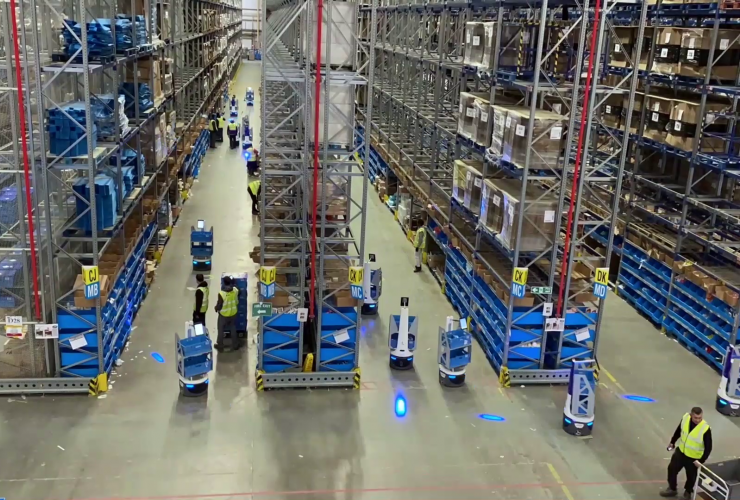
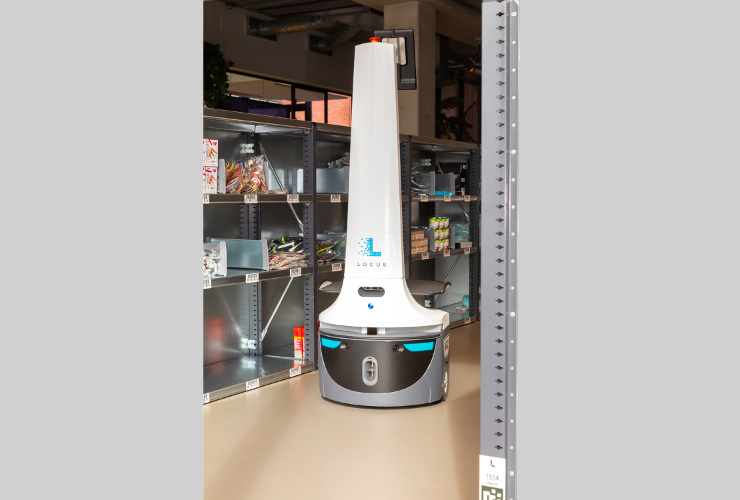
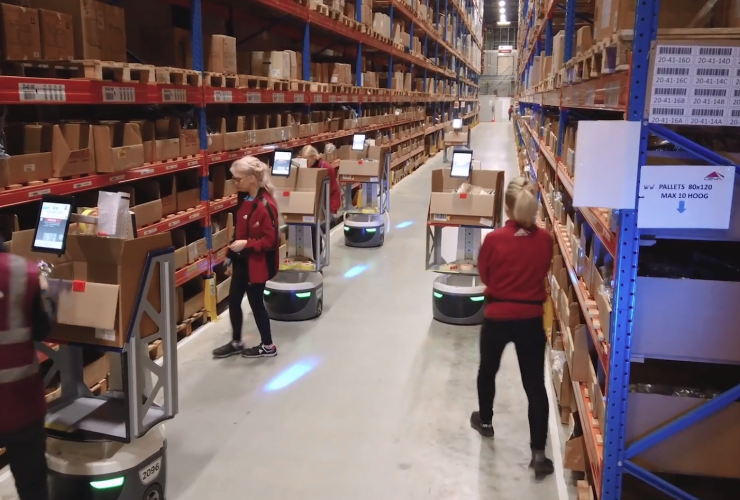
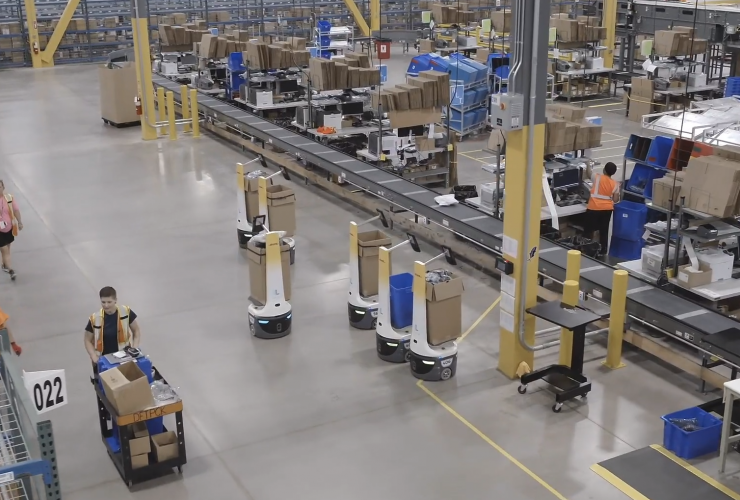
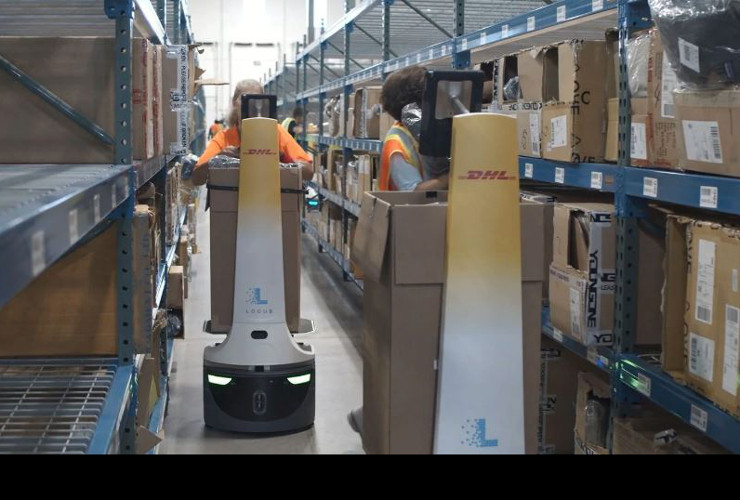
Locus’s strength lies in the maturity and optionality of our execution platform which provides real-time optimization of all tasks to be completed within the four walls and across multiple levels in warehousing and manufacturing environments. The software acts as a fleet manager, managing complex workflows that support a variety of use cases and clustering work to build optimal robot missions.
The unique multi-bot approach decouples workers from orders and tasks, minimizing unproductive associate time and assigning the right robot form factor to meet the right human at the right time to collaboratively perform the next most efficient task. Proven at scale, the system can seamlessly add robots to add capacity to any operation within minutes.
Locus also improves the overall workplace quality and ergonomics. Workers no longer need to push heavy carts and walk long distances to keep up with growing order fulfillment demands. Workers stay in zones while the bots bring the work to them. This significantly lowers worker fatigue, and improves workplace safety to deliver higher productivity and lower overall labor costs for recruitment, training, and retention. Locus customers are seeing documented double or triple increases in their fulfillment productivity and fulfillment cycle times, while significantly lowering labor recruitment, training, and retention costs for both full time and seasonal positions.
Locus addresses operators’ multifaceted challenges to manage growing online ordering volume and the rapidly increasing shortage of available labor by delivering a cost-effective, fully-autonomous mobile robot for use in ecommerce and distribution warehouses. Locus does this by dramatically improving order fulfillment productivity, lower operational costs, and improves the overall workplace for the workers.
Locus’s innovative Robots-as-a-Service (RaaS) subscription model means there’s no investment by a customer in costly hardware or maintenance of the system. In effect, they are hiring the bots to do the work. A deployment can happen in as fast as four weeks and generate an ROI in six to eight weeks.
Locus’s industry-leading, advanced navigation software stack makes the LocusBot nimble and intuitive. The software is so advanced, it allows the bot to work closely and safely alongside humans and machinery and smoothly navigate a dynamic warehouse environment, avoiding obstacles, and optimizing travel paths to improve speed and productivity.
Locus currently has over 30 worldwide patents granted, with several additional currently pending.
Worker training is intuitive and easy. Workers can be trained to use the bot in less than five minutes due to an innovative and easy to use user interface. The UI not only displays the pick information, product image, and location, it also automatically changes the onscreen languages to reflect multiple picker’s preferences. This feature improves picking accuracy, worker comfort and productivity, making the work easier and more natural for the worker. Currently, Locus has more than 20 languages.
The Locus solution improves the overall workspace ergonomics by eliminating the heavy physical demands on warehouse workers including eliminating unproductive walking time and pushing heavy carts to each individual pick.
As online ordering has exploded over the last 18 months, order volumes have increased while the availability of labor has become increasingly difficult to find. In order to meet the growing demand while keeping costs down, fulfillment companies and retailers are turning to robotic automation to span the labor gap. Locus Robotics’ industry-leading robotics fulfillment solution enables fulfillment warehouses, retailers, and third-party logistics (3PL) operators to easily meet and scale to manage higher order volumes and increasing consumer demand for faster e-commerce, retail, omnichannel, and manufacturing order fulfillment. The solution has proven scalable across deployments from ten to several hundreds bots operating 24/7 in a single facility. The industry-first, Robots-as-a-Service (RaaS) subscription-based business model gives operators the ability to easily and seamlessly scale up and down to meet changing demand. Locus ships thousands of peak-season and ‘surge’ robots every year, with many customers choosing to keep them onsite for future use.
The global warehouse fulfillment and ecommerce market represents a $35 trillion (US) market with over $140 billion in labor costs. In addition, because of limited real estate space, many existing warehouses are going vertical, adding multi-level mezzanines to their warehouses to expand and optimize available picking floor space. Locus has more than 60 customers at 120 sites around the world.
Customer benefits:
Other Features and Benefits:
3PL
Retail
Healthcare
Manufacturing
The US provider Locus Robotics offers its autonomous robots, which work collaboratively with warehouse staff, exclusively in a packaged rental model. After the set-up with a one-time “start-up fee”, a “core fleet” is available to the customer for his tasks. This is an average of between 45 and 50 vehicles per customer, with fluctuations (rather) upwards and less downwards not excluded, of course. The robot manufacturer from Wilmington in the Greater Boston metropolitan region (Massachusetts/USA) has been active in Europe since 2019.
At the moment, Locus serves around 80 customers in about 200 warehouses with its picking system. The customers come not only from retail, but also from pharmaceuticals and industry (ABB). Picking into the 45-kilogram moving robot is extremely easy: the type and quantity of the products to be picked at the location and placed into the small load carrier on the Locus robot are very clearly displayed on the clear touchscreen. Picked, confirmed, and the fast journey continues. The tester has never found this so easy, intuitive and without a single second of “learning the ropes”.
The peak season for Locus is November/December, because the Christmas business easily burdens retailers with four to five times as much picking work as during the year. According to a survey by Material Handling Industry (MHI) and Deloitte, 56 percent of respondents have “extreme problems” finding suitable staff. No wonder: up to now, about 40 to 60 per cent in the warehouse are determined by walking, with an average age in Germany of 40 to 55 years.
Locus solves this problem pragmatically and effectively by separating the employees from the picking trolleys: the work comes to the pickers, i.e. a classic goods-to-person principle. However, not stoically standing only at a fixed workstation, but “flowing” in a certain area, which normally, however, does not go beyond the warehouse aisle. This not only saves a lot of energy, but also makes the work far more effective and productive than picking along. Locus does not replace the customer’s inventory management system, but obtains its information about the product and the number of units to be picked from it. The Locus software clusters the orders for the optimal picking route – of the roving units, mind you, not of the individual pickers – and which orders are connected on a container. In the field, the system works with high-quality Lidar sensors (“Light Detection and Ranging”). Irrespective of the time saved by short distances for the pickers: the picking system also increases productivity by the fact that the human at a single picking position, for example, spends only 8 instead of 12 seconds – that adds up. When picking, both hands are free for the products to be picked.
If necessary, a seasonal fleet can easily be added to the core fleet mentioned at the beginning, for example for two to three months for the Christmas business. The robots themselves are produced between May and November and are maintained quickly and leanly. A total of around 8,000 of these robots are currently in use, 2,000 of them in Europe. When the going gets tough, 100 to 500 f the robots can easily be produced – per week. The “package” also mentioned above consists of the uncomplaining replacement of the robots during maintenance; in the event of malfunctions, the customer does not incur any additional costs. Every three months, the so-called “field service” comes to the customer’s premises to check on things. It also takes three months for the customer to implement such a system.
With collaborative AMR, retailers, 3PLs, but also operators of special warehouses or manufacturers can greatly improve their effectiveness with an ROI of six to eight months. In doing so, an integrated execution platform uses proprietary optimisation algorithms and operational performance data to coordinate “man and machine”. On the subject of innovation, Locus has 33 patents in the US and seven in Europe. An additional 23 patents have been filed in Europe!
In terms of market relevance, Locus’ AMR Solution hits the head. The massive increase in e-commerce requires cost-effective solutions to increase throughput, which has been impressively realised with Locus’ all-in-one solution. The business concept makes the solution affordable also for smaller companies. Therefore, the market relevance is considered to be very high. In addition, the sustainable handling of the equipment through reuse and refurbishment meets the demand of today’s trend, which makes the solution even more interesting.
Customers benefit in many ways and to a great extent from the AMR Solution. An enormous increase in productivity can be expected with a simultaneous reduction in the workload of the employees. In addition, customers enjoy a full service if required, can monitor internal performance data and use the software system to optimise workflow. The presentation based on reference projects is fully convincing and shows the benefits for the current boom in e-commerce. Enormous customer interest is also seen in the flexibility. An uncomplicated expansion or reduction of the machinery fleet in the case of fluctuating seasonal business is possible without financial risk and thus meets the modern requirements in this area.
The overall system impresses in many ways and can be considered highly innovative. Without complex technology, the robots are used efficiently to increase productivity and can also be operated intuitively. The human-machine interaction is limited to the essentials for a practical application and has been implemented very well. This is where innovation meets real practical benefit. An innovative convenience is working with individual personal tags, which, for example, immediately adapts the user interface to the correct language of the employee.
Due to a professional presentation of all aspects, the AMR solution from Locus could be comprehended very well. The handling of the devices during order picking is very easy and the flexible reaction to obstacles is done without any problems. The devices themselves are limited to the most essential things and make it clear that an efficient use of hardware and software can have a huge effect.
Locus’ extraordinary AMR solution is an excellent response to current market demands.
| Functionality / type of implementation | + |
| Novelty / Innovation | ++ |
| Customer benefits | ++ |
| Market relevance | ++ |
| ++ very good / + good / Ø balanced / – less / — not available | |
Image/video credits: Locus Robotics
Finalists undergo the three-stage IFOY Audit as part of the IFOY Audit, which takes place during the TEST CAMP INTRALOGISTICS. This consists of the scientific IFOY Innovation Check, the IFOY Test and the jury test.
In den Statuten sind die Grundwerte und die Standards des IFOY AWARD festgelegt, nach denen die Organisation handelt. Dazu gehören unter anderem Gremien, Wahlomodus, Bewertungskriterien sowie der Code of Conduct.
The International Intralogistics and Forklift Truck of the Year has three bodies: Jury, sponsors, and advisory board.