

IFOY Audit
Finalists undergo the three-stage IFOY Audit as part of the IFOY Audit, which takes place during the TEST CAMP INTRALOGISTICS. This consists of the scientific IFOY Innovation Check, the IFOY Test and the jury test.
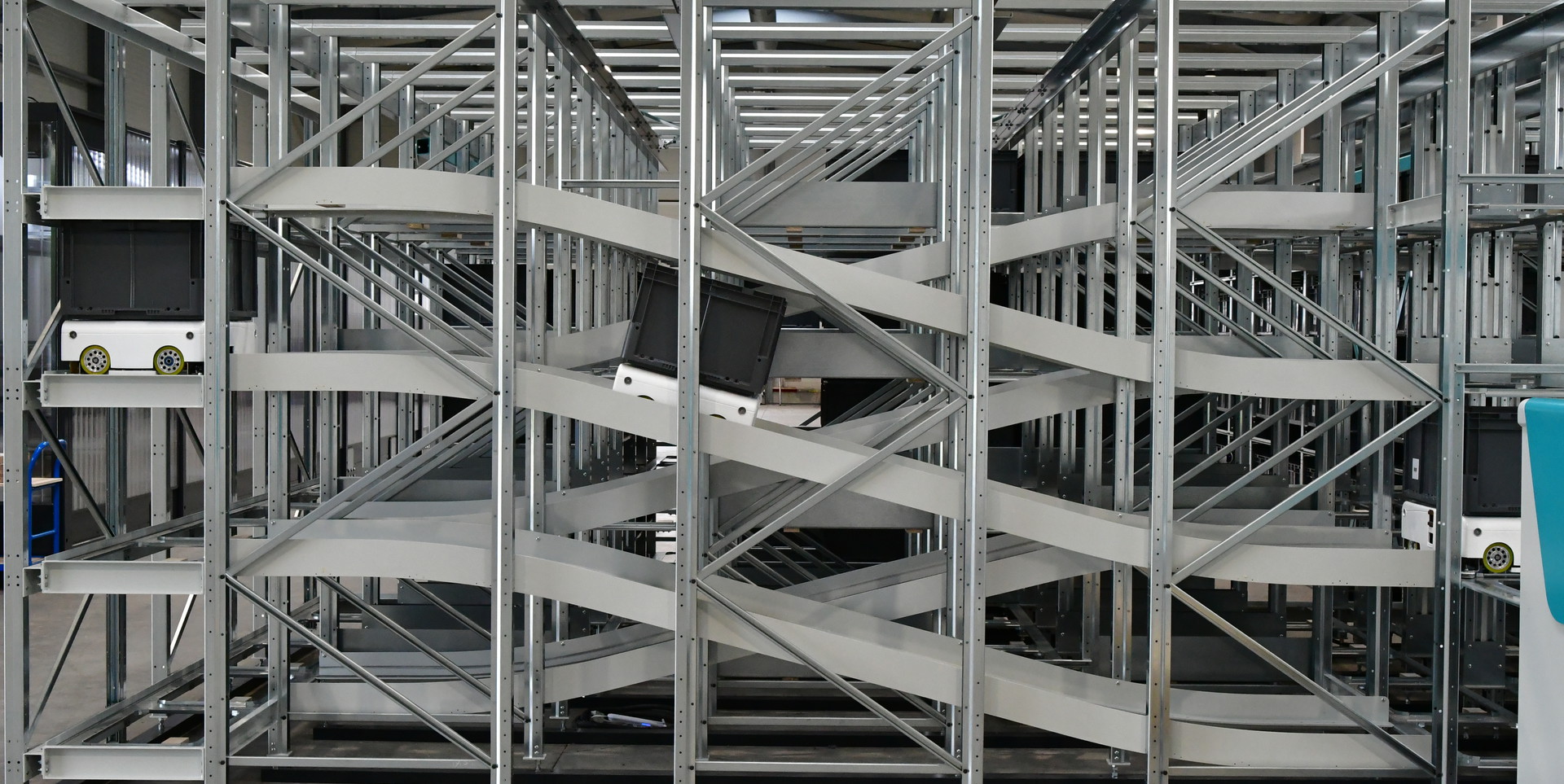
e.scala is a highly standardized, robot-based goods-to-person system that replaces all classic components of an automated warehouse system with one robot, thus enabling a realization time of only three months in addition to a significantly lower investment and running costs.

Product name and company
e.scala – robominds
Category
Stationary Robot / Robot Warehouse System
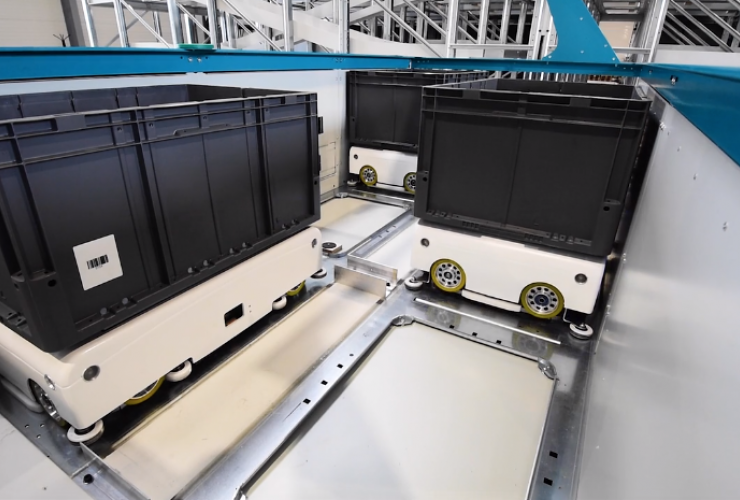
The e.scala is a robot-based storage and picking system, where the robot moves in three dimensions in a storage cube and reaches any point in a warehouse or production in an easy way via a rail system. A patented ramp system allows the robots to move from storage level to storage level as well as to overcome height differences outside the storage cube. Due to the high flexibility of the robots, multiple workstation variants can be mapped in a very simple way. This makes it possible to map almost any customer process requirement with standard modules.
The area of application for e.scala is in small and medium-sized installations with a focus on applications in e-commerce, production supply and microfullfilment solutions. The high level of standardization of the system makes it possible to automate even small requirements starting from 500 storage locations and thus enables full automation to be carried out significantly earlier than with classic systems.
The big innovation compared to existing systems is the simplicity of the overall system. Due to the consistent focus on only one automation component, no electrification is required in the entire storage area or for the entire material flow. As a result, the e.scala causes uniquely low maintenance and service costs.
On the one hand, the high level of standardization makes it possible to plan a complete system within a very short time and to deliver the 15 basic components of the storage system as well as the e.scala robot directly from stock. This enables an extremely fast delivery and implementation time. Incremental automation in capacity and performance is thus easier than with all existing systems.
In addition to simplicity, another important innovation is the accessibility of every container in the entire system via multiple paths. Availability is therefore uniquely high, even in the event of a robot breakdown.
The third major innovation is the flexible sequencing options. Sequencing is possible at three positions in the system. Each storage location can be redefined as a sequencing location, which greatly facilitates the preparation and consolidation of orders at the workstation level. The second possibility is to have a separate sequencer line, which is located in the pre-zone. This is used by the robots as a “short-term parking area”. The third option is located inside the workstation.
The demand for container-based automation solutions has risen continuously in recent years and will continue to increase in the coming years. This is due on the one hand to the continuing e-commerce boom and on the other hand to the pressure for further automation due to the lack of skilled workers. The total market is currently estimated at around € 20 – 30 billion.
In particular, the demand for small and medium-sized automation solutions has increased in recent years. For the automation of small plants, a low initial investment and easy scalability are important. The e.scala is designed exactly for this. With the e.scala it is possible to increase the competitiveness of e-commerce merchants and manufacturing companies within a very short time with a low investment. The flexibility of the system is so high that an extension or subsequent change of the system is not only possible in capacity and performance but also in the workstations.
The manufacturer stow robotics is coming to the IFOY TEST DAYS in Dortmund with a demo system of a classic goods-to-person shuttle system that has been transported in one piece from the truck to the test hall. The only moving part in the storage and order-picking system is the shuttle, which runs on rails and is called “Robot” at stow. Otherwise, the customer gets pure redundancy. The strength of e.scala lies where the entry into automation is concerned.
The USP of the installation is the fact that the complete system consists of only 15 different parts. However, only the “exciting” warehouse pre-zone is shown, with three lines to reach four levels in the warehouse. How the system works is also reflected in the product name: The “e” comes from escalator. And the “scala” is meant to demonstrate the scalability. And something else very special is immediately noticeable: The entire installation does without a vertical lift, i.e. without a lift: The individual aisles are accessed via inclined ramps, which considerably reduces the susceptibility to errors. The module at which the robot can change the direction of travel in order to move the goods to be transported into or out of the warehouse and, with or without the goods to be transported, to change levels, is called the “connector”.
In principle, the system resembles a multi-storey car park, although the actual order system is usually located outside the warehouse. The manufacturer places the highest value on the redundancy of the system: the only thing that can break, according to the manufacturer, is the robot. But it does not block the entire system. The manufacturer stow uses the 200-year-old concept of the railway. The transport robot has eight wheels: four for travelling in the X direction, the other four move the robot in the Y direction after the wheel change. Basically, the entire setup only needs electricity twice: once for the charging station where the individual robots can charge their power caps – with a charging time of eight seconds, by the way, they drive around for about twelve minutes – and once for the WiFi robot communication with the warehouse management system. This also means that there is no cable in the entire pre-zone.
The individual modules of the e.scala system are 5.0 metres x 2.5 metres in size and are scalable. The system can easily handle a total height of 24 metres. The Stow Traffic Control (STC) knows when the robot drives over the passive RFID tags installed in the respective section of the route. Some would call it a material flow system, others a warehouse control system.
e.scala is basically designed for use in small and medium-sized installations with a focus on applications in e-commerce, production supply and micro-fulfilment solutions. Because the system is standardised to a high degree, even small requirements from 500 storage locations to be automated can be well served with it. Because the 15 basic components of the system as well as the robot can be delivered directly from stock, a complete system can be planned and realised within a very short time. Even in the event of a robot breakdown, the availability of the system is extraordinarily high, because accessibility to each location in the system is ensured at all times via multiple paths.
The “charge on the fly” system of the robots, which can recharge their power caps at any time, guarantees the customer 100 per cent performance of this storage and order-picking system in 24/7 regular operation. Because low initial investment and easy scalability are of great importance for the automation of smaller facilities, e.scala is made for small or medium enterprises that do not want to “go all out” with their investment in automated intralogistics.
With e.scala, Stow robotics is targeting small and medium-sized container-based warehouse automation solutions based on the goods-to-person principle, which are currently in particular demand in the growth sectors of e-commerce, micro fulfilment and production supply. Economical use should be possible from 500 storage locations or 250 square metres floor space. e.scala has to compete with systems from Autostore and Exotec in this area. Market potential and relevance are expected to be high due to the system’s special features.
The ramp system for changing robots between storage levels makes it possible to dispense with lifts, rigid conveyor technology and electrification of the storage area, thus realising low system complexity with low investment, operating and maintenance costs. The standardisation allows a quick realisation and commissioning within only three months. The storage cube can be scaled quite freely in height, width and length and allows a certain flexibility in the choice between storage density and performance. Advantages over Autostore are the higher payload, faster response time, higher throughput and better redundancy. In certain configurations, even higher storage densities should be achievable.
The main innovation is the low system complexity due to the use of the ramps. The robots are the only actuated units in the warehouse framework, which means that the solution scales excellently at moderate costs. In addition, there is increased redundancy, as each container in the system can be accessed via multiple paths. Containers can be flexibly sequenced at three points in the system, but this is not an innovation compared to other systems. The loading management of the robots is excellently solved by supercaps, which are quickly recharged in 8 seconds for 12 minutes of operating time during the picking process, ensuring true 24 hours availability of the robots.
The functionality of the test system was successfully demonstrated. The robot with two-way trolley safely changed storage levels with and without load via the ramps. Apart from the integrated lifting function for picking up the boxes, the robots are kept simple and robust. Via the rail system, the robots can also perform sequencing in the pre-zone as well as travel to other areas of the building for production supply.
The specific customer benefit of e.scala is primarily for small and medium-sized systems that are to be realised quickly and cost-effectively due to the simplicity and standardisation of the solution. The system is technically simple and solidly constructed and impresses with its flexibility in the choice between storage density and performance, as well as with its comparably high redundancy even in the event of failure of individual robot units.
| Functionality / type of implementation | ++ |
| Novelty / Innovation | + |
| Customer benefits | + |
| Market relevance | ++ |
| ++ very good / + good / Ø balanced / – less / — not available | |
Image/video credits: robominds
Finalists undergo the three-stage IFOY Audit as part of the IFOY Audit, which takes place during the TEST CAMP INTRALOGISTICS. This consists of the scientific IFOY Innovation Check, the IFOY Test and the jury test.
In den Statuten sind die Grundwerte und die Standards des IFOY AWARD festgelegt, nach denen die Organisation handelt. Dazu gehören unter anderem Gremien, Wahlomodus, Bewertungskriterien sowie der Code of Conduct.
The International Intralogistics and Forklift Truck of the Year has three bodies: Jury, sponsors, and advisory board.