

IFOY Audit
Finalists undergo the three-stage IFOY Audit as part of the IFOY Audit, which takes place during the TEST CAMP INTRALOGISTICS. This consists of the scientific IFOY Innovation Check, the IFOY Test and the jury test.
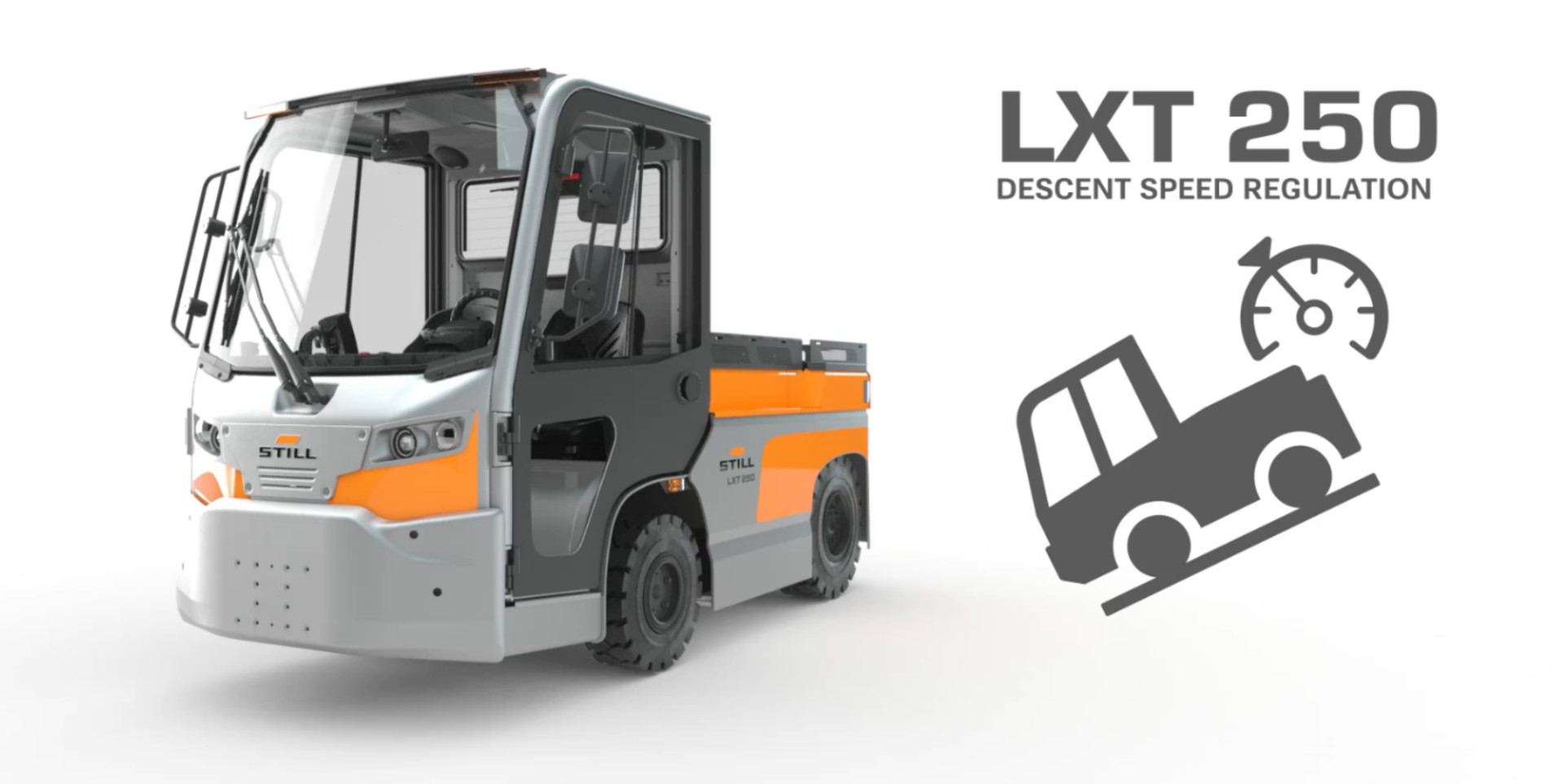
STILL Descent Speed Regulation (DSR) is a three-stage assistance system for platform trucks and tractors which facilitates safe descent for the driver, especially with heavy trailer loads. Depending on the configuration, it manually or automatically regulates the speed of the vehicle to a value that can prevent dangerous situations.

Product name and company
DSR (Descent Speed Regulation) – STILL
Category
Special of the Year
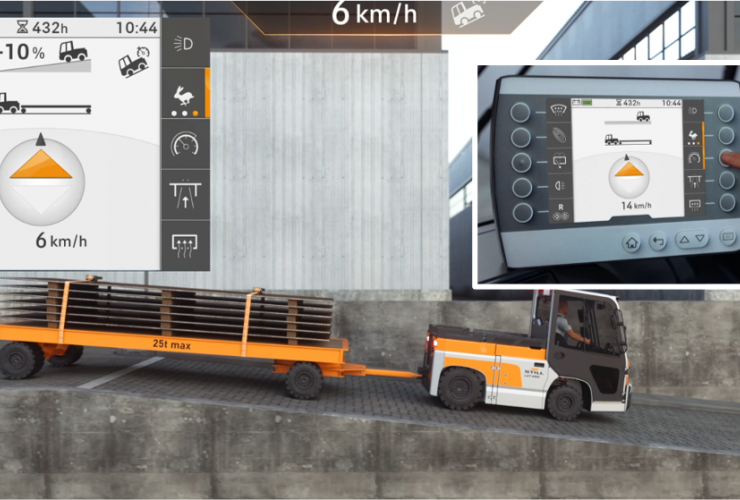
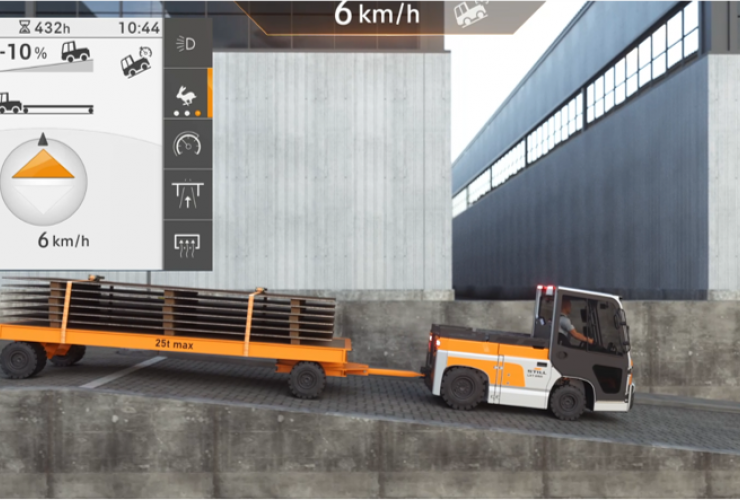
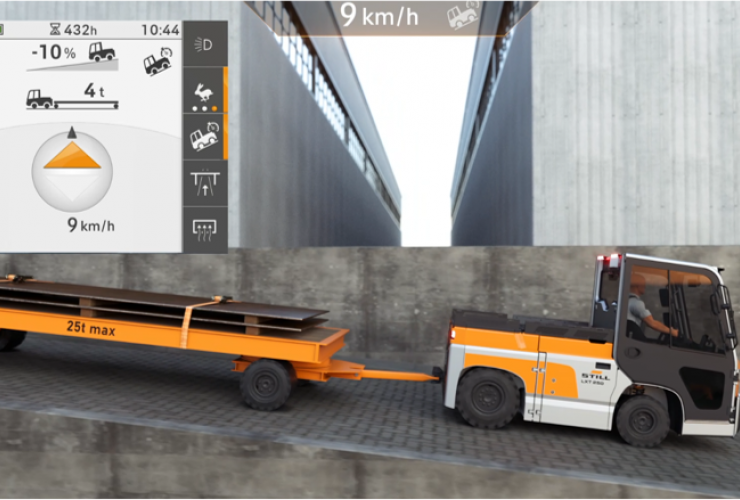
DSR is an assistance function that supports operators of towing and transport vehicles in their daily work. Especially when driving downhill, there is a risk of dangerous situations. DSR can prevent these.
The first configuration level is DSR Basic. Here, the driver must activate the system manually via the STILL Easy Control operating unit. When activated, a previously set maximum speed is maintained, even when driving downhill. The hydraulic service brake is actively engaged if the vehicle threatens to become too fast when travelling downhill. Even if the driver does not step on the brake pedal, the vehicle is braked.
The second configuration level is DSR Eco. In this configuration, the system does not have to be activated manually, but is always on stand-by in the background. The system activates automatically when a slope is detected. With DSR Eco, a gradient indicator is continuously shown in the display. The speed is limited to one predefined value when a slope is detected.
The third configuration level is DSR Premium. Here, in addition to DSR Eco, the load weight is estimated and shown on the display. With DSR Premium, the vehicle regulates the speed when driving downhill depending on the slope and the towed load. So, the speed is not set to a predefined value, but to the appropriate value for the respective situation. This allows for optimum performance coupled with maximum safety at all times.
STILL’s new tractors and transport trucks are equipped with maintenance-free, hydraulic oil-bath lamella brakes on the front and rear axles. The intelligent dual-circuit brake system is controlled electro-hydraulically. The brake on the front axle is designed as a brake-by-wire system. The braking request is recorded on the brake pedal via a potentiometer and the braking is initiated hydraulically by actuating an electric pressure-reducing valve. The electrical control of the pressure valve enables not only very precise braking but also the active intervention of assistance systems in the service brake. This technical design enables the DSR system to regulate speed when driving downhill – even without active intervention by the driver.
The DSR is activated either by a manual keystroke of the operator (DSR Basic), or by a detected inclination of the ground, through the evaluation of an acceleration sensor and gyroscope (DSR Eco and Premium).
With the third configuration level (Premium), the approximate weight of the load is also determined, and the maximum speed is limited depending on the load and inclination. The inclination and load are estimated by evaluating the speeds and torques of the drive units and data from an acceleration and rotation rate sensor.
Dangerous situations when driving downhill are among the most frequent causes of accidents and impact damage in connection with towing and transport vehicles. Therefore, assistance systems such as the Descent Speed Regulation are of great relevance in towing and transport operations.
DSR is of great advantage wherever there are many inclines in the company infrastructure, for example to get from one hall to another, or if there are large differences in height in the topography of the customer’s premises. This makes the Basic system interesting for a large number of customers. The DSR assistance system is independent of the application, so it does not matter what is being towed.
Depending on the steepness of the slope and the towed load, the Eco or Premium variant will be relevant for about 50 percent of the vehicles.
There are various risks, if longer distances have to be covered on sloping terrain on the company premises or in operation. The driver continuously presses the service brakes until they run hot; the driver is briefly inattentive and applies the brakes a moment too late, so that the load pushes the towing vehicle to an ever faster speed as it descends beyond the power of the engine brake. The driver must keep the vehicle under control and thus brake carefully, but nevertheless energetically, to prevent, for instance, instability of the attached load carriers or jackknife situations.
It is often very difficult for the drivers of towing vehicles and platform trucks to determine the current slope of roadways unaided. Also, the weight of the load being towed usually cannot be realistically estimated unless it is marked. This is where the DSR supports the driver. With the third configuration level (DSR Premium), it provides the driver with both the current inclination angle as well as the current load weight. Based on this information, the driver can adjust his driving behaviour. The driver is actively supported by the Descent Speed Regulation, which automatically reduces the vehicle’s speed even if the driver fails to do so due to carelessness or misjudgement.
With the Descent Speed Regulation, DSR for short, Still introduces a unique assistance system for trucks and tuggers that facilitates safe driving on ramps even with heavy trailer loads. The system monitors and regulates the speed of the vehicle – manually or automatically, depending on the configuration. There are three different versions: DSR Basic, DSR Eco and DSR Premium.
With DSR Basic, the driver activates the system manually via the Still Easy Control operating unit. When activated, a preset maximum speed is maintained, even when driving downhill. The hydraulic service brake is actively activated as soon as the vehicle threatens to go too fast when going downhill. Even if the driver does not depress the brake pedal, the vehicle brakes. DSR Eco goes one step further. In this version, the programme does not have to be activated manually, but is always on stand-by in the background. It is activated automatically when an angle of inclination is detected.
The slope and load are calculated by evaluating the speeds and torques of the drive units and the data from an acceleration and speed sensor. With DSR Eco, a slope indicator is constantly shown on the display. If an incline is detected, the speed is automatically limited to a preset value.
The luxury version, DSR Premium, was nominated for the IFOY AWARD. Here, in addition to DSR Eco, a load evaluation is also carried out and shown on the display. With DSR Premium, the vehicle regulates its speed when driving downhill depending on the gradient and the load being towed. The speed is therefore not reduced to a predefined value, but optimally adapted to the respective situation. In this way, the vehicle always achieves the best possible performance with maximum safety.
The maintenance-free, hydraulic oil-bath brakes on the front and rear axles operate electrohydraulically. The brake on the front axle is designed as a brake-by-wire system. The brake demand is registered via a potentiometer on the brake pedal, whereupon the braking process is initiated hydraulically via an electric pressure-reducing valve.
The electrical control of this pressure valve makes it possible to brake very precisely and also to actively intervene in the service brake. Thanks to this technical concept, the DSR system can regulate the speed when driving downhill – even without active intervention by the driver.
DSR reduces the need for the driver to apply the brakes and thus the risk of overheating. In addition, the system monitors driving behaviour, which significantly reduces the risk of unsafe situations.
Still Descent Speed Regulation (DSR) is a world first. The unique assistance system supports safe driving on inclines and improves driving characteristics at the same time. Depending on the version, DSR recognises the exact gradient and the current load weight. The speed is then automatically adjusted to the respective conditions. Pulling sometimes heavy loads becomes much safer with this system.
The development of the Descent Speed Regulation (DSR) supports very well the increasing safety requirements of the users and helps to prevent consequential costs due to negligent driving behaviour. The possible effects of exceeding the maximum permissible speed of heavy tow trains are high and therefore actually justify a very high market relevance. It should be noted, however, that inclined tracks for tow trains are not very widespread and the development of DSR does not have to be applied everywhere.
The indisputable benefit results from the safe and reliable detection of steep sections and the load-dependent reduction of speed. Systems for general speed reduction lead to a loss of throughput and to a reduction in the motivation of drivers, who feel patronised by such a system and may switch it off. The increased safety for the driver, but also for uninvolved road users, is just as high as the consequential costs for vehicles or the transported goods due to serious accidents. The benefit is limited at best, since material flow planning already tries to avoid downhill stretches, which is why they occur comparatively rarely in the field of application.
The safe and reliable detection of both the inclined sections being travelled on and the attached load has never been solved in a comparable way before. The successful combination of existing sensor principles and measuring sections as well as their evaluation in a computer unit, together with a powerful actuator system, result in a very good innovation.
The aforementioned recognition and evaluation of the driving characteristics leads to an impressive driving behaviour, which could be experienced in a comprehensible way on a driving route with a 10 per cent gradient. The driver information display shows the driving mode and the determined parameters and thus makes the behaviour of the assistance system easy to understand.
The product provides an innovative solution to avoid accidents by determining the actual towing weight and the actual inclination of the driving path. It is not relevant for all users, but helps safely and well on existing downhill stretches.
| Functionality / type of implementation | + |
| Novelty / Innovation | ++ |
| Customer benefits | + |
| Market relevance | + |
| ++ very good / + good / Ø balanced / – less / — not available | |
Image/video credits: STILL
Finalists undergo the three-stage IFOY Audit as part of the IFOY Audit, which takes place during the TEST CAMP INTRALOGISTICS. This consists of the scientific IFOY Innovation Check, the IFOY Test and the jury test.
In den Statuten sind die Grundwerte und die Standards des IFOY AWARD festgelegt, nach denen die Organisation handelt. Dazu gehören unter anderem Gremien, Wahlomodus, Bewertungskriterien sowie der Code of Conduct.
The International Intralogistics and Forklift Truck of the Year has three bodies: Jury, sponsors, and advisory board.