

IFOY Audit
Finalists undergo the three-stage IFOY Audit as part of the IFOY Audit, which takes place during the TEST CAMP INTRALOGISTICS. This consists of the scientific IFOY Innovation Check, the IFOY Test and the jury test.
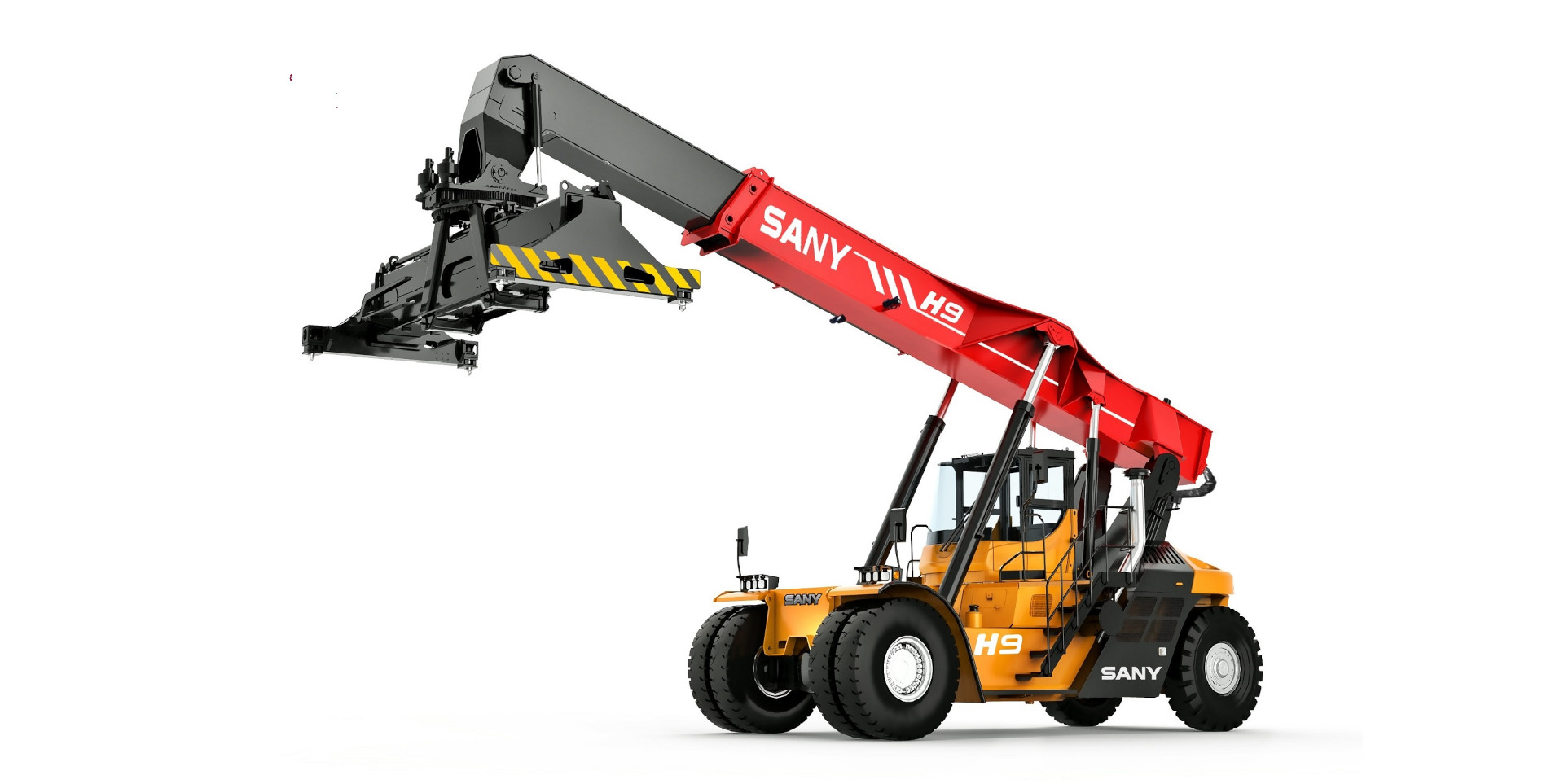
The SRSC45H9A Hybrid Reach Stacker features a hybrid system which focuses on lifting and lowering the boom with spreader. Faster lifting of loads moves more containers per hour and it consumes less fuel. Coupled with weight savings from the novel spreader design and a more efficient transmission, this saves approximately 15 percent machine-related costs per container handled.


Product name and company
SRSC45H9 Hybrid Reach Stacker – Sany Europe
Category
Heavy Load Forklift and Special Vehicle
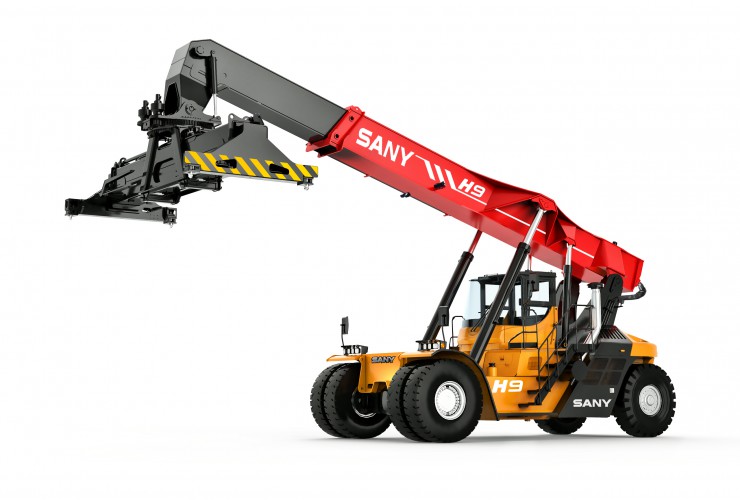
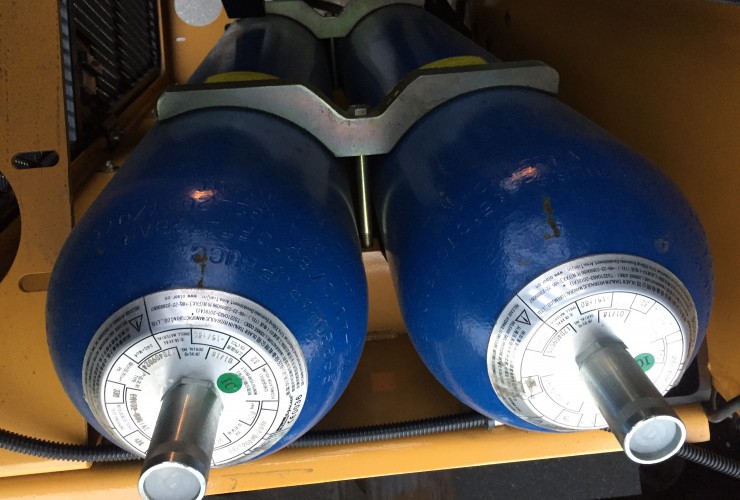
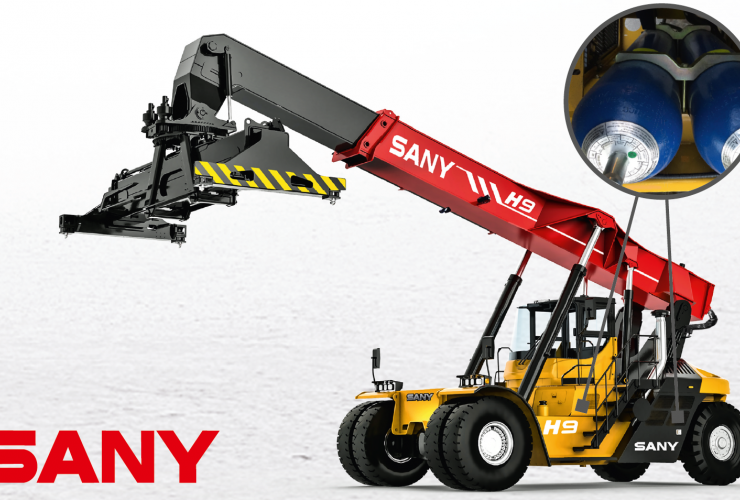
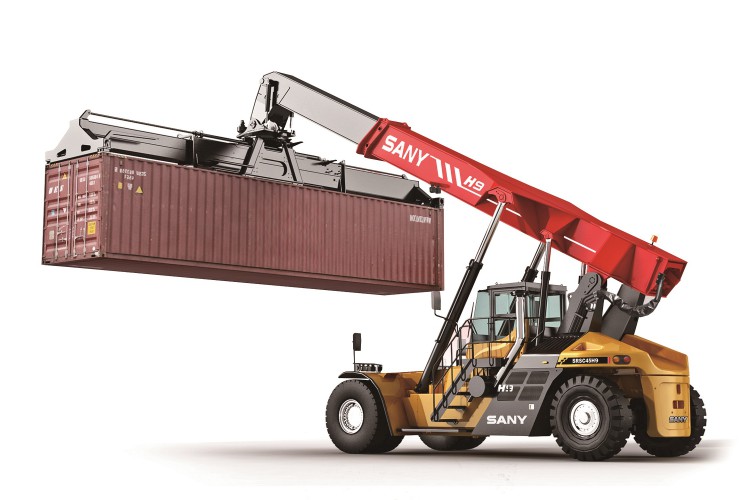
The SRSC45H9A Hybrid Reach Stacker delivers 15 percent overall machine cost saving, achieved by more container moves and less fuel per hour. Technically, this is realized by the energy recovery, weight reduction and improved transmission efficiency.
Energy recovery – hybrid system for the boom
Weight reduction of 3 respectively 4 t
Efficient transmission
Hybrid system for the boom
Weight reduction
Drive-train
Reach Stackers are becoming increasingly important for large, medium-sized and small logistics companies in the growing container handling sector. The machine costs per container-move are considerable. Fuel consumption and tyre wear are the largest variable costs of a Reach Stacker.
Causalities:
The SRSC45H9A reduces machine costs by 15% per container handled through the benefits of more container moves and lower diesel consumption.
More container handling by bundling the 3 technical measures of hybrid system, weight savings and more efficient drive train. Machine costs are spread over more containers.
The SANY SRSC45H9A Hybrid Reach Stacker moves more container per hour with lower fuel consumption and lower overall machine costs. In less than 2 years a customer reaches the break-even point for the investment of the SANY Hybrid Reach Stacker compared to a standard SANY Reach Stacker.
Benchmark-test of the Hybrid Reach Stackers against standard SANY Reach Stackers on test site:
19 – 21 percent diesel savings per container.
A) Stacking and short travel: 23 percent more containers, 4 percent less diesel per hour:
21 percent diesel savings per container
B) Stacking and long routes: 9.5 percent more containers, 11.5 percent less diesel per hour:
19 percent diesel savings per container
Customer application in Antwerp: diesel consumption of only 10.8 to 12.5 l/h
Further advantages:
Performance:
Ergonomics:
Durability and safety:
Sany Europe’s new SRSC45H9A Hybrid Reach Stacker offers lifting capacities in first, second and third row of respectively 45, 31 and 15 tonnes. As a result of innovative technologies, productivity increases and costs per container are reduced. According to Sany, productivity gains amount to no less than 15 percent compared to the manufacturer’s standard machine. In addition, fuel consumption is reduced by 20 percent.
The gains are largely due to a hybrid system focussing on lifting and lowering the boom with spreader. Two additional lifting cylinders are connected to accumulators which store (pressured) energy that is released when the boom is lowered. In a direct power flow the energy is released to additional lift cylinders for boom lifting. The hybrid system acts parallel to the main lift cylinders and delivers up to 70kW additional power. Power that no longer needs to be supplied by the diesel engine, which can now use its energy for other tasks, increasing productivity. The system has already been proven in other sectors and, as far as the test team knows, is now being used for the first time in this type of trucks.
The main lift cylinders are slimmer, allowing faster lifting, with less engine power and lower energy consumption. At full load the gain in lifting speed is 13 percent, according to Sany.
By using a single tube instead of a double tube spreader a weight reduction of 1 to 2 tons has been achieved. The use of single tubes is known from the empty container handling, but is new for the laden container handling. An additional weight saving has been achieved on the boom head and the counterweight. In practice, this results in less fuel consumption. Furthermore, as a result of the lower weight and the optional movable counterweight, the lifting capacity on both the second and third row increases by one ton. The reach stacker has a 5 instead of 4 container stacking-height in 2nd row.
The IFOY Test does not provide a test course for this type of truck, but Sany’s own tests show that productivity (containers per hour) increases by up to 23 percent and fuel savings by up to 11.5 percent. Converted to fuel savings per container, this profit is about 20 percent.
During the impression of the IFOY test truck, the comfortable cabin catches the eye. The cabin is designed to facilitate the driver’s natural range of movement. Frameless windows provide the operator with an unrestricted view around the working environment. The sliding function of the cabin enables the driver to find the most appropriate position for the handling job in-hand. The Grammar seat is fully adjustable and is available with air suspension. The steering wheel can be adjusted easily, so the operator can find one of any number of positions for complete comfort. Sound insulation exceeds the highest industry standards, providing even more comfort and resulting in lower operator fatigue.
A wide variety of equipment features is already provided in the standard machine, e.g. hydraulically movable cab, reversing camera, air conditioning, responsive joystick control, modern colour display and the adjustable steering column. The rear-facing camera is automatically activated when the reverse gear is engaged. The display in the control panel provides an unrestricted view.
With the SRSC45H9A Hybrid, Sany puts a reach stacker on the market that meets today’s high demands. Various innovative technologies provide direct benefits to the user, both in terms of productivity and fuel consumption.
In container handling, reach stackers are an essential part of the process. An increase in efficiency in this area due to the savings that have been achieved represents a high market relevance. Due to the high volume of containers handled worldwide, the implemented innovation can have a great effect in terms of saving resources and costs.
The greatest and direct benefit for the customer is the saving in costs per container being handled. Sany has proven through systematically conducted tests in real handling scenarios that the stated cost savings of approximately 15 percent per container are achieved. This is made possible by an increase in handling performance with a simultaneous reduction in diesel consumption. Depending on the exact conditions at the customer’s premises, the additional expenditure compared to the standard machine is amortized in a relatively short time (approximately one year). In addition, the product convinces with higher load capacities, resulting from material savings at the spreader and boom as well as an extendable counterweight. All-round visibility is guaranteed in the spacious, movable cabin and by assistance systems.
The machine shows that innovations do not necessarily have to be complicated. A technology of hydro-pneumatic accumulators known from related fields was used and applied in the right place. The energy from the lowering movement is stored directly without efficiency-reducing conversion processes and supports the next lifting process. The accumulators are dimensioned sufficiently large so that an almost constant lifting support is achieved. The energy saving is supported by the change from a 4 to a 5-speed transmission, which is basically not a new insight. All this in combination with an additional new spreader and boom design, which has resulted in considerable weight savings, the overall concept of this reach stacker is a very successful innovation, although the technologies used in itself are not new.
The implementation of energy recuperation is excellent and appears to be very good in dimensioning and component arrangement. The modified design of the spreader as well as of the boom is in line with the load and thus utilizes the potentials of the steel structure. The integrated assistance systems are convincing in a functional cabin with a very good overview and simple operation.
| Functionality / type of implementation | ++ |
| Novelty / Innovation | + |
| Customer benefits | ++ |
| Market relevance | ++ |
| ++ very good / + good / Ø balanced / – less / — not available | |
Image/video credits: Sany Europe
Finalists undergo the three-stage IFOY Audit as part of the IFOY Audit, which takes place during the TEST CAMP INTRALOGISTICS. This consists of the scientific IFOY Innovation Check, the IFOY Test and the jury test.
In den Statuten sind die Grundwerte und die Standards des IFOY AWARD festgelegt, nach denen die Organisation handelt. Dazu gehören unter anderem Gremien, Wahlomodus, Bewertungskriterien sowie der Code of Conduct.
The International Intralogistics and Forklift Truck of the Year has three bodies: Jury, sponsors, and advisory board.