

IFOY Audit
Finalists undergo the three-stage IFOY Audit as part of the IFOY Audit, which takes place during the TEST CAMP INTRALOGISTICS. This consists of the scientific IFOY Innovation Check, the IFOY Test and the jury test.
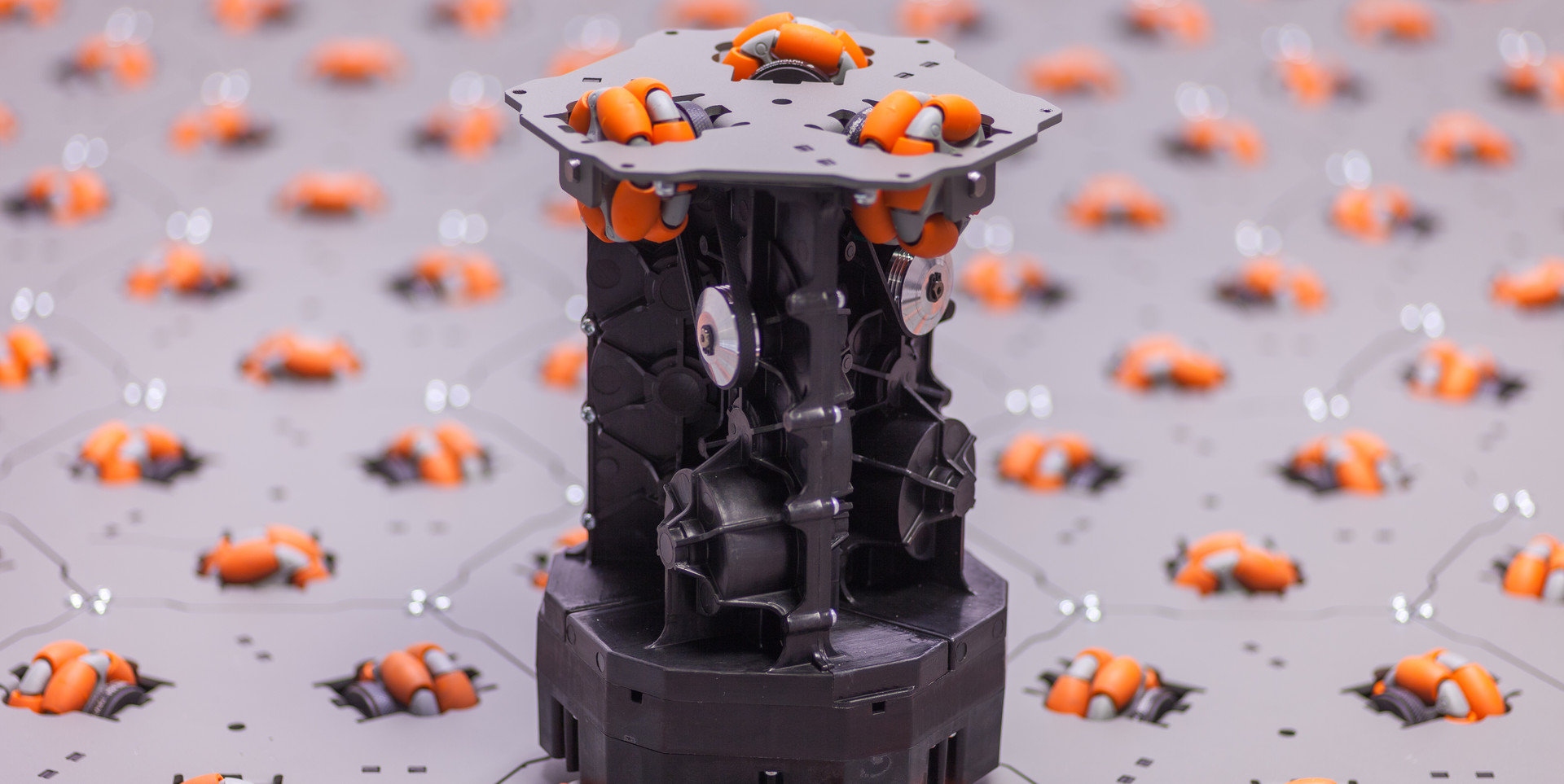
We have turned soccer robots upside down and with their wheels we freely move packages in any direction: A celluveyor consists of several hexagonal cells that can be clicked together like LEGO® bricks to form any system layout. The celluveyor can realize all tasks of conveyor technology and the function is solely defined by the software. Clients can adapt material flow systems at any time at the push of a button, achieve enormous space savings and are able to easily create new processes.
Product name and company
celluveyor – cellumation
Category
Special of the Year
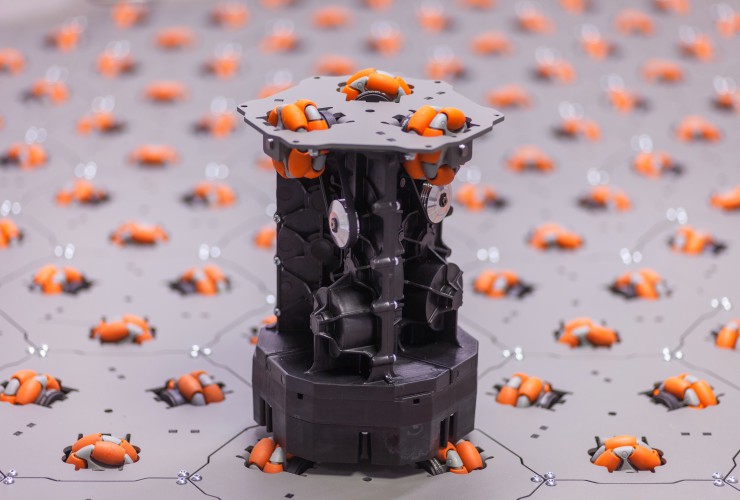
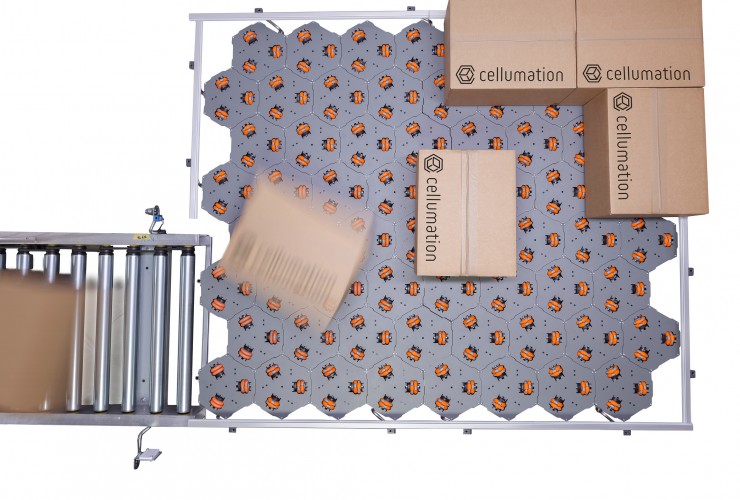
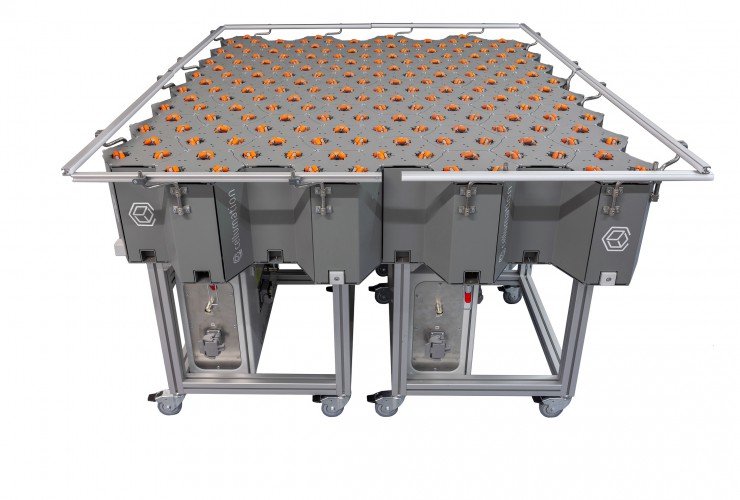
A celluveyor is a modular material flow system consisting of hexagonal cells, which can be assembled to any layout. On the celluveyor surface, packages can be moved and positioned flexibly thanks to omnidirectional wheels. Thus, even complex material flow tasks can be realized – for example, the celluveyor can receive individual packages and form layers for automatic palletizing systems.
Complex applications become a piece of cake for customers: the celluveyor can be programmed and configured by installing new software – similar to apps on a smartphone. No programming knowledge is required and anyone who can use a smartphone can control a celluveyor system.
The technology can be used in all stations of a material flow chain where a more complex movement than simply “straight ahead” is required. Especially logistics centers, but also production centers, in which packages are moved, are the main operation area for the celluveyor. The celluveyor can also be optimally used by machine manufacturers who transport or process plate-like material such as wood, glass or metals.
The celluveyor cell is the central element of the technology – it is always identical regardless of the application and can be produced in large quantities. Thus, very high scaling effects are achieved.
Conventional material handling systems are designed to perform a specific function and provide optimum performance at peak loads. Most conventional conveyor systems move objects in predefined paths. Such systems consist of hundreds of components for linear movement and nodes for all special functions (such as rotation). To cover peak volumes efficiently and reliably, systems are often built larger than they need to be. They are “reliable workhorses” for relatively simple, unchanging tasks. However, they cannot provide the multifunctionality and flexibility required today. They are therefore very inflexible, capital-intensive, take up a lot of space and require a lot of spare parts.
In contrast, the celluveyor is a modular, multi-functional material flow system that represents a completely new approach: instead of a rigid, mechanical conveyor belt designed for a single, unchanging task, the celluveyor can be (re)configured with a few clicks at the touch of a button – rotation and linear movements are “mechanically decoupled” and are controlled solely by software. The celluveyor requires up to 95 percent less space than conventional material flow systems and the spare parts are reduced to a single element: the cell. Compared to traditional systems, it is more flexible, less expensive and can be delivered at short notice.
The main growth driver in this market is e-commerce and associated changes in customer purchasing behaviour. This growth is expected to continue – for the five years 2018-2023 at a CAGR of 17 percent to €5.9 billion in global e-commerce retail sales.
The relevant market for the celluveyor is the market for material flow technology. Industry sources estimated the size of the relevant global subsegment of continuous conveyors at € 33.5 billion in 2016 (of which EU: € 13.2 billion) and forecast significant growth (CAGR 9.9 percent). Manufacturers and logistics companies are the main customers for material flow systems, with the main target group being system integrators who install complete systems for manufacturing and logistics companies. Secondary target groups are logistics operators, OEMs and manufacturers. cellumation has already successfully implemented various pilot projects with key customers, several systems are in industrial use and the sales pipeline is filled.
The main advantages for the customers are:
The provision of totes, cartons and boxes as part of the palletizing process as well as the breaking up of layers during depalletizing are of great interest for a wide range of applications in industry and trade.
With its celluveyor product, Cellumation offers a solution which is very extensively modularised and thus allows a high degree of standardisation with a high degree of flexibility. Free movements are possible and system tracks charges by itself. Interventions and disturbances can also be intercepted in a far-reaching robust manner.
Especially the modular design is innovative and due to the cooperation of the modules almost free surface movements of the containers can be carried out. Due to the high degree of standardization, even failed modules can be replaced very easily and do not have to be readjusted or put into operation afterwards.
The conveyor is robust and suitable for industrial use and makes a very high-quality impression both visually and technically. However, the applications are limited to (layer) palletizing and depalletizing, so that the economic importance and the wide application cannot be estimated.
Very innovative conveying principle with high flexibility. The system achieves an impressive performance – even with manual intervention as a “malfunction”. The system is space-saving.
All in all, the application possibilities are limited. Probably the system is difficult to use economically.
| Functionality / type of implementation | ++ |
| Novelty / Innovation | ++ |
| Customer benefits | + |
| Market relevance | + |
| ++ very good / + good / Ø balanced / – less / — not available | |
Image/video credits: cellumation
Finalists undergo the three-stage IFOY Audit as part of the IFOY Audit, which takes place during the TEST CAMP INTRALOGISTICS. This consists of the scientific IFOY Innovation Check, the IFOY Test and the jury test.
In den Statuten sind die Grundwerte und die Standards des IFOY AWARD festgelegt, nach denen die Organisation handelt. Dazu gehören unter anderem Gremien, Wahlomodus, Bewertungskriterien sowie der Code of Conduct.
The International Intralogistics and Forklift Truck of the Year has three bodies: Jury, sponsors, and advisory board.