

IFOY Audit
Finalists undergo the three-stage IFOY Audit as part of the IFOY Audit, which takes place during the TEST CAMP INTRALOGISTICS. This consists of the scientific IFOY Innovation Check, the IFOY Test and the jury test.
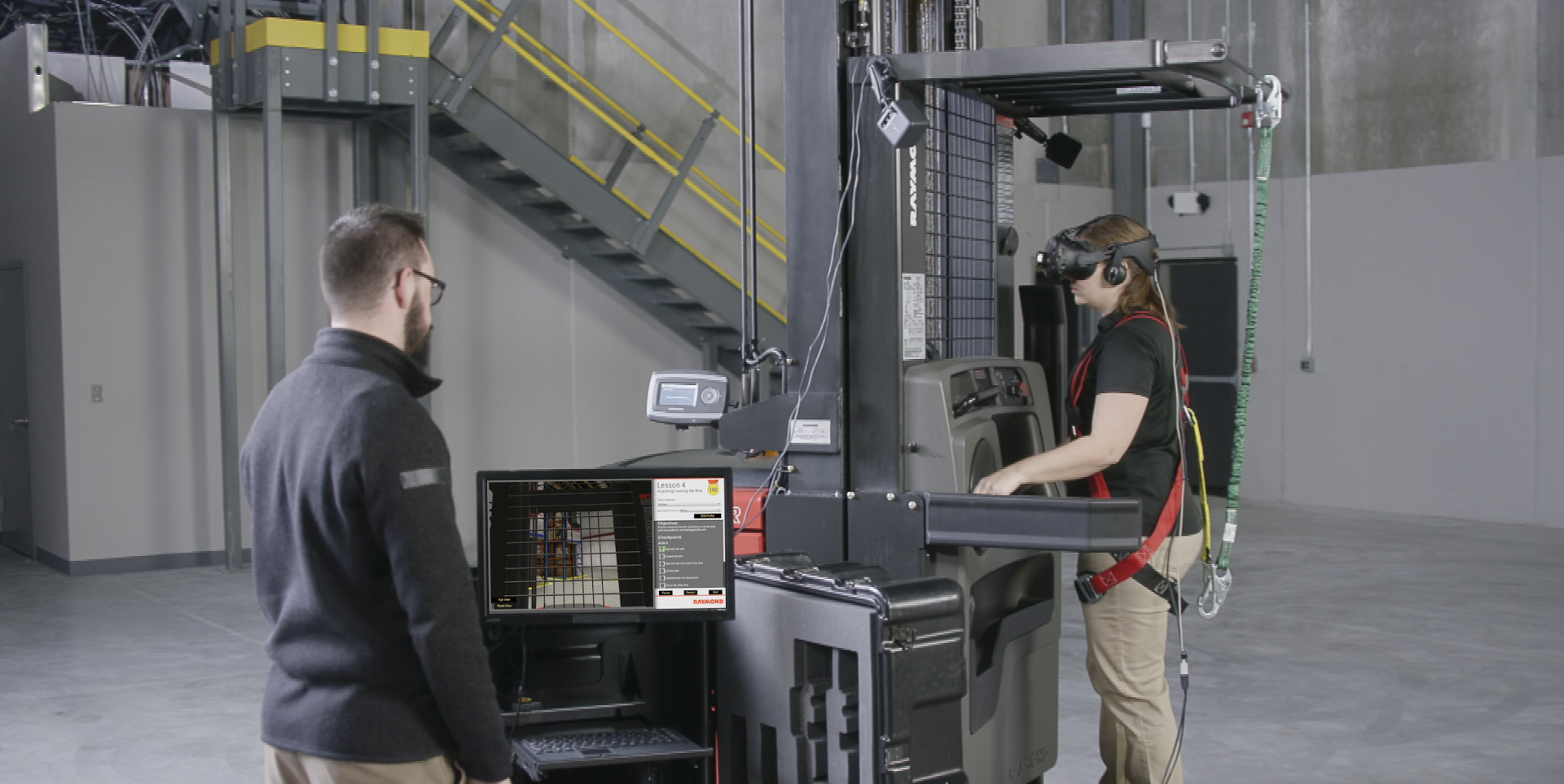
The Raymond Virtual Reality Simulator provides advanced, hands-on instruction that is designed to improve operator skills and build confidence as well as help retain employees and keep them learning. This tool helps companies attract new talent to the industry, reach higher proficiency levels, provide progressive coaching and reteaching on areas that require more attention, and increase overall productivity.


Product name and company
The virtual reality simulator from Raymond – The Raymond Corporation
Category
Special of the Year
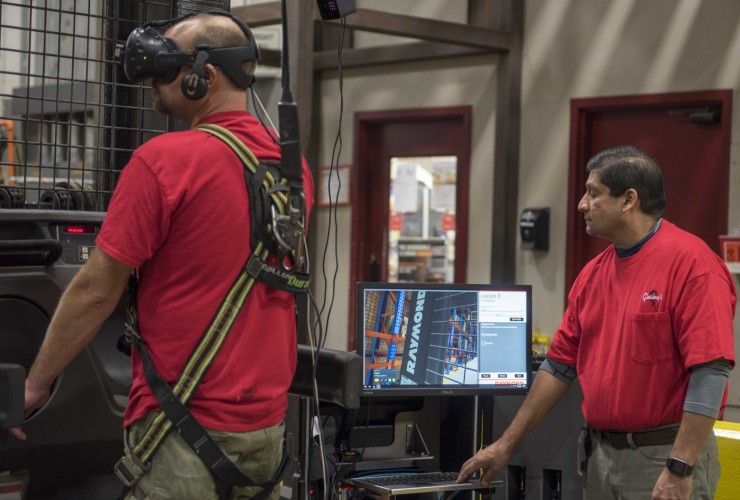
The Raymond Virtual Reality Simulator is specifically designed to educate employees on forklift best practices as well as review and enhance current employees’ skill sets — ultimately leading to a more productive workforce and warehouse. An industry first, the tool is used on an existing Raymond® forklift and plugs into the company’s patent-pending sPort (Simulation Port) to create an immersive learning environment for operators.
Under the guidance of a certified instructor, operators progress through a series of standardized lessons within a controlled virtual environment — all while using and learning on the actual controls of the Raymond truck.
The VR lessons, preloaded by truck model, increase in complexity to build upon principles learned in earlier lessons and assist in providing the user with consistent, quality instruction — while reinforcing desired behaviors.
The Raymond Virtual Reality Simulator offers:
Launched in January 2018, the Raymond Virtual Reality Simulator allows operators to learn in a virtual environment, under the guidance of a certified instructor, while using an actual truck and controls by plugging into Raymond’s patent-pending sPort, or Simulation Port — unlike any competitor’s offerings today. By using a truck that is already part of an existing fleet, companies don’t have to invest in additional equipment that can take up warehouse or distribution center floor space.
Through the simulated environment, operators are taken through a series of standardized lesson modules offered on six different truck models, with only one simulation kit required.
The progressive coaching tool allows operators to learn the skills needed to not only operate a forklift but also manage various types of scenarios that can occur in a warehouse environment. The VR software can simulate scenarios that prepare operators for the unexpected, helping operators familiarize themselves with conditions in the warehouse environment and work through them in a controlled setting rather than experiencing them for the first time on the actual floor.
The Raymond Virtual Reality Simulator also provides a comprehensive picture of operator performance as they progress through the modules. When evaluating which operator may be right for a specific task, having standardized reporting can help managers make data-based decisions on who is best suited for the job.
Some of the biggest challenges the U.S. manufacturing industry is facing are the skills and labor gap and e-commerce demands. Technology like the Raymond Virtual Reality Simulator can help narrow the skills and labor gap by providing a lifelike job experience to uninitiated lift truck operators before they start operating in a warehouse, affording them a real-world experience before entering a busy facility. The Raymond Virtual Reality Simulator makes it easier for lift truck operators to more readily understand what a material handling job entails, by providing early exposure in a static environment on a truck using the actual controls.
This VR learning experience is especially helpful during a time when there are more manufacturing jobs available than there are workers to fill those positions, in part because of negative images of manufacturing and lack of applicable skills. Well-instructed lift truck operators who stay on the job and are given the tools to work efficiency and effectively can help increase their company’s productivity.
In addition, manufacturing executives believe the greatest impact of the skills shortage will be in maintaining or increasing production levels — in line with customer demand — and implementing new technologies while achieving productivity targets. This is especially impactful when consumers are demanding extremely fast — sometimes within 24 hours — product deliveries. And e-commerce is showing no signs of slowing down.
Customer benefits:
User benefits:
Working with and driving a lift truck or warehouse truck requires craftsmanship. That has so far been taught in special training centres or in practice. However, there is still the risk of injury, or damage to the truck, building or goods. In addition, the trucks are of course subject to maintenance.
With the Raymond Virtual Reality Simulator the company offers a solution to learn this craftsmanship in a safe, but very realistic environment, or to improve the skills and confidence of drivers. Without all the risks and costs of before.
The VR Simulator is linked to a real truck, with exact operation as in practice. However, the training (or testing) of the driver takes place in a virtual, simulated environment. Obviously under the supervision of a certified instructor. The simulator is connected to the company’s sPort (Simulation Port), for which a patent has been applied for. The advantage of using an existing serial truck is that there is no need to invest in extra equipment or extra space.
For the time being, the simulation kit is available for six truck models, all from the Raymond product line. During the IFOY TEST DAYS, the solution is presented for the brand’s high lift order pickers and reach trucks. For the order picker, nine standardized training modules are available. The reach truck driver can be trained and tested on 23 different skills.
The Raymond VR Simulator gives a detailed picture of the operator’s performance. Not only whether the truck is properly operated, but also whether the operator stays within the contours of the truck. These performances can be analysed directly on site. In the opinion of the IFOY testers, this feedback certainly helps to improve the driver’s performance. By recording the performance, it is possible to later train exactly those elements that require more care.
Based on the collected data, a standardized report is also compiled. This helps in assessing the operator’s skills and identifying areas for improvement. In performance reports, the progress of each individual driver can be documented.
Moreover, the use of the system proves to be very simple in practice. By putting on a headset with VR glasses (also suitable for spectacle wearers) you can actually get started. The IFOY test team has taken various courses and concludes that the Raymond Virtual Reality Simulator is a very realistic and enjoyable way to learn and/or test the craftsmanship in a safe, virtual environment. The fact that the actual operation is used, definitely reinforces the solution. Looking around in the warehouse from the workplace when working with the order picker at height is downright impressive.
With the Raymond Virtual Reality Simulator, the American brand (part of Toyota) offers a very practical and realistic way to train and maintain driving and operating skills in a safe way. By using standard trucks, the operation seems and feels lifelike. Those who then work in practice know exactly how to operate the truck. It is to be hoped that this technology will not be reserved for trucks on the American continent.
The customers of simulators for the training and education of industrial truck drivers include both companies that operate industrial trucks and service companies that train drivers. In this respect, the market for training simulators for industrial truck drivers is very large. However, Raymond’s simulator is only useable for operators of Raymond industrial trucks. Therefore only a very small submarket can be reached with the product presented, so the market relevance is estimated as low.
The Raymond simulator offers two important benefits for operators of Raymond industrial trucks: First, they do not need a special platform with the controls to replicate the driver’s environment. The Raymond simulator uses the existing industrial truck for this purpose. This reduces the cost and effort of purchasing and commissioning the simulator. Secondly, the trainee learns how to operate the industrial truck, which he or she will later also use in everyday operations. For the second potential customer group, the training service providers, there is the advantage of a mobile driver platform. On the other hand, there is the disadvantage that the trainee is specially trained to operate Raymond industrial trucks. A fundamental disadvantage of the Raymond simulator is the missing motion system. Training simulators from competitors offer at least a small amount of simulation of vehicle movement by tilting the driver’s platform around two orthogonal axes of rotation. Driving simulators without a motion system often lead to kinetosis (seasickness) among users because the motion and vision information do not coincide.
The novelty of the simulator presented here is that an ordinary industrial truck is used as the driver’s operating environment. However, it must be manufactured by Raymonds and have a special data interface, the so-called sPort. All other elements and features of the system can also be found in products of competitors. In addition, the Raymond simulator offers the possibility to obtain data during the execution of training tasks, which can be used for the individual optimization of further training as well as for the deployment of personnel.
The technical implementation of the simulator is, as far as can be seen, professional. High-quality components (VR glasses, tracking sensors) according to the latest state of the art are used. Nevertheless, during the on-site demonstration it was found that the accuracy of the tracking of the hands is still insufficient. How detailed and realistic the vehicle movement models stored in the simulator software are cannot be assessed.
| Functionality / type of implementation | + |
| Novelty / Innovation | + |
| Customer benefits | + |
| Market relevance | − |
| ++ very good / + good / Ø balanced / – less / — not available | |
Image/video credits: The Raymond Corporation
Finalists undergo the three-stage IFOY Audit as part of the IFOY Audit, which takes place during the TEST CAMP INTRALOGISTICS. This consists of the scientific IFOY Innovation Check, the IFOY Test and the jury test.
In den Statuten sind die Grundwerte und die Standards des IFOY AWARD festgelegt, nach denen die Organisation handelt. Dazu gehören unter anderem Gremien, Wahlomodus, Bewertungskriterien sowie der Code of Conduct.
The International Intralogistics and Forklift Truck of the Year has three bodies: Jury, sponsors, and advisory board.