

IFOY Audit
Finalists undergo the three-stage IFOY Audit as part of the IFOY Audit, which takes place during the TEST CAMP INTRALOGISTICS. This consists of the scientific IFOY Innovation Check, the IFOY Test and the jury test.
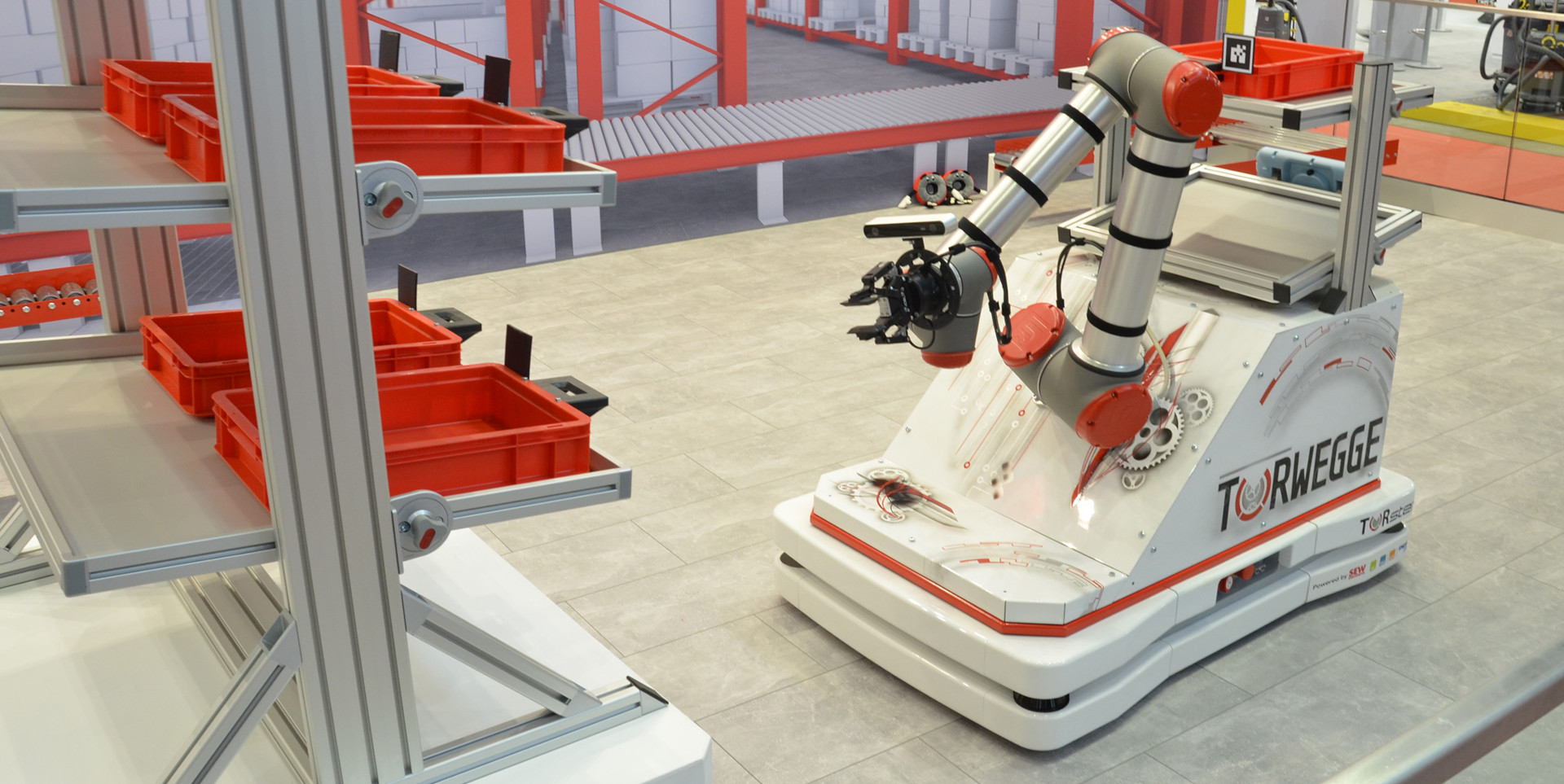
TORsten follows a versatile modular design, allowing it to be used as a self-navigating ROS-based AGV and robot. The AGV was fitted with a manipulator for this year’s IFOY usage scenario, transforming it into a mobile picking robot aptly named Manipula-TORsten. TORsten provides a fully mobile solution to ensure efficient procedures while lowering production costs. An integrated inductive charging system increases the AGV system’s availability.

Product name and company
MANIPULA-TORsten (TORsten meets Friends) – Torwegge GmbH & Co. KG
Category
Mobile Robot
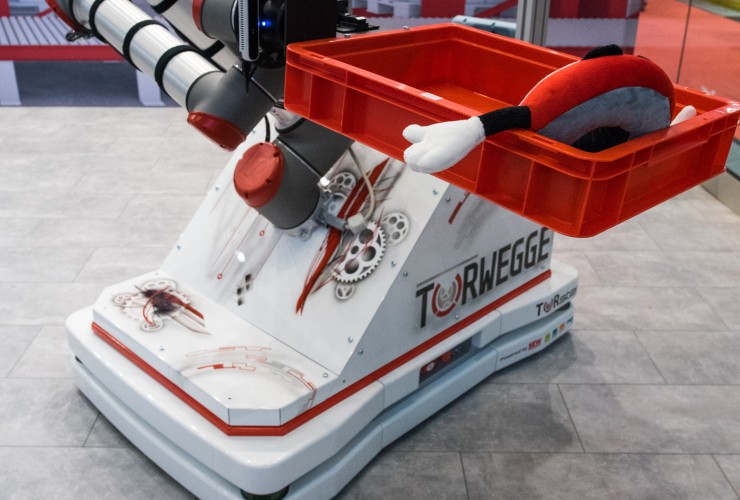
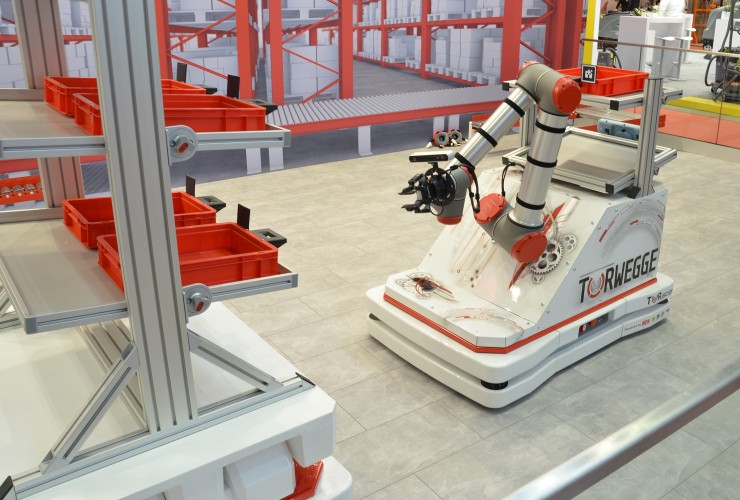
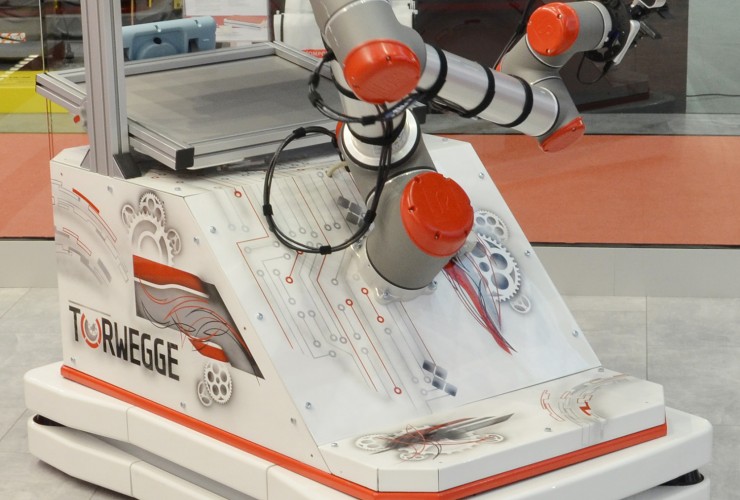
TORsten has a modular design that maximises versatility and scalability, which are key requirements in intralogistics. The AGV is easy to extend by goods handling components such as roller and belt conveyors for integration into existing installations. Apart from that, the ROS-based system allows for use in mobile robotics.
Equipped with a PILZ PRBT manipulator, TORsten in its base version converts into Manipula-TORsten, a mobile picking robot. Accurate SLAM navigation means that the AGV can be used as a fully mobile system. The two units in Manipula-TORsten are HSW-compliant and communicate using the MQTT IoT protocol.
Manipula-TORsten automates production and picking processes in a wide variety of applications and industries; the AGV adapts to changing conditions for full flexibility.
The TORsten AGV in its base version comprises a modular underrider for handling a variety of load carriers or individual components of up to 1.2 tonnes in any direction. The AGV is around as big as a euro pallet and only 230 mm high. Laser contour navigation guides TORsten without assistance according to its own route plans while keeping to the requirements of staff safety.
TORsten is constantly developed, the last example being improvements in robot control, localisation and positioning. As Manipula-TORsten, the AGV can now adapt to even more complex interaction environments.
The three degrees of freedom in omnidirectional movement have seen an additional six axes in the AGV’s state space in serial robot kinematics resulting in an increase in radius of action. Stable picking procedures require overall environment detection in three dimensions as implemented by integrating heterogeneous sensor technologies such as laser scanners and deep-imaging cameras.
Manipula-TORsten has a distributed network of on-board computers to connect the technologies. The ROS framework allows different CPUs and GPUs to be combined and scaled up regardless of manufacturer and platform, the integration of robot kinematics in the PILZ manipulator being a case in point.
Mobile robots have a heavy power requirement, so the power concept has undergone further development with a station-independent inductive charging system to increase battery life. Apart from operating times, this also increases the system’s radius of action.
Manipula-TORsten is an extension to the base system, and also prioritises versatility and availability. The complete fully automated HS-compliant solution serves as an innovative component in advanced material and production flows.
Freely navigated movement has taken its place on the market with ongoing adoption in almost all intralogistics processes. Mobile robotics comes as the next evolutionary step and will benefit from the acceptance of AGV technology. The AGV can be used where stationary robots cannot overcome their spatial limits. Apart from that, modern consumer behaviour has led to more intensive picking. The potential for automation solutions such as this is far from exhausted.
Even so, a migration phase with humans working together with machines will be needed before complete automation can be achieved, placing heavy requirements on health and safety at work. Manipula-TORsten would be ideal for the resulting market.
Above all, automated picking maximises the availability of productive capacity in these systems with potential for 24/7 deployment. In addition, Manipula-TORsten works with both humans and other machines, helping to closing the gap in manual processes such as in e-commerce from the virtual shopping cart to final shipment. This would not only speed up the process but also improve reliability and accuracy by minimising errors with sophisticated safety technology in the system.
Further development the TORsten system into a mobile manipulator combines the two approaches to partial automation applied up to now – robots to goods and goods to robots. This will lead to substantially faster picking times by eliminating return and empty runs while also reducing production costs and increasing production rates. This versatile system could save costs even further by replacing individual stationary components.
The sum of the advantages mentioned pays in to make customers more efficient and thus more successful. Since the system is based on the standard technology ROS, the technology variance and thus the complexity is reduced for operators, whereby a purchase always remains future-proof, flexible and above all scalable.
In 2017 Torwegge won an IFOY Award with the TORsten AGV. This year the company has been nominated for the prestigious awards with a further development of that award winner: the MANIPULA-TORsten, a mobile manipulator.
The MANIPULA-TORsten consists of a compact TORsten AGV. It is about the size of a europallet and only 230 millimeters high, on which a manipulator has been mounted – in the case of the IFOY nomination a PILZ robot arm. Other configurations are also conceivable.
The system shown during the IFOY Test Days can be used for order picking, e-commerce activities or other tasks where the combination of a precisely navigating AGV and a manipulator offers advantages to perform tasks more efficiently and at lower costs. The combination of both techniques prevents empty transportation trips. The system can be used for both goods-to-robot and robot-to-goods concepts.
Using laser contour navigation, the TORsten AGV navigates with a maximum deviation of five millimetres. As soon as the vehicle is on a location, the manipulator positions itself in the current location and the picking process can begin.
A deep image camera is used to position the manipulator each time again. This camera recognises the tray or box to be picked and automatically identifies where exactly it is to be picked.
The nominated solution offers a load capacity of six kg. However, depending on the manipulator configuration which is placed on the AGV, heavier alternatives are also possible. One of the factors determining this is the load capacity of the AGV (1.2 tons).
The entire operation is controlled by the Robot Operating System, ROS in short, which was developed in cooperation with IfU IMA RWTH Aachen University. In this middleware, all system components can be easily integrated and configured according to the plug & play principle. ROS can also communicate with other system components in the warehouse.
Because the energy consumption of the AGV is significantly higher with this new nomination, the system is equipped with an inductive charging system. Floor contacts, e.g. at fixed AGV stops, allow the battery to be charged quickly and without contact, thus ensuring a high level of availability.
However, this charging principle could not be shown during the IFOY Test Days, as it requires permanent adjustments to the floor. This was of course not possible in the test hall.
During IFOY set-up, MANIPULA-TORsten performs the predestined tasks calmly and controlledly. The AGV once again proves its practical navigation and transport capabilities. The robotic arm certainly adds a dimension.
The techniques used make the system very accurate and enable an efficient and flexible custom-made automation solution. The combination of techniques opens a door to more efficient fully automatic transports and goods handling.
Driverless transport systems (autonomous guided vehicle) have established themselves over the past 40 years as flexible means of transport for production supply. The number of applications has multiplied in the last ten years in particular. With the help of modern navigation and communication processes, the systems allow the combination of a high degree of automation and high system flexibility. The connection with a robot arm also permits flexible load pick-up and delivery or even process steps during the transport time (sorting or assembly). The already growing hype could thus be further intensified.
Automation and flexibility of the transport are increased by a sensible use of the transport time or fully automated load pick-up and delivery can be realized. Only then is the completely automated material flow complete.
Perception-based navigation and control with extensive use of the ROS (Robot Operating System) in all control components can be clearly classified as innovative. The combination of transport and handling is known from individual applications, especially in the USA, but can also be classified as quite innovative.
The scope was realized on the basic vehicle presented two years ago as an underride vehicle and realized on the basis of an example application – additional functions besides load transfer and transport have not yet been implemented
| Functionality / type of implementation | + |
| Novelty / Innovation | ++ |
| Customer benefits | + |
| Market relevance | ++ |
| ++ very good / + good / Ø balanced / – less / — not available | |
Image/video credits: Torwegge GmbH & Co. KG
Finalists undergo the three-stage IFOY Audit as part of the IFOY Audit, which takes place during the TEST CAMP INTRALOGISTICS. This consists of the scientific IFOY Innovation Check, the IFOY Test and the jury test.
In den Statuten sind die Grundwerte und die Standards des IFOY AWARD festgelegt, nach denen die Organisation handelt. Dazu gehören unter anderem Gremien, Wahlomodus, Bewertungskriterien sowie der Code of Conduct.
The International Intralogistics and Forklift Truck of the Year has three bodies: Jury, sponsors, and advisory board.