Case Study
The customer
The migrolino AG, a fully-owned subsidiary of the Federation of Migros Cooperatives, is one of the leading providers in the Swiss Convenience Store market with stores at train and gas stations, as well as other highly-frequented locations. Around half of the stores are run by the franchise partners of the migrolino AG. The other half is run by migrolino itself in cooperation with its strategic partners. Under the name of migrolino Wholesale, the company has been offering its logistics and support services to partners outside the migrolino family since 2014.
What was the initial situation and the definition of the project?
migrolino supplies more than 300 stores (retail areas from 100 to 160 m2) while being open 365 days a year, around the clock, offering approximately 3.000 different items – such as groceries, non-food products, items of convenience, tobacco and alcohol. This logistical operation is very demanding due to the fast reaction times required by the store owners. It is called small volume logistics at Migros. In contrast to the regular store logistics at Migros (600 regular stores, 300.000 trading units/day), which has already been fully automated, the small volume logistics operation has been handled manually with high labor costs. The two business areas were also separated physically and in terms of IT and thus causing higher than usual costs.
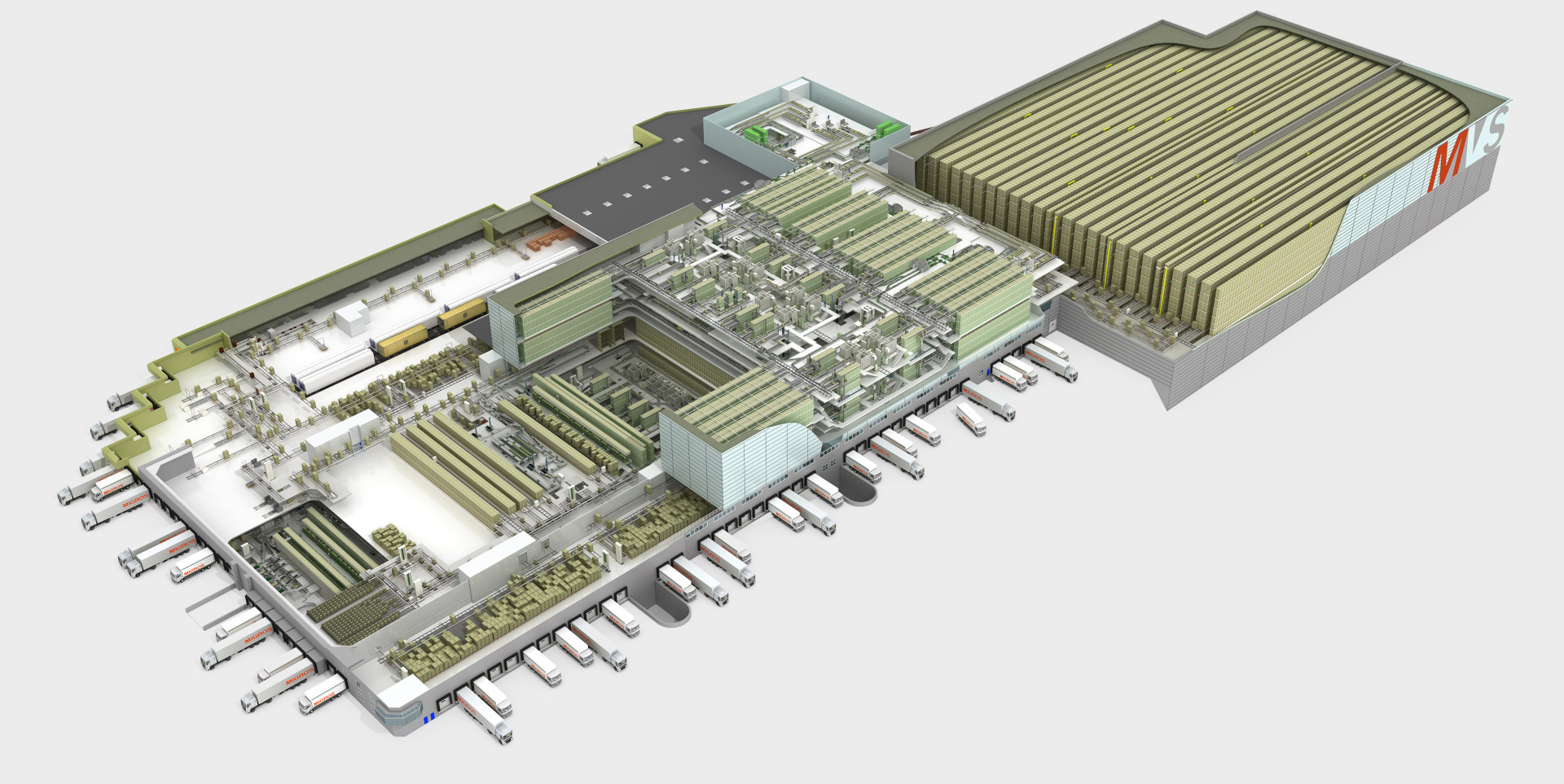
It was Witron’s task to automate the small volume logistics and, despite entirely different logistical requirements, to merge products and temperature ranges with the regular store logistics (processes + mechanics + IT + items + master data). This had to happen in a way that an integral omni-channel logistical system is created – providing high flexibility and transparency – while being mutually supportive and permanently and independently optimizing itself. During its realization, it had to be well-thought-out that up to 118,000 trading units needed to be picked on a peak day and that an increase in volume from 9 to 20 million picks per year was included for the following years. Integration into the existing warehouse was only possible while the current operation was still running. The existing logistics area with 14.000 m2 spread over two floors was another factor that shaped the project.
What challenges have to be overcome and how have they been solved?
Each individual day is different at Migros – both in the small volume picking and in the regular store business. At migrolino, there can be a lot of dry goods that are picked on one day, and on other days it is a lot of fresh goods. For example, on a Friday, there is 100% more throughput than on a Wednesday. Throughput is even up to 400% higher with national holidays approaching having a direct effect on the flow of goods and the utilization of all picking systems.
The demanded high flexibility and economic efficiency in the small volume logistics was achieved by the automated and semi-automated solutions being mutually supportive and optimizing themselves independently. That means goods picked into totes are optimally compressed onto a roll container using picked trading units. Likewise, a logistics module operates as a buffer stock for the other logistics module, so the goods are available extremely quickly, throughput times are significantly shortened and storage locations are reduced. Moreover, ˮend-to-end“ software tools facilitate a forecast for all picking areas and guarantee full transparency for storage, picking, consolidation, transport and tour planning. Following entirely in the sense of Industry 4.0, the small volume system automatically distributes load-volume onto the individual subsystems and optimizes their interaction automatically.
Furthermore, by the merge of the small volume logistics and the regular store logistics in terms of IT and conveyor technology, numerous synergies are created. Thanks to the existing data transparency, the storage systems of both distribution channels can permanently support each other. Orders are picked ˮhere or there“, logistics areas (as for example the pallet HBW) are utilized for both systems and inventory does not need to be stored twice. Here also, the developed software tools support and create a highly optimized global process that is able to adapt to changes largely by itself.
Both challenges ˮspace restraints“ and ”throughput“ were met by (fully) automated picking systems with high picking speed and low space requirements developed and patented by WITRON.
What is the solution and what specific innovations / highlights does it offer?
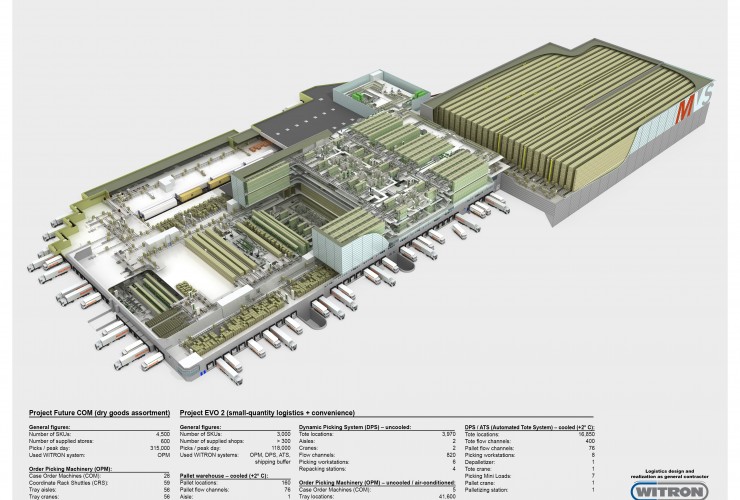
The highlight of the solution is the optimized connection between advanced IT functionalities and highly dynamic mechanical elements, which is the focus of an integral end-to-end networking of different distribution channels, clients, product, and temperature ranges. All system parts and product ranges – both in the regular store logistics and in the small volume logistics – are intelligently connected with each other and are controlled by a WITRON-WMS-System 4.0. Consequently, for the customer, this represents an economic and highly flexible omni-channel logistics center largely optimizing itself independently and supplying more than 600 Migros branches with a capacity of more than 300,000 trading units and over 300 migrolino stores with more than 118,000 picking units on a peak day.
The following logistics modules are being utilized: the ˮOrder Picking Machinery (OPM)“ for fully automatic picking of trading units, the ˮDynamic Picking System (DPS)“ for small volume items, the ˮAutomated Tote System (ATS)“ (crates, totes) as well as the fully automatic dispatch buffer. All areas are supplied from an automated pallet high-bay warehouse.
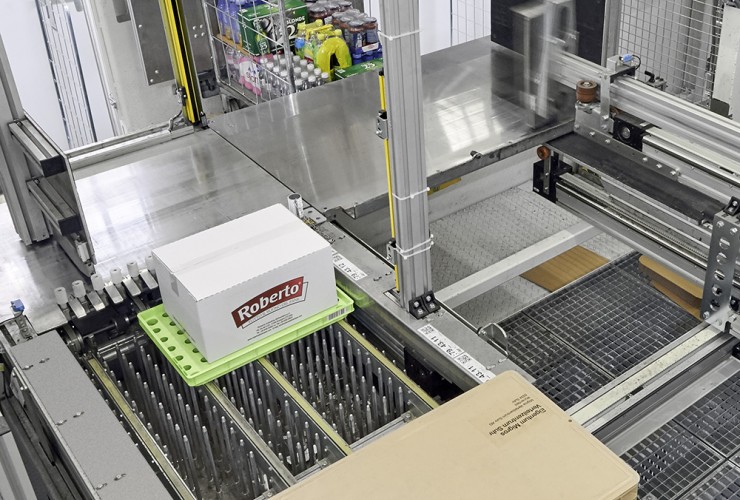
The Case-Picking-System, OPM, is used in the dry goods area of the distribution center and facilitates the stacking of trading units, various beverage formats and totes of different sizes onto pallets or roll containers – without staff intervention, in a store-friendly manner and without errors. This also includes totes with customer orders containing small volume items that have already been pre-picked in the DPS.
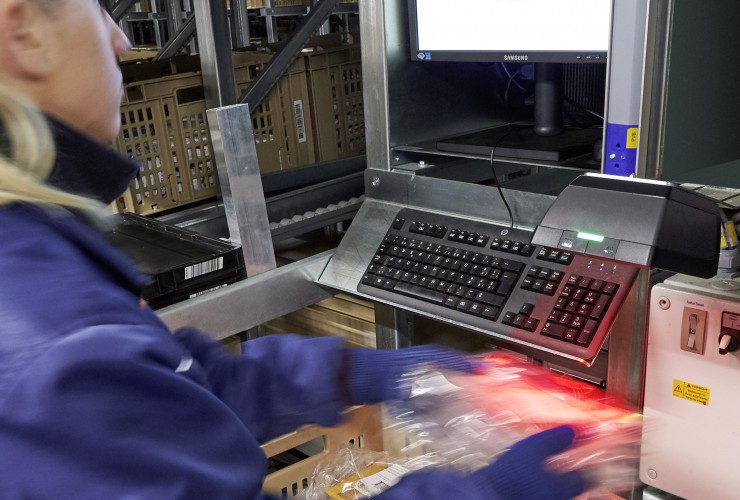
The highly dynamic picking of small parts in the DPS is supported by a pick-by-light system. The DPS works according to the ˮgoods-to-person“/”person-to-goods“ principle. Depending on the order structure, the goods are positioned in the pick front either permanently or on demand, thus enabling constant optimization. The pick front profiling is done automatically by cranes. The DPS at migrolino is divided into two temperature zones – ambient dry items and chilled fresh items.
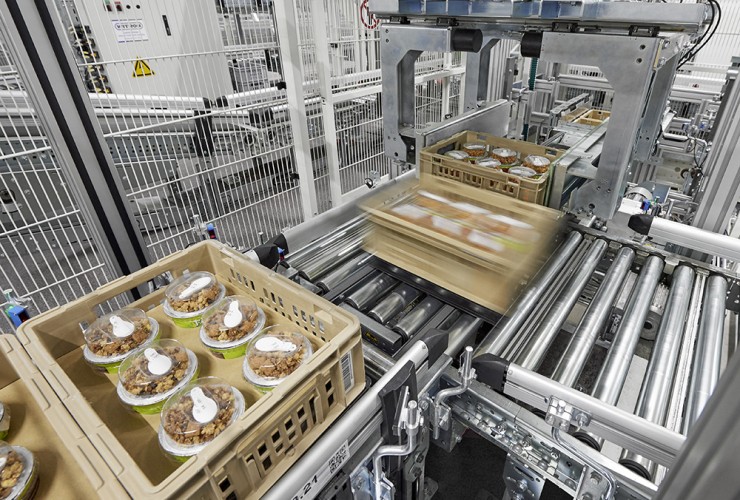
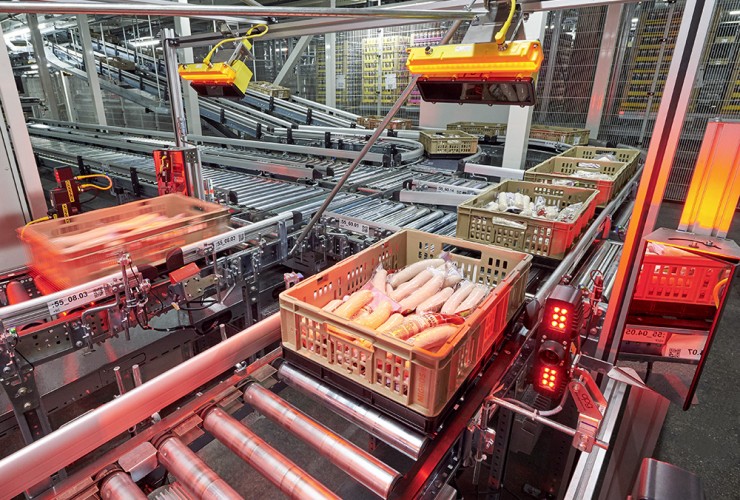
The ATS facilitates the fully automatic storage and picking of totes / tote stacks that have already been filled with goods in their own production department or by the supplier. These dispatch units are collected in the ATS without any staff deployment, are occasionally buffered, picked, stacked onto a dispatch unit in a store- and tour-friendly manner and staged for outbound delivery. This includes the cross-docking business as well. Furthermore, the ATS enables the store- and tour-friendly stacking of order totes that have already been pre-picked in the fresh DPS.
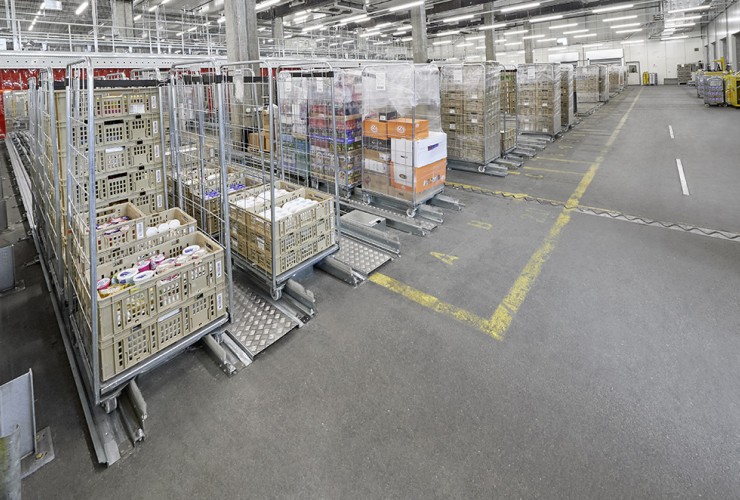
An fully Automated Dispatch Buffer, modularly designed including different temperature zones, optimizes the dispatch area and provides the employees in the dispatch area with the roll containers via roller conveyor in the right sequence, in the right order, ˮjust in time“ for outbound.
What specific customer benefit does the solution offer?
- High flexibility, economic efficiency, customer and employee satisfaction. Numerous synergy effects (inventory, logistics, and transport) by the merging of small volume logistics and regular store business and the corresponding cost savings.
- By intelligent mechanization and integral network generation, quality, productivity and flexibility of all logistical services were sustainably increased both for the small volume business and for the regular store business.
- The independent control of the global system ensures shorter throughput times. Thus, customer service is increased as customers are able to order various product ranges by 08:30 a.m. on the day before delivery. The stores need to be supplied once a day only.
- High-quality customer service and savings on transport and return costs thanks to order roll containers that have been densely packed without error on the basis of stacking algorithms, maximum order consolidation and volume calculation. A considerable decrease in customer complaints (by 59%).
- By highly dynamic and automated systems the pick performance was significantly increased (3 times compared with a manual warehouse).
- High employee satisfaction thanks to ergonomic workstations and diverse tasks.
The ambitious customer targets / target return on investment was achieved.
Key figures small volume logistics:
Realization period: 22 months
Investment: 29 million €
Number of SKUs: 3.000
Supplied shops: more than 300
Number of picks/day: 118.000
Case Order Machines (COM) in the OPM (ambient/chilled): 5
Workstations DPS (ambient/chilled): 14
Storage locations in total: 63.650
Cranes: 22