

IFOY Audit
Finalists undergo the three-stage IFOY Audit as part of the IFOY Audit, which takes place during the TEST CAMP INTRALOGISTICS. This consists of the scientific IFOY Innovation Check, the IFOY Test and the jury test.
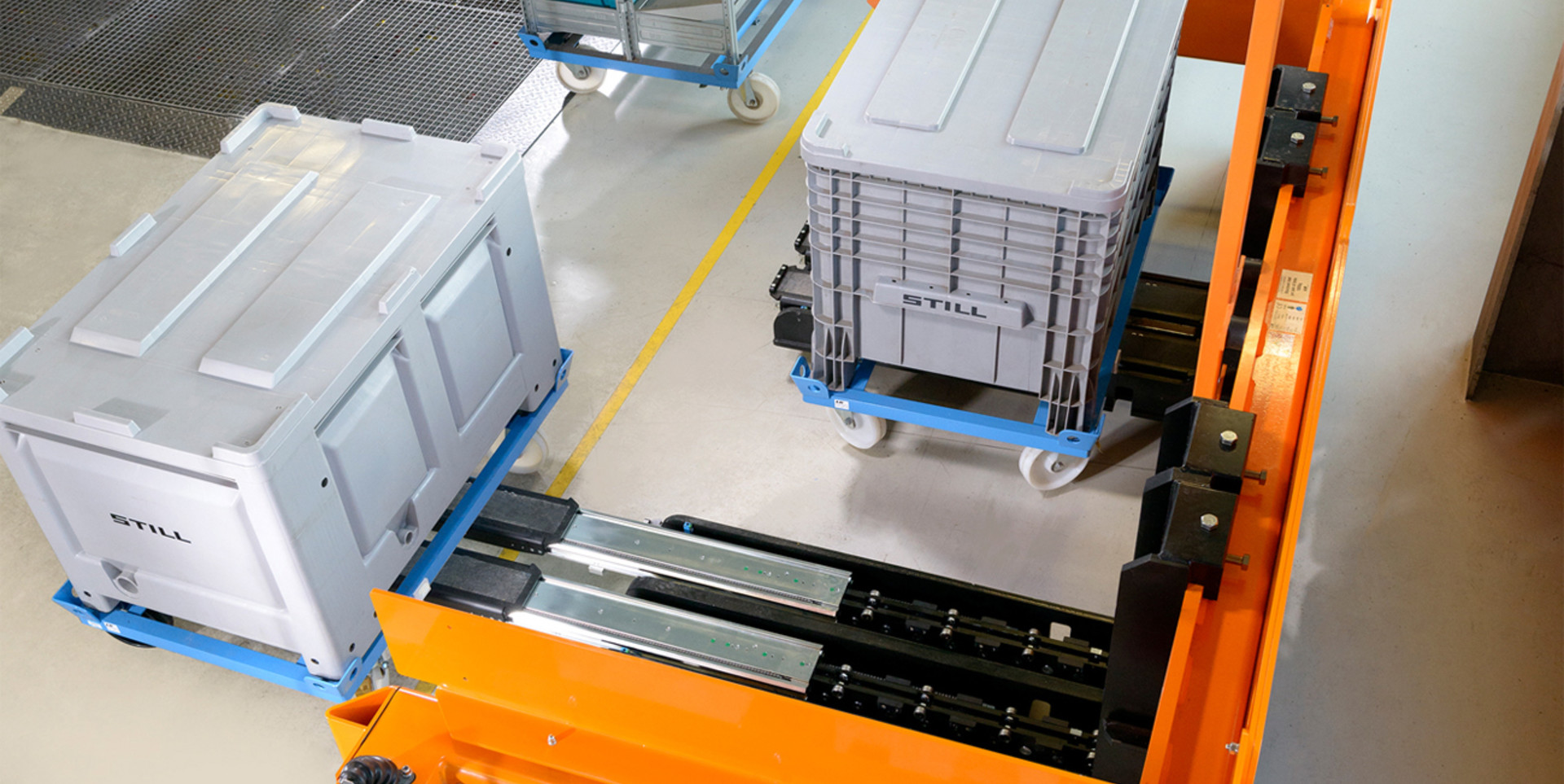
In modern and lean production logistics, Tugger Trains are essential to ensure an efficient flow of materials. They supply operation sites, for example assembly areas, with materials in different load carriers and small batch sizes in line with demand. As a result, the operating company is not only able to reduce expensive logistics space in production areas but also to drop stock levels and energy consumption as well as risk of accidents due to minimised traffic frequencies. This is why the goal of a renowned gearbox manufacturer for construction machinery in England was to change the entire production supply from using counterbalanced trucks to deploying a circulating system (Milk run). Besides implementing standard Tugger Train solutions from the existing Still portfolio, the challenge was to develop an individual frame capable to move oversized load carriers with a weight of two tons and dimensions of approximately 1200 x 2400 mm and integrate this solution in the planned production supply based on Tugger Trains. Developing a semi-automated C frame with an intuitive control concept enabled the company, which was formerly forced to move the oversized loads by counterbalanced trucks, to benefit from the advantage of Tugger Trains.

Product name and company
TUGGER train with automatic loading and unloading – STILL
Category
Heavy Load Forklift and Special Vehicle

The LiftRunner systems implemented by Still consist of an LTX tractor and the LiftRunner frame (trailer) as well as trolleys (rolling load carriers). For the transport of the oversized and heavy load carriers, a Tugger Train system with C frames was implemented. By standard Still LiftRunner C frames are designed to carry loads of 1 600 kg – but size and load capacity can also be adjusted to other customer requirements. To allow loading and unloading, a Tugger Train with oversized load carriers, the C frames were for the first time equipped with two electrically-controlled, double-telescopic fork pairs with a load capacity of up to 1 000 kg. This way, the loading and unloading process of the Tugger Train was automated. The adjustable forks are controlled on a panel on the tractor with touch screen and allow the driver to operate the Tugger Train intuitively. The mini dome camera placed above the frame, provides a panoramic view of the frame as well as the loading and unloading areas and transmits the live images on the control panel on the tractor. In addition, the system indicates the next useful action to the driver. If the unloading area is occupied, the driver is only allowed to pick up load carriers, whereas in vacant areas loads must be dropped. Additionally installed laser-controlled positioners enable precise positioning of the tractor to place the load carrier exactly in its designated storage space.
While in standard solutions, the load is manually pushed into or onto the trolleys of the LiftRunner frames, it was necessary to automate this process step because of the heavy weights. This was made possible by electrically controlling the forks of the LiftRunner C frame from the control panel in the tractor. New safety requirements for the use of the Still LiftRunner system resulted from automatic loading and unloading. The additionally installed mini dome camera provides a perfect panoramic view of each trailer and the respective loading and unloading areas. The projected live image on the tractor panel enables the driver to react to unexpected events, e.g. pedestrians, and therefore guarantees maximum safety during loading and unloading. Furthermore, the laser-controlled positioner enables precise loading and unloading.
The Still LiftRunner system with the specially designed semi-automated C frames can effect advantages even in those companies that were so far only able to manually transport cargo due to oversized load dimensions. In addition to a standardised production supply, the transport capacity for these specific transport processes could be increased by 800 per cent (from one to eight pallets). Furthermore, the gearbox manufacturing company benefits from a clear reduction of space requirements in aisles and unloading areas as large loads, for example gear boxes, can now be transported lengthwise and not crosswise as in the past. Another positive effect is the reduction of costs by saving personnel and equipment while simultaneously increasing process reliability. While in the past two employees and two counterbalanced trucks were required to transport the oversized load carriers, nowadays one person is able to handle those transports with the use of a single Tugger Train consisting of an LTX tractor and two automated C frames. Moreover, the LiftRunner Tugger Train system convinces by excellent ergonomics. The combination of the intuitive control concept with the control panel on the tractor and the automated loading and unloading means that truck access and exit and usual pushing of heavy loads is not needed anymore and relieve the employee from physical effort.
It was the lean concept that prompted Still to develop a tugger train that goes further than conventional rival ideas. Where other tugger trains are often restricted to handling maximum loads of around 500 kg per trailer, the Still version can handle very large or very heavy loads weighing up to 2,500 kg and measuring as much as 6 metres on a relatively small area.
One special feature is that employees are relieved of physical burdens, as the loading and unloading of the “C” frame is performed fully automatically. From a demographic point of view and in light of the increasing average age among logistics employees, this concept has obvious benefits.
Before the system can be used to its full effect, the working environment first needs to be determined and the various stations and routes specified. The tugger train then works very intuitively but nevertheless requires a very precise driving style.
A blue arrow is projected onto the floor at the front of the tugger, and a laser liner shows a clear green line on the floor at the side of the trailer. As soon as the blue arrow approaches one of the marked stops and the green laser line is exactly aligned with the stop mark, the load can be easily loaded or unloaded via the telescopic forks.
The process is monitored by a camera mounted on the “C” frame. The camera image is shown in real time on a large touchscreen on the tugger. If multiple trailers are used at the same time, each trailer is shown in split-screen mode, so that all workplaces are always easily visible.
The driver does not need to leave the tugger for loading and unloading of the heavy trolleys. All orders are entered via the touchscreen and confirmed by additionally pressing the activation button on the tugger.
The Still tugger train can transport up to four trailers simultaneously and therefore paves the way for a high level of productivity and efficiency. The combination is also extremely agile thanks to the four-wheel drive of the trailers – and the system runs very quietly.
The Still tugger train with automatic loading and unloading is a first step towards the full automation of the production process. Heavy loads can be easily taken up and transported by a single person without the operator having to leave the vehicle. Age and strength no longer play a role, and this makes for greater flexibility in practice.
| Hard facts | Test Truck IFOY Test | Average other trucks | Value 1 to 10 | ||
| Productivity Max mode | no data | no data | Pallets p. 8 hrs | 8 | |
| Productivity Eco mode | no data | no data | Pallets p. 8 hrs | 8 | |
| Energy level Max mode | no data | no data | kWh 100 pallets | 8 | |
| Energy level Eco mode | no data | no data | kWh 100 pallets | 8 | |
| Driving speed with load | no data | no data | km/hr | ||
| Driving speed without load | no data | no data | km/hr | ||
| Lifting speed | no data | no data | mts/sec | ||
| Acceleration speed with load | no data | no data | time 10 mtrs | ||
| Acceleration speed without load | no data | no data | time 10 mtrs | ||
| Averages soft facts | |||||
| First impression | 7.80 | ||||
| Load Safety | 7.00 | ||||
| Entry / exit truck | 7.50 | ||||
| Working position | 7.67 | ||||
| Working space | 8.00 | ||||
| Activate truck | 8.00 | ||||
| Hydraulics | 7.86 | ||||
| Steering | 7.43 | ||||
| Sight | 8.00 | ||||
| Driving & Turning | 8.00 | ||||
| Parking truck | 8.00 | ||||
| Safety elements | 8.00 | ||||
| General after test | 7.75 | ||||
| Sustainability | 8.00 | ||||
| Totals | |||||
| Total average soft facts | 7.79 | ||||
| Total productivity | 8.00 | ||||
| Total Energy consumption | 8.00 | ||||
Over the last decade, tugger trains have played an ever greater role in in-plant material transport. They are mainly used to supply material to workplaces in the assembly area, and the transported goods on rolling load carriers are pushed onto or into the trailers by hand. Small loads are also loaded and unloaded manually. In some cases, however, big and heavy objects that cannot be loaded or unloaded by hand also need to be transported by tugger train. The purpose-developed tugger train trailers from STILL with lateral telescope ejector forks therefore enhance the application options for the concept, opening up a new market segment for these vehicles. As with all special vehicles, the volume of the market segment is relatively small, however. Nevertheless, with its heavy-duty tugger train, STILL has implemented a technical concept that also has potential for more widespread use in other materials handling equipment. This concept is based on the remote control of working routines. The loading and unloading of the big and heavy load carriers is remote controlled by the tugger train driver from the tugger.
The customer benefit of the heavy-duty tugger train is to be described as very high, as the machine was developed to meet the requirements of a specific customer. Remote-controlled load insertion and removal allows safe handling of large and heavy transport consignments. The fisheye cameras and the laser-controlled positioning feature provide the driver with optimum support during work routines. Replacing the counterbalance trucks that are normally used for transport with the heavy-duty tugger train also offers economic benefits.
The main innovative elements are the telescopic forks and the remote control concept. Although telescopic forks have been used in the sector for many years, their use in tugger train trailers is – though logical – actually a new idea. What deserves special mention, however, is the remote control of work functions by an operator in a different location who receives the necessary information from technical assistance instruments. Remote control has long been used in cranes for the purpose of semi-automation and to take the physical strain off the operator, but using it in industrial trucks is a new concept.
The technical concept is well implemented. During the Innovation Check, the software exhibited a certain degree of response time-lag. Exact positioning of the vehicle requires a fair amount of practice and makes operation of the vehicle more difficult. Once the machine is in the right position, unloading and loading are performed reliably and automatically.
| Functionality / type of implementation | + |
| Novelty / Innovation | + |
| Customer benefits | ++ |
| Market relevance | Ø |
| ++ very good / + good / Ø balanced / – less / — not available | |
Image/video credits: STILL GmbH
Finalists undergo the three-stage IFOY Audit as part of the IFOY Audit, which takes place during the TEST CAMP INTRALOGISTICS. This consists of the scientific IFOY Innovation Check, the IFOY Test and the jury test.
The bylaws set forth the core values and standards of the IFOY AWARD, which guide the organization’s actions. These include, among other things, governing bodies, the election process, evaluation criteria, and the Code of Conduct.
The International Intralogistics and Forklift Truck of the Year has three bodies: Jury, sponsors, and advisory board.