

IFOY Audit
Finalists undergo the three-stage IFOY Audit as part of the IFOY Audit, which takes place during the TEST CAMP INTRALOGISTICS. This consists of the scientific IFOY Innovation Check, the IFOY Test and the jury test.
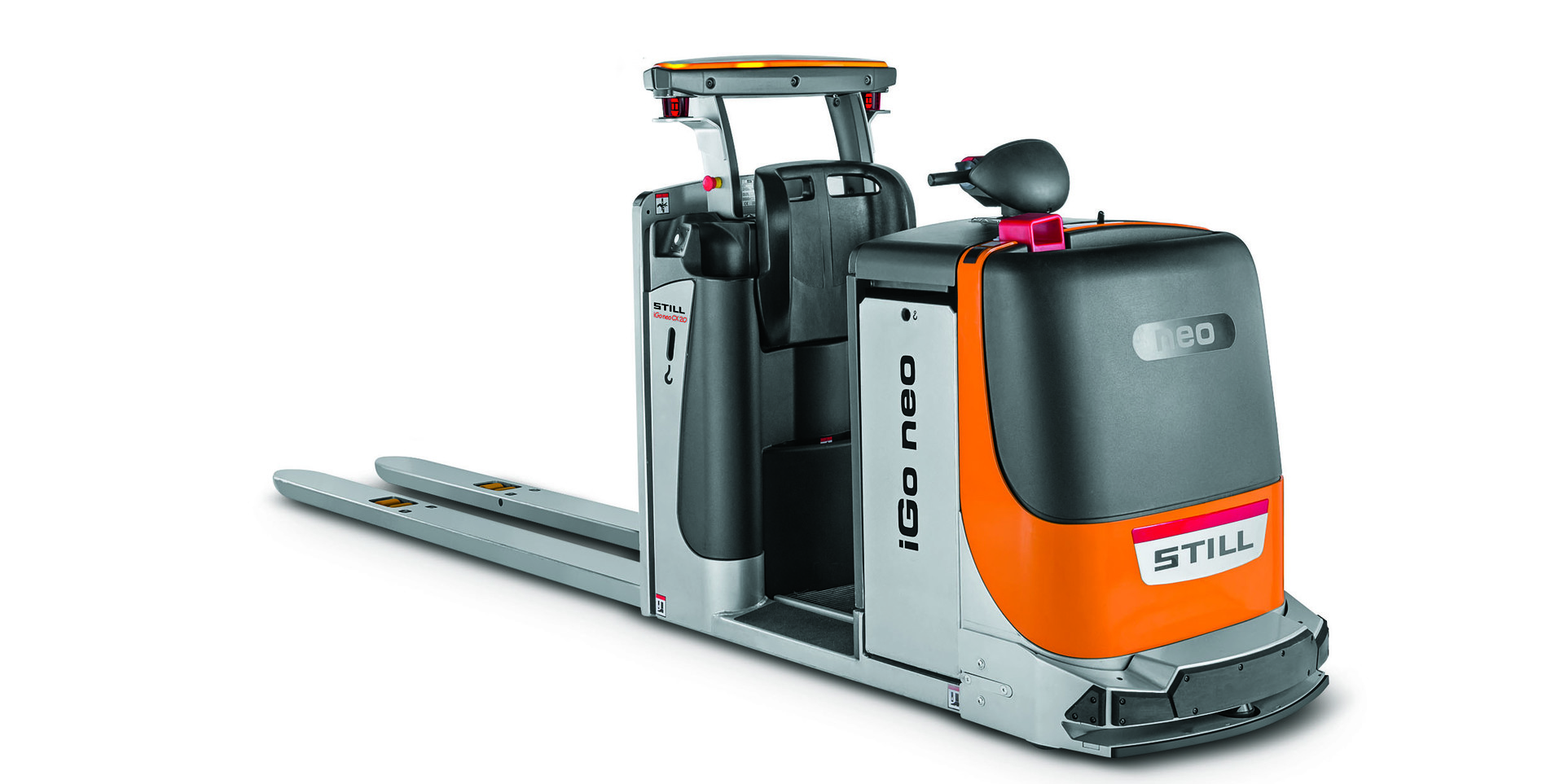
The future of smart horizontal order picking now has a new name: STILL iGo neo CX 20. The worldwide first autonomous horizontal order picker closes the gap between robotics and intralogistics. The truck is equipped with laser scanners that scan their environment and recognize the whole warehouse layout. Besides racks or obstacles, the system also recognizes its operator and other people in the warehouse and as a result, it easily adapts to changing conditions and to the flow of materials. The industrial truck switches from conventional automation to autonomous operation without any pre-setting, infrastructure or remote control and is therefore ready for operation at any time. The industrial truck navigates by its sensors and reacts to obstacles or other trucks in its drive path while observing traffic regulations at all times. The operator can individually adjust the picking distance to the rack. Safe convoying of autonomous and conventional industrial trucks is possible for the first time. With its narrow contour of just 80 centimeters and a rated load capacity of 2 000 kg, the iGo neo CX 20 is a flexible and autonomous partner for every working environment. Thanks to “Automation on Demand”, the operator can freely switch between manual and autonomous mode at any time. It does not make any difference whether the operator picks orders from left or right, or from both sides. The iGo neo CX 20 is a team player at eye level.

Product name and company
iGo neo CX 20 – STILL
Category
Warehouse Truck „lowlifter“
The most important innovation of the iGo neo CX 20 is its intelligence. Thanks to its 360 degree motion sensors, the truck is able to react to changes in its surroundings at all times. The truck precisely distinguishes static from dynamic objects and pedestrians. Also the operator can be detected without any pre-installation or remote control. The truck recognizes the intention of its operator by his movements making the iGo neo CX 20 the first order picker with cognitive abilities. The 180 degrees panoramic detection of the laser scanner in the front of the truck enables the truck to drive proactively. The truck detects obstacles early, evaluates them in an intelligent manner and reacts with an adjusted driving behaviour and soft driving characteristics. Loads on the forks tipped over by spontaneous emergency braking are a thing of the past. The sensors record their surroundings 250 000 times per second while the computer interprets and utilises the current warehouse layout in real time.
An optical signalling unit, mounted on the truck, shows the current work mode by emitting a simple light code. This new, non-verbal user interface crosses all language, culture and age barriers and allows use of the truck without previous training.
The main goal for the development of the iGo neo CX 20 was to make picking processes safer and more efficient while relieving strain from the operator at the same time. To achieve this goal, the development clearly focussed on the operator. Not a conventional order picker, but a team colleague for the operator was the design goal.
All activities, such as accessing and leaving the truck as well as unnecessary walking with loads, were to be reduced to enable the operator to pick orders freely and precisely.
In addition, it was necessary to prevent personal injuries and impact damages during picking.
Also the operation of the truck itself was to be made easy and intuitive. For this purpose, the truck was supposed to solely react to the movements of its operator. The use of a remote control or other controls were to be refrained from.
In order to meet the challenges of globalisation, the communication between operator and iGo neo CX 20 was supposed to be designed as intuitive as possible and overcome language barriers.
Furthermore, the truck was to be implemented in an already existing warehouse as flexibly as possible, without having to adapt infrastructures, such as installations of WLAN, reflectors or RFID chips.
The benefit of the iGo neo CX 20 is the intelligence it provides: The laser scanners detect static and dynamic objects as well as pedestrians over a range of up to 15 m. As a result, the autonomous truck can flexibly adjust to the actual situation it finds itself in and thus avoid collisions and personal injuries.
The iGo neo CX 20 supports the operator during order picking and acts as an autonomous team colleague that relieves strain from the operator at the same time. This allows the operator to adjust the distance between the rack and the truck to his individual comfort at any time. In addition, the operator can choose whether the truck stops at the centre of the first or the second pallet: Ergonomic order picking is ensured at all times.
The iGo neo CX 20 is navigated by the movements of its operator and follows him wherever he goes. It does make no difference whether the operator works left, right or even at the centre of the truck. This minimises walking distances and reduces accessing and leaving of the truck during order picking by up to 75 percent. At the same time, the overall performance of picking processes can be increased by up to 30 percent.
All information is displayed non-verbally by the LED signalling unit mounted on the truck and by the motion tracking sensors.
By accessing the truck, the operator can switch to manual mode at any time and move around the warehouse independently.
| This is a | Vollständig neues Modell |
| Date of market launch | 07/01/2016 |
| Competitive products | Crown QuickPick Remote |
| Special equipment IFOY test device |
| Drive type | Elektro |
| Lifting weight max. | 2000 kg |
| Truck weight | 1228 kg |
| Driving speed without load | km/h |
| Lifting speed without load | m/s |
| Lifting height max. | 130 mm |
Still launched the first robot order picker – the STILL iGo neo – in early 2016. The iGo neo automatically recognises “its” operator, who can then keep the truck in motion if desired without the need to board the machine again. If the operator exits the order picker and presses a button on the side of the machine, the iGo neo “keeps an eye” on the operator via its 360º scanner. When the order picker proceeds to the next picking station, the iGo neo then automatically follows while ensuring the correct spacing relative to the shelves as well as to all obstacles along the way. If the operator stops moving, then the iGo neo also stops next to him or her.
The IFOY Test shows that the savings compared to conventional order pickers are spectacular. TheiGo neo is more efficient and more productive in all test layouts whenever the pedestrian principle is used, and the test team found that efficiency can be boosted by up to 47 percent. The dynamic process that causes the machine to move at the same time as the operator ensures that the benefits of the system are fully exploited. This was also demonstrated with an “ideal trip” with an additional operator who always positioned the truck exactly in the correct position for the order picker.
The limiting factor is no longer the machine and its operation but the walking speed of the operator.
What is noticeable is that the Still iGo neo takes account of all the safety requirements during the work process. It evades and stops if necessary in order to avoid collisions. The end-of-aisle stopping function is just as precise as the operator recognition feature.
The operator wears the remote control on his or her upper arm and can use it to stop or fetch the iGo neo. The remote control can also be used to change the aisle side or select a pre-programmed stopping point so that the iGo neo automatically “offers up” the desired pallet or container, thereby further minimising walking distances.
There is, however, room for improvement both with regard to the design and in terms of the handling characteristics of the remote control.
Thanks to the options provided by robotics, one conceivable idea for the future is that automatic following and alignment of the vehicle is initiated not via remote control but automatically using gesture recognition via the 360º scanner or a new technology. This would enable the truck to also automatically recognise a change of operator in the same way as it already recognises objects and obstacles.
Interconnection with LVS or voice systems would be a further possibility.
The iGo neo offers the same benefits already seen in other remote order pickers: the work process is pleasant, easier, more efficient and considerably less strenuous, as the operator does not have to constantly get on and off the machine. Moreover, the truck itself uses less energy.
A further advantage of the iGo Neo is that it is not necessary to press any buttons or sensors, which means the operator has both hands free to pick, hold and position goods. In addition, the increased dynamics of the machine make it convenient to walk alongside it, even over longer distances. The walking speed of the operator determines the speed of the vehicle. The test team found this to be an extremely pleasant experience.
The iGo neo from Still shows that innovations in robot technology can make a valuable contribution to intelligent intralogistics. The key benefits are the high performance capability, ease of operation and the numerous options.
Horizontal order pickers represent a relevant segment in the overall market for warehouse trucks. The STILL iGo neo CX20 can be used in any horizontal order picking warehouse without the need for additional technical measures. The market relevance of the iGo neo is therefore to be rated as high, as it offers a considerable uplift in customer benefit. Whether the autonomous order picker will be able to gain a sizeable share of the market will ultimately also depend on the cost-benefit ratio – as the complex sensor and control technology naturally has its price.
The technical innovations of the iGo neo, such as laser-assisted scanning of the immediate environment, the intuitive-to-use communication interface and autonomous driving, mean that the resulting customer benefit can be described as very high. Thanks to the iGo neo, personnel in the order-picking warehouse can concentrate fully on the task at hand – namely removing the right item from the right storage compartment in the right quantity. The concept also takes the physical strain off employees. Operators of order-picking warehouses can expect far higher order-picking performance and lower error rates. As the iGo neo can be used together with conventional horizontal order pickers without any problem, the new order-picking zone technology can be trialled with minimum effort and the vehicle fleet successively converted if desired.
Even though the first automation tests for horizontal order pickers were conducted back in the early 1990s, the iGo neo without question constitutes a milestone in the development of autonomous warehouse trucks. The laser scanning feature to recognise the immediate surroundings gives it cognitive capabilities which – together with the intelligent vehicle control system – ensure that the machine follows the operator in its own. Both the operating concept and the sensor and control technology are highly innovative.
The functions are implemented very professionally, and the vehicle can be intuitively operated. Recognition and monitoring of the operator are reliable, and the Innovation Check showed that order picking was significantly faster due to the shorter walking distances.
| Functionality / type of implementation | ++ |
| Novelty / Innovation | ++ |
| Customer benefits | ++ |
| Market relevance | + |
| ++ very good / + good / Ø balanced / – less / — not available | |
Image/video credits: STILL
Finalists undergo the three-stage IFOY Audit as part of the IFOY Audit, which takes place during the TEST CAMP INTRALOGISTICS. This consists of the scientific IFOY Innovation Check, the IFOY Test and the jury test.
The bylaws set forth the core values and standards of the IFOY AWARD, which guide the organization’s actions. These include, among other things, governing bodies, the election process, evaluation criteria, and the Code of Conduct.
The International Intralogistics and Forklift Truck of the Year has three bodies: Jury, sponsors, and advisory board.