

IFOY Audit
Finalists undergo the three-stage IFOY Audit as part of the IFOY Audit, which takes place during the TEST CAMP INTRALOGISTICS. This consists of the scientific IFOY Innovation Check, the IFOY Test and the jury test.


Product name and company
EJQ – Jungheinrich
Category
Heavy Load Forklift and Special Vehicle
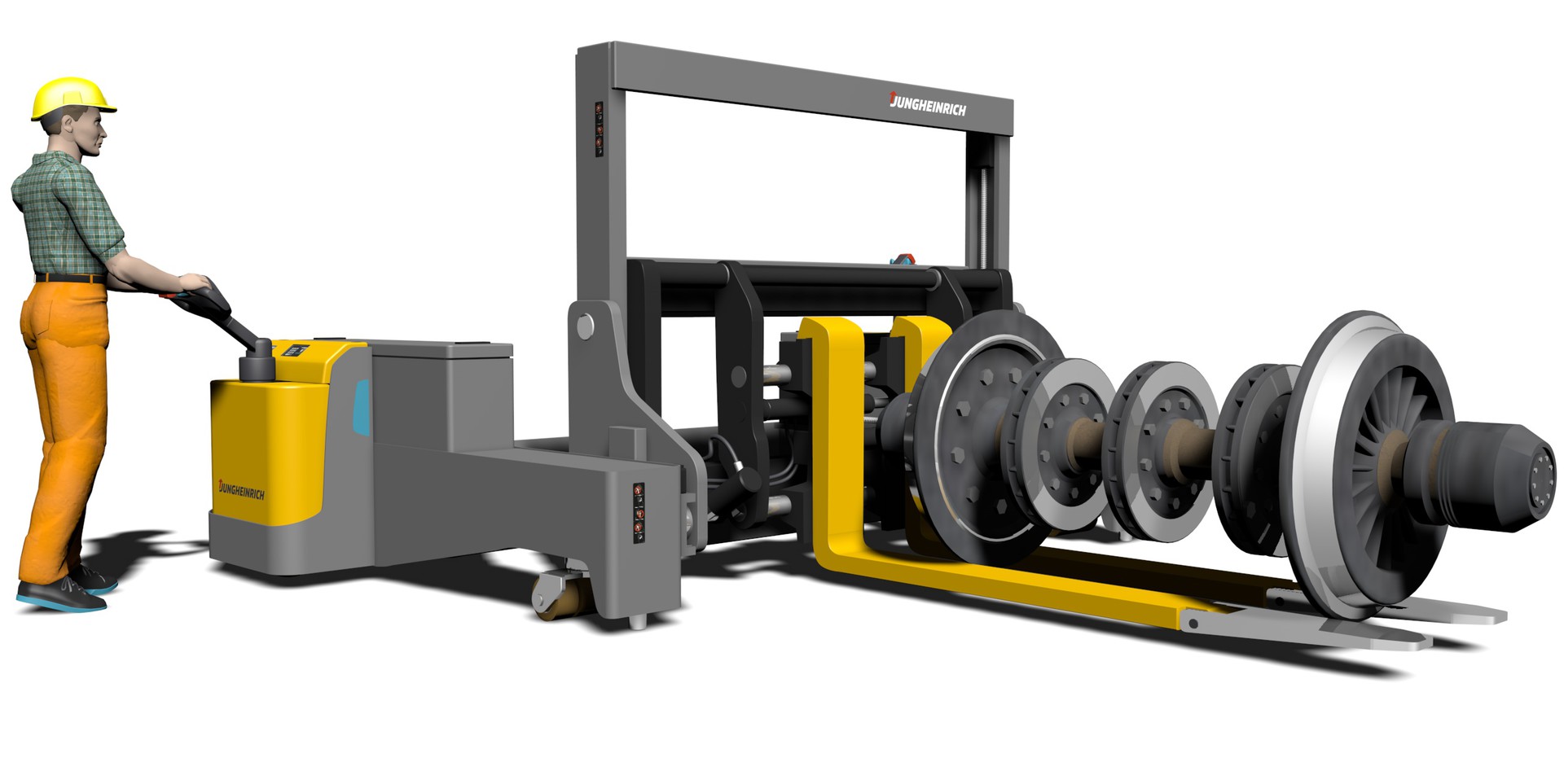
As the only internationally manufacturer of intralogistics solutions, Jungheinrich develops special build trucks, from small series to individual trucks, at its specially designed special build plant in Lüneberg. This is because special tasks, such as company-specific transport operations, unusual stored goods or complicated factory layouts require special fork lift trucks.
The Deutsche Bahn plant in Dortmund presented Jungheinrich Special Build with a particularly complex task: The development and implementation of a truck capable of changing the wheelsets on its IC / ICE trains.
The special challenge in this workshop is the longitudinal and transverse travel carrying a 2.4 m long load along an aisle which is only 2.9 m wide.
The Jungheinrich EJQ 325 is the perfect solution.
The ‘side-loader’ principle enables long loads to be transported along the narrowest of aisles. In contrast to conventional side-loader, the EJQ has two separate drive units based on the Jungheinrich EJE Series 3 pedestrian trucks. For optimum visibility, the operator can choose to operate the truck from the left or the right drive unit.
Thanks to four-way technology, the EJQ is able to manoeuvre in confined spaces:
The mast reach for picking up the wheelsets takes place via ball roller spindles in the support arms. Precision positioning is required for picking up the wheelsets.
All four hydraulic functions can be sensitively and proportional operated via the tiller head:
At Jungheinrich Special Build in Lüneburg, special build designers develop new trucks every day to meet the logistics needs of the customers.
The designers work universally and flexibly; they combine their knowledge of Jungheinrich production trucks and new technology with the circumstances of the customers.
Although the developments are creative and individual, when it comes to process reliability standards are everything.
This process reliability is achieved thanks to the intelligent combination of components from the large-scale production series.
The Jungheinrich EJQ special build solution enables Deutsche Bahn, to replace its ICE wheelsets reliably and cost-effectively.
Jungheinrich Special Build offers individual customer solutions including EU safety requirements, quality standards, test routines and ISO certifications from large-scale production.
Jungheinrich developed the EJQ 325, a tailored vehicle for picking up and moving ICE wheel sets, for the Deutsche Bahn rail company in Dortmund. The solution comprises standard components mainly produced in-house by Jungheinrich. The 2.8-kW drive motors are already used in the “Junior” segment, for example, and the tiller is fitted to existing electric lift trucks.
The main problem for DB is the limited amount of available space. The aisle width in which the wheel sets with a length of 2.4 metres are handled is only 2.9 metres wide, and there are also various obstacles in the aisle. This means precision manoeuvring is not only desirable but an absolute necessity. In order to achieve this goal, the tailored Jungheinrich solution is equipped with four different drive modes: straight ahead, transverse, circle and light diagonal. The modes are selected and shown via a display on the control unit.
The various drive modes guarantee maximum agility. There are two buttons on the tiller (one for left-hand and one for right-hand operation) for exact positioning on the final millimetres during transverse travel. As soon as the buttons are pressed, only one of the two drive units is active.
The operator has two control consoles at his disposal when operating the EJQ 325, so that he can always choose the position that offers the best view of the load and the surrounding area. The operating functions are proportional and responsive, although a very short delay in mast function control is noticeable with the second control console.
When the EJQ 325 has been driven to the correct position, the mast is extended. This is a relatively slow process due to the specific load parameters of the DB task. It takes around 40 seconds for the mast to become fully extended. This process stops automatically as soon as there is any risk of tilting. The mast can then only be pushed out further at reduced speed after the supports have been positioned via the tiller.
The truck smoothly lifts wheel sets with a maximum weight of 2.5 tonnes and a load centre of 1,000 mm up to the desired lifting height (max. 550 mm). For this purpose, Jungheinrich uses two synchronously operating hydraulic motors. To ensure safe and precise positioning, the truck is also fitted with a side shift with a range of up to 700 mm and an integrated fork spreader.
The use of standard components makes for easy and convenient operation of the EJQ. The desired drive mode is selected by pushbutton. Switching between the different modes is relatively time-consuming, but this does not constitute a disadvantage in a precision truck like the EJQ.
The well-arranged buttons and switches make for easy and precise dosing of the various functions. The stacker shows a slight drift during travel, but this is easily corrected using the fine positioning feature.
Special designs like the EJQ have been developed for special applications. In this market segment, Jungheinrich has succeeded in building a machine that meets the customer requirement of absolute precision, performing its tasks with millimetric accuracy. Speed is of no relevance for these task definitions. What characterises this truck overall is that the use of proven standard components creates a “whole” that is more than the sum of its parts.
| IFOY Test Report | Special Truck | ||||
| Truck name | Jungheinrich | ||||
| Truck Type | EJQ | ||||
| Date of test | IFOY 2016 | ||||
| Hard facts | Test Truck IFOY Test | Average other trucks | Value 1 to 10 | ||
| Productivity Max mode | NA | NA | Pallets p. 8 hrs | 7 | |
| Productivity Eco mode | NA | NA | Pallets p. 8 hrs | 7 | |
| Energy level Max mode | NA | NA | kWh 100 pallets | 7 | |
| Energy level Eco mode | NA | NA | kWh 100 pallets | 7 | |
| Driving speed with load | NA | NA | km/hr | ||
| Driving speed without load | NA | NA | km/hr | ||
| Lifting speed | NA | NA | mts/sec | ||
| Acceleration speed stand on | NA | NA | time 10 mtrs | ||
| Acceleration speed walking | NA | NA | time 10 mtrs | ||
| Averages soft facts | |||||
| First impression | 7.80 | ||||
| Load Safety | 8.00 | ||||
| Entry / exit truck | 0.00 | ||||
| Working position | 6.50 | ||||
| Activate truck | 7.50 | ||||
| Hydraulics | 8.29 | ||||
| Steering | 7.29 | ||||
| Sight | 8.40 | ||||
| Driving & Turning | 7.33 | ||||
| Parking truck | 7.75 | ||||
| Safety elements | 7.50 | ||||
| General after test | 7.67 | ||||
| Sustainability | 8.00 | ||||
| Totals | |||||
| Total average soft facts | 7.67 | ||||
| Total productivity | 7.00 | ||||
| Total Energy consumption | 7.00 |
The Jungheinrich EJQ 325 is a highly specialised truck designed to perform a complex, customer-specific transport and handling task whereby a single special consignment (ICE wheel set) is transported horizontally without loading device and has to be positioned with extreme precision for mounting/removal of the wheel sets. As a result, this special truck is not geared towards a large customer base, which means its market relevance is to be seen as low. The same applies to most special vehicles, however. At the same time, the underlying technical concept, which uses multiple smaller series-manufactured trucks to create a larger-scale special-purpose vehicle, can be used to produce a wide range of different special solutions. The philosophy of the special-purpose design experts at Jungheinrich is to develop and produce cost-effective, tailored customer-specific solutions and their components, and this is a philosophy that has potential for larger-scale use.
Customer benefit is to be described as very high, as the machine is tailor-made for the requirements and operating conditions of the customer. The four-wheel steering makes for superb manoeuvrability, which means that the user can safely transport the ICE wheel sets despite the tight operating space. In addition, the vehicle can be operated from two opposite sides.
High-precision positioning for mounting/removal is ensured by the lifting frame for raising and lowering of the load, a mast forward reach feature, mast tilting, a side slider with large displacement path and a fork positioner.
The degree of innovation is extremely high, as this kind of combination of multiple vehicles, each with its own powertrain, steering and brakes is highly sophisticated in technical terms and has previously not been realised in this way in the field of materials handling equipment. Although the four-wheel steering system is already used in multidirectional forklifts such as the ETVQ from Jungheinrich, it is nevertheless an innovation in the area of custom-made handling systems.
One true USP is the option of operating the truck from positions on two opposite sides.
The innovative technical concept has been professionally implemented, but there are still a few minor criticisms. Switching between the different steering modes is cumbersome and relatively time-consuming. Moreover, the vehicle drifts slightly to the side on the left due to the one-sided drive concept, but this can be easily compensated by steering accordingly.
| Functionality / type of implementation | + |
| Novelty / Innovation | ++ |
| Customer benefits | ++ |
| Market relevance | Ø |
| ++ very good / + good / Ø balanced / – less / — not available | |
Image/video credits: Jungheinrich AG
Finalists undergo the three-stage IFOY Audit as part of the IFOY Audit, which takes place during the TEST CAMP INTRALOGISTICS. This consists of the scientific IFOY Innovation Check, the IFOY Test and the jury test.
The bylaws set forth the core values and standards of the IFOY AWARD, which guide the organization’s actions. These include, among other things, governing bodies, the election process, evaluation criteria, and the Code of Conduct.
The International Intralogistics and Forklift Truck of the Year has three bodies: Jury, sponsors, and advisory board.