

IFOY Audit
Finalists undergo the three-stage IFOY Audit as part of the IFOY Audit, which takes place during the TEST CAMP INTRALOGISTICS. This consists of the scientific IFOY Innovation Check, the IFOY Test and the jury test.
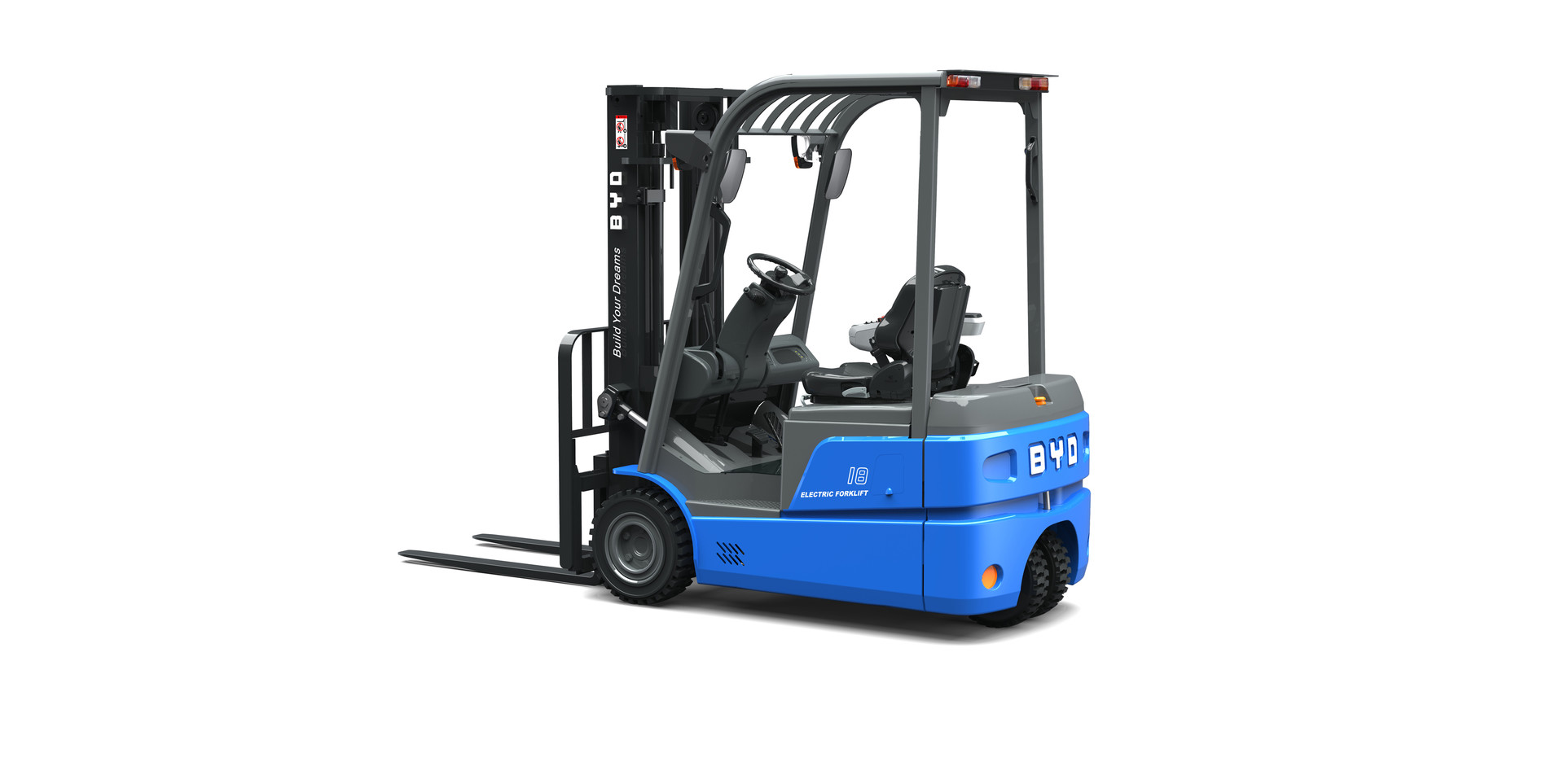


Product name and company
ECB18C – BYD
Category
Counter Balanced Truck
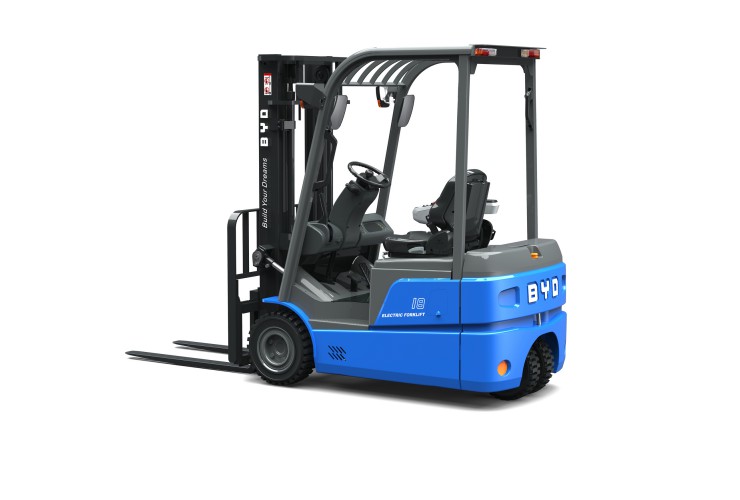
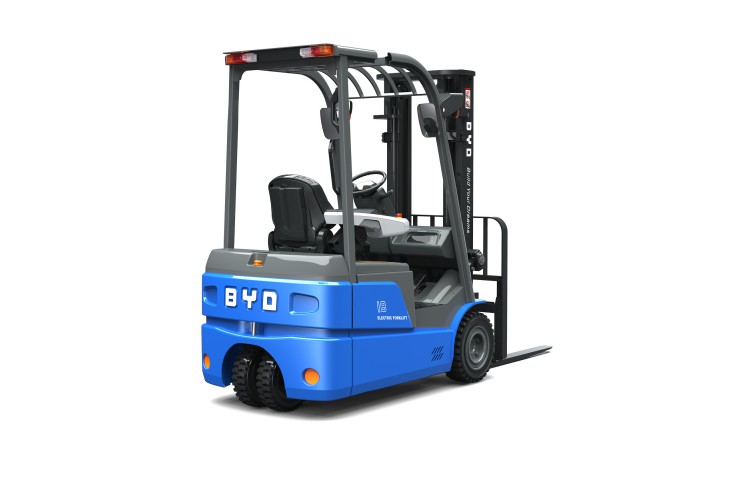
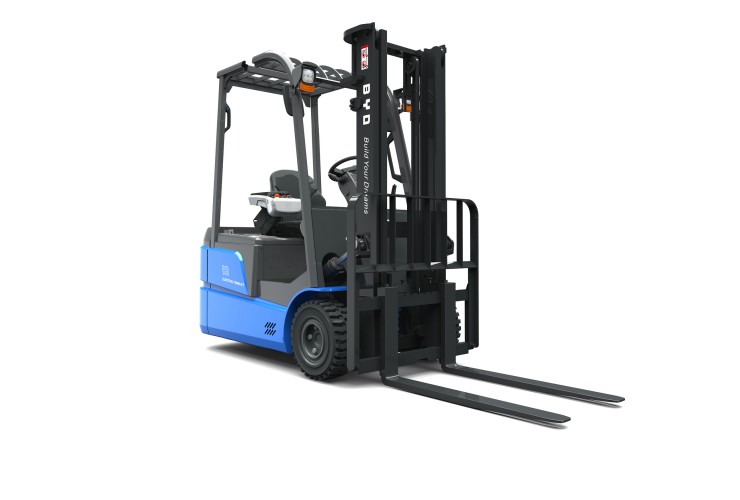
The BYD ECB18C is a 3-wheel counterbalance forklift, powered by an Iron-phosphate battery wirth 80 Volt, AC technology.
It´s advantages:
| This is a | Vollständig neues Modell |
| Date of market launch | 12/01/2015 |
| Competitive products | Jungheinrich EFG 218 LInde E18 Toyota Traigo |
| Special equipment IFOY test device |
|
| Drive type | Elektro |
| Lifting weight max. | 1800 kg |
| Truck weight | 3300 kg |
| Driving speed without load | km/h |
| Lifting speed without load | m/s |
| Lifting height max. | 6000 mm |
The trucks designed for the demanding European market by Chinese manufacturer BYD are more highly developed than rival machines made in Asia. The Chinese trucks with “European character” are all equipped with twin drive motors for additional manoeuvrability and maintenance-free wet brakes instead of drum brakes.
BYD offers the ECB 18C in a basic and a comfort version, the main difference being in the cabin features: the basic version is fitted with a mechanical lever, while the comfort version comes with electrohydraulic levers and deluxe Grammer seat.
The BYD is a good-looking machine. It is fitted with a bright, modern colour display made in-house by BYD. The selected settings and battery discharge level are easily visible. The armrest can be adjusted to suit the sitting position of the driver. Practical mini-levers make mast operation extremely convenient while offering excellent precision of mast positioning. The duplex mast in the IFOY test provides a good view of the fork tips, and all-round visibility is also good. There is a mast cushioning feature at floor level. The forklift is remarkably compact yet is in no way restrictive for the driver. Legroom and foot space are generous, and the overall finish of the BYD is far superior to that of its Chinese competitors.
The software settings of the truck are also adapted to European standards, ensuring extremely responsive handling. The driver can also choose from three operating modes on the display menu: H (High), M (Medium) and L (Low).
In “High”, the forklift shows strong acceleration, and the 80-volt battery gives ample power to the compact vehicle. Steering is predictable but could be slightly smoother on empty runs. Different tyres would also be an improvement in this respect. The power and adjustment of the curve control system have been greatly improved compared to the first edition of the BYD truck.
In addition, handling and operation of the forklift are predictable and easy. In the view of the test team, the BYD handles best of all in the “Medium” setting.
The lithium-iron phosphate batteries were developed to minimise operating costs. The battery is a fast charger, and the producer claims it has a service life equivalent to that of the machine itself. BYD still guarantees 65 percent capacity after 10 years of operation. Moreover, the battery is completely maintenance-free and can be charged anywhere – without the need for an expensive charging station or replacement batteries.
Despite its powerful performance, energy consumption of the BYD is below the test average. Thanks to the different drive modes, the driver can also influence energy consumption and therefore save additional energy. Fully electric steering or automatic steering pump shutoff in stationary operating mode could generate further potential for cost efficiency.
A battery change is no longer necessary for full-day operation, even in multi-shift duty. It is sufficient to connect the truck to the charger, preferably during every break. This is fast and easy via the side door on the forklift. The battery has no memory effect and can be charged at any time irrespective of the charging status. Thanks to its iron-phosphate technology, the BYD passed a series of tests designed primarily to test reliable battery use with flying colours.
The test measurements show that the BYD runs for almost five hours in the most heavy-duty mode, easily bridging the gap to the next break, when the battery can be almost completely recharged. In the “M” mode, the machine keeps going for just under six hours.
In the ECB18C, BYD has brought an attractive forklift on to the market which need not fear comparison with its European competitors. Indeed, BYD even offers significant value added in terms of battery technology. The battery can be re-charged rapidly, as often as desired and without memory effect, which means even three-shift duty is possible with the same battery. All the driver needs to do is charge the truck during every break.
| Hard facts | Test Truck IFOY Test | Average other trucks | Value 1 to 10 | |
| Productivity Max mode | 376 | 376 | Pallets p. 8 hrs | 7 |
| Productivity Eco mode | 361 | 350 | Pallets p. 8 hrs | 7 |
| Energy level Max mode | 9.61 | 10.93 | kWh 100 plts | 8 |
| Energy level Eco mode | 8.2 | 10.14 | kWh 100 plts | 8 |
| Driving speed with load | 15 | 15.32 | km/hr | |
| Lifting speed with load | 44.19 | 44.31 | cm/sec | |
| Acceleration speed | 9.1 | 8.54 | time for 27,2 meters | |
| Averages soft facts | ||||
| First impression | 8.00 | |||
| Load Safety | 6.50 | |||
| Entry to truck | 7.14 | |||
| Seat & Sit position | 7.33 | |||
| Legg Space | 8.25 | |||
| Activate truck | 8.50 | |||
| Hydraulics | 7.88 | |||
| Steering | 6.57 | |||
| Sight | 8.00 | |||
| Driving acceleration | 7.80 | |||
| Driving braking | 7.67 | |||
| Driving & Turning | 7.33 | |||
| Parking truck | 7.29 | |||
| Safety elements | 8.00 | |||
| General after test | 7.63 | |||
| Sustainability | 8.00 | |||
| TOTALS | ||||
| Total average soft facts | 7.62 | |||
| Total productivity | 7.00 |
The forklifts in the BYD ECB18C series are electrically powered, have a load capacity of 1.8 t and a lift height up to 6 m. In times of increasingly stringent emission regulations, electrical drive concepts are playing an ever greater role; indeed, only forklift trucks of this type may be used indoors. This makes the BYD ECB18C series an attractive proposition for a growing number of customers, and the high satisfaction levels of many customers underline the success of the significant technical improvements.
The BYD ECB18C uses a lithium-ion battery with an iron phosphate cathode designed to ensure more flexible operation, an improved machine utilisation factor, and greater environment-friendliness. The relevance of this development can be described as very high, as the innovation offers benefits for all customers.
Lithium-ion batteries have numerous advantages over lead batteries and increase flexibility for the customer. The absence of a “memory effect” together with fast charging capability allows the operator to charge the stacker during breaks without any serious wear effects on the battery. This obviates the need for extra batteries in the battery pool, particularly in shift operations, while reducing the amount of space required for the charging station. The battery can be more completely discharged and charged far more efficiently. Moreover, the energy generated during braking is taken up more effectively by the battery. This generally translates into lower energy consumption and therefore reduced operating costs.
Alongside all the advantages of lithium-ion technology, the use of iron phosphate as cathode material also has clear benefits. The battery has a higher power density, which is particularly advantageous for industrial trucks. In laboratory trials, the battery exhibits a longer service life and improved operational reliability. Resistance to low temperatures down to -40°C additionally means longer operation in cold stores. The decision not to use cobalt and the lower lithium requirements make this battery more environment-friendly and its disposal cheaper.
The manufacturer gives an 8-year warranty on the battery (corresponding to the depreciation period of the forklift), although the actual service life may be longer. This means the service life of the iron phosphate batteries is considerably longer than that of conventional lead batteries, rendering subsequent purchase of a replacement battery unnecessary. On the whole, the battery can be expected to pay for itself within just a few years depending on deployment conditions.
Lithium-ion batteries are used in the automotive and consumer electronic sectors, where they are state of the art. The use of iron phosphate as cathode material represents a clear innovation in this area and helps to bypass the drawbacks of the otherwise standard lithium-ion battery with lithium-cobalt cathodes in terms of reliability, durability and operating life. The use of these batteries in forklift trucks is an innovative concept.
The BYD ECB18C is a newly developed machine that enables the end user to take advantage of the lithium-ion technology while supplying further benefits in terms of reliability and environment-friendliness.
| Functionality / type of implementation | ++ |
| Novelty / Innovation | ++ |
| Customer benefits | ++ |
| Market relevance | ++ |
| ++ very good / + good / Ø balanced / – less / — not available | |
Image/video credits: BYC
Finalists undergo the three-stage IFOY Audit as part of the IFOY Audit, which takes place during the TEST CAMP INTRALOGISTICS. This consists of the scientific IFOY Innovation Check, the IFOY Test and the jury test.
The bylaws set forth the core values and standards of the IFOY AWARD, which guide the organization’s actions. These include, among other things, governing bodies, the election process, evaluation criteria, and the Code of Conduct.
The International Intralogistics and Forklift Truck of the Year has three bodies: Jury, sponsors, and advisory board.