

IFOY Audit
Finalists undergo the three-stage IFOY Audit as part of the IFOY Audit, which takes place during the TEST CAMP INTRALOGISTICS. This consists of the scientific IFOY Innovation Check, the IFOY Test and the jury test.

Product name and company
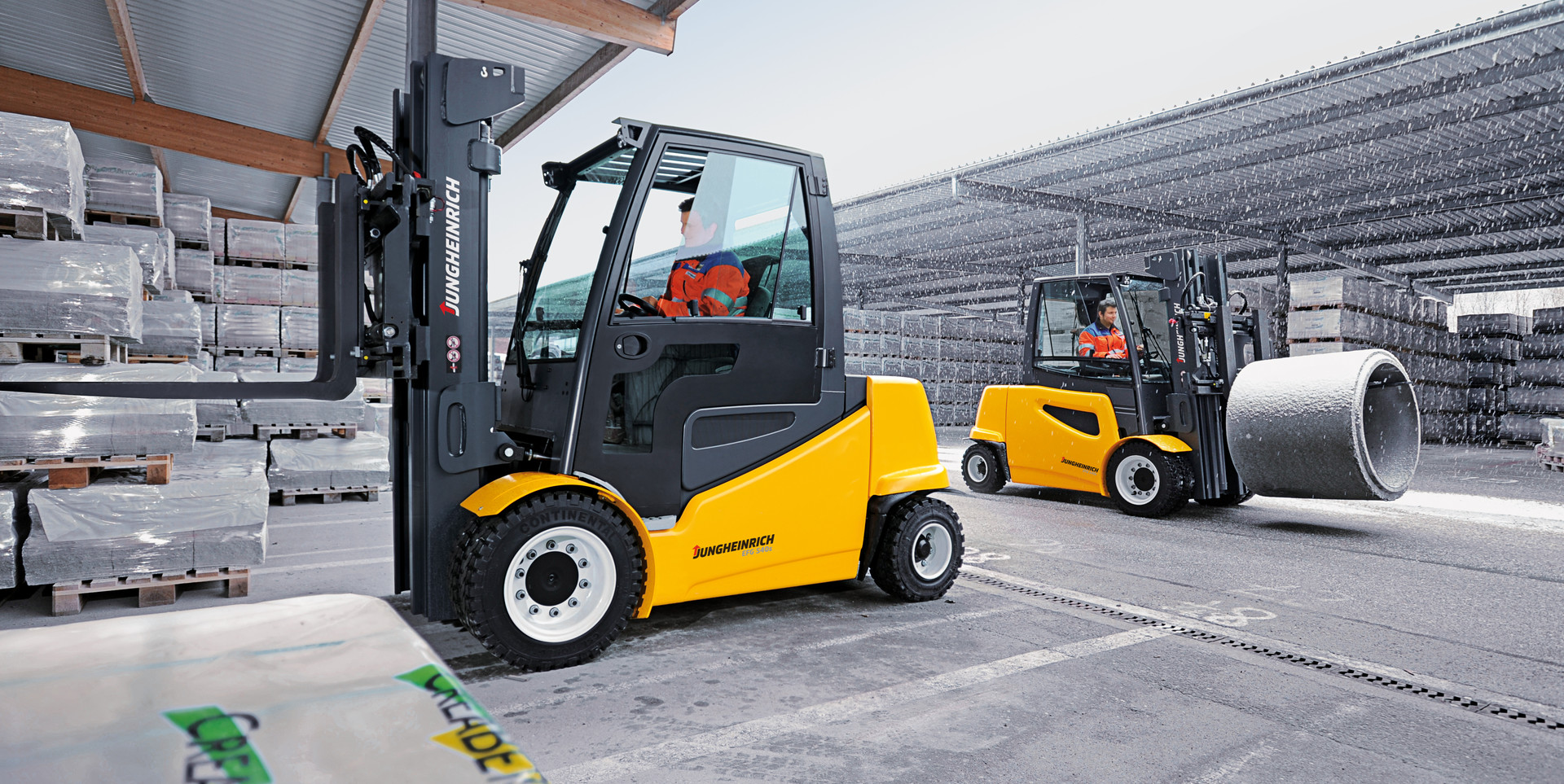
EFG S40 – Jungheinrich
Category
Counter Balanced Truck
With the introduction of the S line as a special element of the new EFG Series 5 electric fork lift trucks, Jungheinrich has expanded the ‘Pure Energy’ technology concept via the 48-V and 80-V motors into the 3.5 to 5.0 tonnes capacity classes. ‘Pure Energy’ enables a reduction of up to 20% in energy consumption (in comparison with the preceding model). Consequently, it is now possible for a truck in this class to complete two shifts with a single battery charge.
With the introduction of S line, two important customer requirements have been met:
1. The requirement for high residual capacities – particularly in connection with attachments and
2. the requirement to increasingly use emission-free trucks outdoors – as a replacement for trucks powered by internal combustion engines.
The ergonomics have also been designed with Jungheinrich’s typical focus on an operator-oriented workstation: A day’s work is made easier with controls which can be intuitively adjusted and many storage options.
The Series 5 is completed with the SnapFit lateral battery exchange system. SnapFit guarantees the reliable, simple and quick repla%ment of batteries.
Pure Energy technology package
Pure Energy comprises three components. 4th generation 3-phase AC technology, compact electronics and compact hydraulics. The current 3-phase AC technology optimises the coordination of hardware and software, bringing them to a new, optimum level of efficiency. The result is maximum throughput with the lowest consumption and two-shift operation on one battery charge.
Parameter steering
With parameter steering, steering support is dependent on the travel program. At low speeds, support from the electrical steering is high – the operator needs to make fewer movements of the steering wheel. At higher speeds, the steering support diminishes. The advantages are: a) minimising unwanted steering movements, b) more legroom due to more compact design and c) further improvement in energy efficiency and throughput.
S line
With the introduction of 3-phase AC technology in electric counterbalanced trucks, these will increasingly be used outdoors and as an alternative to trucks with internal combustion engines, particularly in Europe. In addition, applications will become more specific and, consequently, attachments will be tailored more precisely to applications. The S line offers the necessary range of features needed by customers for difficult indoor and outdoor applications as well as costly attachments.
Energy saving of at least 20% compared with preceding model
In addition to maximum throughput for the lowest possible consumption (as per Andersom Testing comparison test), the aim was to achieve two-shift operation on one battery charge for the first time in the 3.5 to 5 tonnes class.
Adaptation to changing market/customer requirements
Another main aim of the development project was the adaptation of the series to changing market conditions. Due to a) the tightening up of emission regulations, b) customer requirements for lower carbon footprints and c) a more favourable Total Cost of Operations, electric counterbalanced trucks are being considered more frequently for applications where, until now, conventional diesel or LPG trucks would have been used. This demands flexibility regarding the attachments and truck characteristics which have been further optimised for outside use. All this has been achieved with the S series.
Lateral battery exchange with SnapFit
Quick battery access is the most frequently expressed customer requirement for battery handling on common pedestrian pallet trucks. The SnapFit battery exchange system, previously designed for EFG Series 2, 3 and 4, has now also been installed for Series 5.
The main benefits for the user are improved cost-effectiveness, reliability and ergonomics.
The new EFG Series 5 offers improved energy efficiency and throughput. With two-shift operation now possible on one battery charge and the associated lower Total Cost of Operations, running costs are reduced and cost-effectiveness is increased.
With the SnapFit battery exchange, the excellent visibility and the wide variety of assistance systems the forklift truck is designed to provide a high level of safety.
Due to the infinitely and intuitively adjustable controls (armrest, steering wheel), the many storage options and a space-saving steering column, the EFG Series 5 enables the operator to work comfortably and without becoming fatigued.
| This is a | Vollständig neues Modell |
| Date of market launch | 04/11/2013 |
| Competitive products | Linde E40/600HL Still RX60-40/600 Toyota 7FBMF40 |
| Special equipment IFOY test device |
|
| Drive type | Elektro |
| Lifting weight max. | 4000 (@ 600mm) kg |
| Truck weight | 7176 kg |
| Driving speed without load | km/h |
| Lifting speed without load | m/s |
| Lifting height max. | 7180 mm |
In the summer of 2013, Jungheinrich extended its forklift programme with a series specifically designed for heavy-duty use. The “S” series comprises three electric models and one diesel model for use with add-on devices or very deep loads. The models in the electric series are available in 3, 4 and 5-ton versions, the diesel model only as a 5-ton truck. The load centre of gravity of the S series is not at 500 mm but at 600 mm. The model EFG S40s is nominated for the IFOY Award.
The powerful appearance of all S series models is instantly apparent. Both the front and rear axles are wider than usual and give the truck a “broad shoulder” look. Navigating the test course with the additional width takes some getting used to, as the driver cannot seen the rear axle.
The workplace of the EFG S40s is more or less identical to that of the smaller EFG model. The cabin step-up is slightly higher than in other trucks in this segment, but sufficiently spacious and convenient to ensure safe and easy entry and exit. The grey non-slip grating is easily visible and further enhances driver safety. The footwell is generously dimensioned and free of obstacles. Both the gas and brake pedals are set at a convenient height and distance.
After a short time on the Jungheinrich EFG S40s, it is clear that this powerful electric truck is from the same stable. The electric steering is precise and predictable. One new feature is the parameter steering, which adjusts the steering characteristics of the truck to suit the selected drive mode. The main advantage of this feature is precision driver-friendly steering at all speeds. The steering column is equipped with a lever for height and tilt adjustment. The automatic parking brake works smoothly and flawlessly, and mast operation is as expected. The response of the single “Solo-Pilot” control lever is precise and the speeds are satisfactory.
With its top speed of 16.4 kmh, the test truck is fast enough to remain fully controllable with and without load. The braking power on the drive motor depends on the selected drive mode and is almost always at the level that the driver would generally expect.
Thanks to the new “Pure Energy” concept, the Jungheinrich truck achieves added energy savings without any sacrifice in terms of productivity. At the max settings (Drive Mode 5), productivity is only slightly (2.3%) lower than that of the high-performance 5-ton models while energy consumption is a massive 42% lower, increasing to 48 percent in energy-saving mode (Drive Mode 3), which means that the battery (930 Ah) in the EFG S40s is good for almost two full shifts.
With the extra power in the S series, Jungheinrich has achieved major improvements in the handling of low and high loads. The forklift is robust and well made. Handling is extremely predictable, and the truck is quiet and highly fuel-efficient. The productivity of the “S” series is competitive, and the big side door permits fast battery changeover.
| Hard facts | Test Truck IFOY Test | Average other trucks | Value 1 to 10 | |
| Productivity Max mode | 293 | 297 | Pallets p. 8 hrs | 7 |
| Productivity Eco mode | 280 | 280 | Pallets p. 8 hrs | 7 |
| Energy level Max mode | 23.2 | 35 | kWh 100 plts | 9 |
| Energy level Eco mode | 21.6 | 26 | kWh 100 plts | 9 |
| Driving speed with load | 16.36 | 18.02 | km/hr | |
| Lifting speed with load | 38.86 | 38.5 | cm/sec | |
| Acceleration speed | 9.6 | 9.2 | time for 27,2 meters | |
| Averages soft facts | IFOY Test | |||
| First impression | 8.60 | |||
| Load Safety | 9.00 | |||
| Entry to truck | 7.71 | |||
| Seat & Sit position | 8.67 | |||
| Legg Space | 8.00 | |||
| Activate truck | 8.50 | |||
| Hydraulics | 8.50 | |||
| Steering | 8.57 | |||
| Sight | 7.50 | |||
| Driving acceleration | 7.80 | |||
| Driving braking | 8.67 | |||
| Driving & Turning | 8.00 | |||
| Parking truck | 7.86 | |||
| Safety elements | 8.25 | |||
| General after test | 8.75 | |||
| Sustainability | 8.00 | |||
| Totals | ||||
| Total average soft facts | 8.27 | |||
| Total productivity | 7.00 | |||
| Total Energy consumption | 9.00 | |||
| Total result all facts | 8.14 | |||
Jungheinrich’s goal is to achieve higher energy savings through a combination of measures and to produce the first truck in its class that boasts an operating time that permits non-stop duty for two shifts without the need to change the battery. A further aim is to optimise the ergonomics of the truck with an adaptive concept for steering power support.
In order to implement its concept of an energy-saving counter balanced truck, Jungheinrich has optimised various existing technologies and combined them in such a way that they achieve the defined targets. For the development of the adaptive steering power support feature, the company has adapted a known technology and equipped the electric steering unit of the EFG S40 with a function similar to that used in conventional cars for speed-dependent regulation of steering power.
According to Jungheinrich, the combination of three technical elements in this optimised form results in energy savings of at least 20 percent compared to the predecessor model. This concept, which Jungheinrich calls “Pure Energy”, is based on the threephase technology that is already being used in the 4th generation of its trucks, underlining the fact that this a further development of an existing technology. The two other elements in this concept are the “compact control system” and the “compact hydraulic assembly”. Electrical elements such as a power switch or the computer for control and regulation of the driving and lifting functions have been merged to create integrated control modules specifically for this type of counter balanced truck. The hydraulic components have also been carefully selected and adapted. With this strategy, which represents an alternative to the use of generally available standard components, Jungheinrich is following the trend towards functional integration using embedded systems. If backed up by suitable design parameters, this concept can help to achieve the targeted improvements in efficiency.
Taken together, the three efficiency-enhancing elements introduced by Jungheinrich represent an extremely interesting approach, and the positive effects of this approach may be reflected in the achievable parameters for consumption and operating time. This is something that will have to be verified in the various test categories. The partial innovations employed by Jungheinrich are based on known concepts in a combination and design that constitute an innovative further development for the truck category in question.
The adaptive steering concept is a systematic further development of the assistant system from everyday road vehicles for use in MHE units.
| Functionality / type of implementation | ++ |
| Novelty / Innovation | ++ |
| Customer benefits | ++ |
| Market relevance | ++ |
| ++ very good / + good / Ø balanced / – less / — not available | |
Image/video credits: Jungheinrich AG
Finalists undergo the three-stage IFOY Audit as part of the IFOY Audit, which takes place during the TEST CAMP INTRALOGISTICS. This consists of the scientific IFOY Innovation Check, the IFOY Test and the jury test.
The bylaws set forth the core values and standards of the IFOY AWARD, which guide the organization’s actions. These include, among other things, governing bodies, the election process, evaluation criteria, and the Code of Conduct.
The International Intralogistics and Forklift Truck of the Year has three bodies: Jury, sponsors, and advisory board.