

IFOY Audit
Finalists undergo the three-stage IFOY Audit as part of the IFOY Audit, which takes place during the TEST CAMP INTRALOGISTICS. This consists of the scientific IFOY Innovation Check, the IFOY Test and the jury test.

Product name and company
The STILL Route Train Concept – Still
Category
Warehouse Truck „lowlifter“
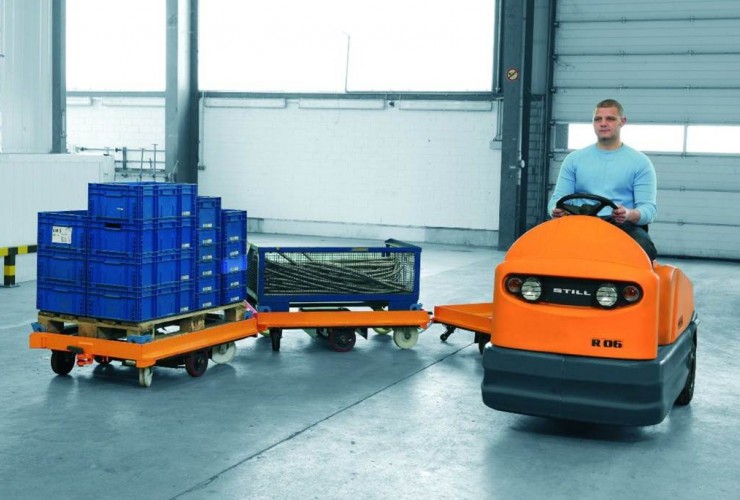
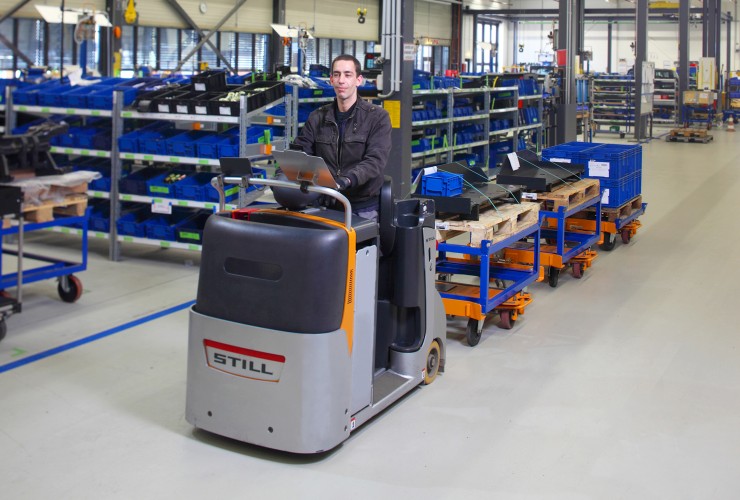
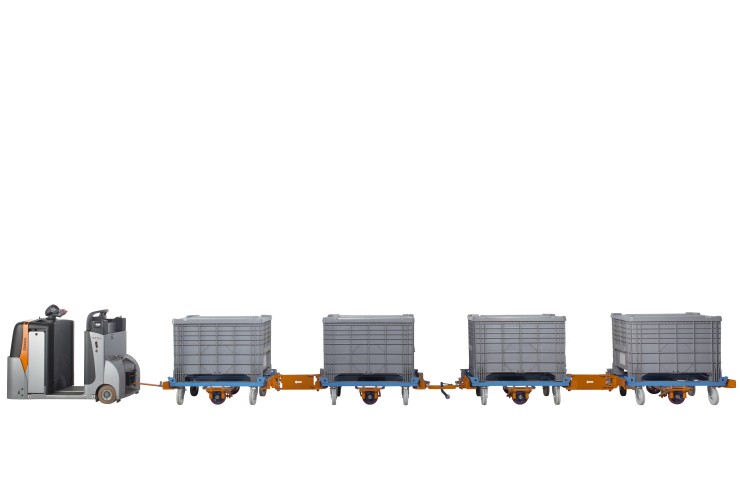
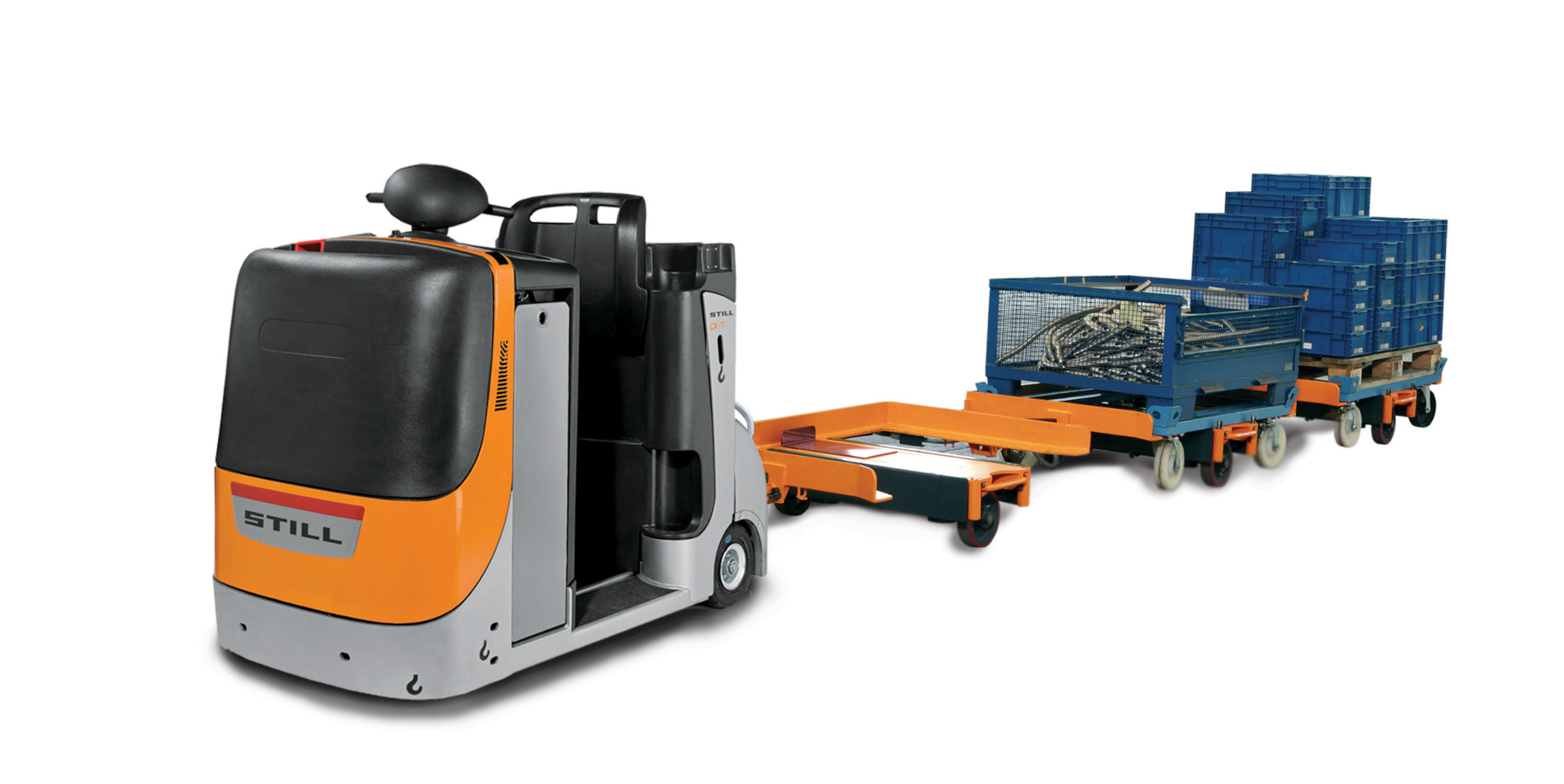
New logistics and production concepts (lean production) are presently seeing a trend not only to increase efficiency and to reduce costs (operational expenses and human resource costs) but also to prevent any kind of waste. Waiting times, transports, moving materials and retrofitting work is to be limited to a minimum. Such requirements triggered the idea of the future factory with few trucks in which virtually all transports of materials are handled by tugger trains.
For this trend, STILL has developed a new version of the tugger train which does not only increase efficiency but also improves occupational safety and eco-friendliness. The new tugger trains make material handling more comfortable for the user, the turnaround will speed up and there are more possible applications.
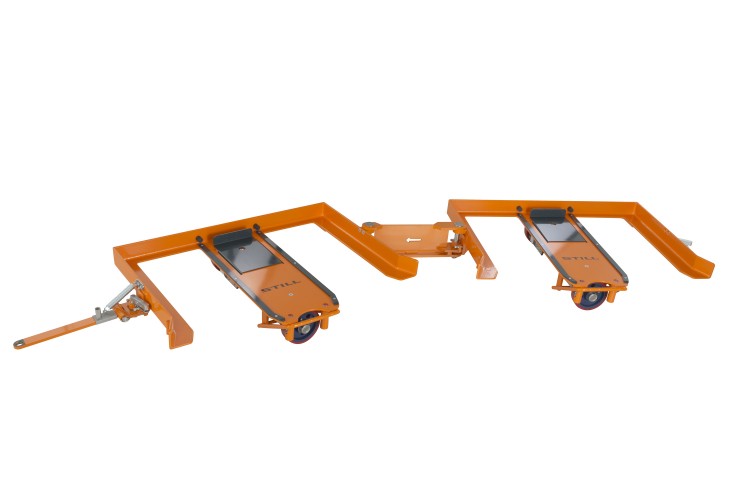
Up to now the STILL tugger train was available with a tractor and pneumatically or hydraulically operated C-type or E-type frames. In the newly developed version of the E-type frame, the generator producing the pressure needed for lifting was integrated into the frame so that the new frame now operates independently of the power supply by the tractor. This way hydraulic or pneumatic connections from the tractor to the trailers/load carriers with the trolleys are not needed anymore. This does not only save time but also electric energy. The pressure must not be generated to lift all the trailers but only for the one that is actually being loaded. When the new trolley is pushed completely into the frame, it will automatically lift. The autonomous trailers allow combining the tugger trains even more flexibly, e.g. when operating several trains with one tractor.
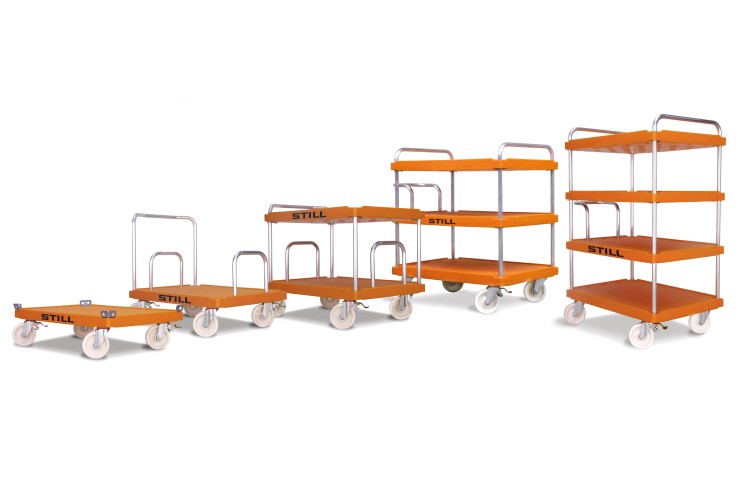
The staff in production often have to push or pull heavy trolleys. To facilitate handling, it is therefore necessary to minimise the tare weight of the trolley as much as possible. The innovative series of resilient plastic trolleys it ideally suitable for this. It is designed as a modular system for load weights up to 1 000 kg and makes load handling in production, warehouse and workshop much easier.
The target for STILL in developing the autonomous frame and the respective trolleys was not only to substantially facilitate handling but also to improve the efficiency and the functional safety in case of a failure of the tractor.
Goal for the development was to improve the hydraulically or pneumatically operated C-type and E-type frame of the conventional tugger train. Especially the time needed to change the tractors or individual trailing frame had to be reduced. In case of failure or defect of a tractor there is often no replacement truck to move the train. In this case the replacement truck is often only connected provisionally to the train, i.e. without the hydraulic/pneumatic connection. This impairs operational safety. A solution cost-efficient, universally applicable and functional solution was needed to solve this problem. Another goal was to optimise handling of the tugger train. On one hand physical effort for the worker had to be minimised and on the other hand the tugger trains as such were to be made more flexible. Requirements for this were the capability to load the trains from both sides, a lean design and easy loading and unloading the frames with the trolleys.
Discarding of the hydraulic/pneumatic connections in-between the trainers saves work time and electric energy. Each load carrier can be lifted and lowered individually, so that only the energy to lift one trailer is needed opposed to the energy to lift each trailer in the train. The more trailers the train has, the more energy is saved. When travelling a pump reloads the pressure vessel mounted beneath the chassis of the trailer. The autonomous trailers allow to combine the trains more flexibly and the time needed to modify the trains is shortened. The autonomous pressure generation does not only save space and reduces the risk of oil spillages, it also increases safety. The trailers can operate autonomously so that they are independent from the tractor used. This means that when changing the tractor, it is not necessary to match the correct pneumatic or hydraulic combination of tractor and trailers. The innovative product series of plastic trolleys is ideally suited for operation with the STILL tugger train. The series is designed as a modular system, rated to carry load up to 1 000 kg to facilitate load handling in production, warehouse and workshop. The low weight of the trolleys substantially reduces the weight of the whole train cutting the power consumption, floor loads and physical effort staff need to make when moving the trolleys. During an eight-hour shift clocked in 10-minute cycles with four E-type frames, the moved weight can be reduced by as much as 1 152 kg.
| This is a | Vollständig neues Modell |
| Date of market launch | 07/01/2011 |
| Competitive products | k. A. |
| Special equipment IFOY test device |
| Drive type | Elektro |
| Lifting weight max. | 1000 kg |
| Truck weight | 170 kg |
| Driving speed without load | km/h |
| Lifting speed without load | m/s |
| Lifting height max. | mm |
In line with innovative production and logistics concepts (lean production), the trend is not only towards increased efficiency and cost reduction (operating and personnel costs) but also geared towards avoiding all kinds of wastage. The aim is to minimise waiting times, re-working, unnecessary transports and material movements. With this in mind, Still has implemented the idea of a truck-reduced factory in which virtually all transport tasks and stock movements are performed by tugger trains.
To this end, the developers have designed and built a new type of tugger train which the manufacturer says is not only more efficient than comparable tugger train concepts on the market but also superior in terms of safety and environment-friendliness. The new Still tugger train makes handling even more convenient, increases loading and re-loading performance and extends the range of application options.
The tugger train concept has been continuously optimised and perfected since its 2011 launch and ensures flexible and easy transport operations. For the IFOY test, Still provided a CX-T as a towing tractor for the tugger train. The tractor has a maximum capacity of 4 tons. The Still R 06 tractor (up to 6 tons) and the recently launched Still R 07 (with a maximum towing load of 25 tons) based on the same concept are available for heavier loads. But the tractor has numerous advantages even if used by a different manufacturer or in a combined fleet.
The CX-T is available with built-in hydraulic pump and clutch, and a pneumatic version is also available for use in sectors like the food industry. As the trolleys on the trailers are raised while the machine is in motion and are therefore not in contact with the floor, there is significantly less wear on the wheels and operation is pleasantly quiet.
The trailers are available with C and E profiles. The E frame (as used in the IFOY test) is only equipped with one axle, which makes the train extremely agile. The rubber wheels of the trailers are extremely quiet. The “E profile” trailers are fitted with their own on-board hydraulic system. The movements during transport build up pressure, which is stored. This pressure is then subsequently used for lowering and (after handling) lifting during the loading and unloading of the trolleys on the trailers. The trailers are lifted automatically as soon as the trolley is driven to the stop point. The integrated hydraulic system renders an additional connection between the trailers unnecessary, and this rules out the possibility of leakage. If desired, the user can lower or raise individual trailers when using the tugger train. This saves energy, although the saving is only marginal.
The tugger train concept from STILL is a plug-and-play solution that can be adapted to suit the specific circumstances of the customer rapidly and without any tools. The trailers are extremely agile and easy to manoeuvre. Moreover, very little power is required to drive the trolleys in and out, and the loads are automatically secured, thereby always ensuring safe operation.
When driving the tugger train, the trailers followed the chosen route perfectly. This makes for safe and high-precision operation. The train is based on the CX order picker that has already been on the market for a number of years. The machine is easy to operate, offers a high level of driver comfort and has an extremely low entry height.
| Hard facts | Test Truck IFOY Test | Average other trucks | Value 1 to 10 | |
| Productivity Max mode | no measurements | tows | 7 | |
| Productivity Eco mode | no measurements | tows | 7 | |
| Energy level Max mode | no measurements | kWh towing | 7 | |
| Energy level Eco mode | no measurements | kWh tow | 7 | |
| Driving speed with load | 10.78 | km/hr | ||
| Acceleration speed | 10.4 | time for 27,2 meters | ||
| Averages soft facts | ||||
| First impression | 8.00 | |||
| Load Safety | 7.00 | |||
| Entry to truck | 8.57 | |||
| Seat & Sit position | 9.00 | |||
| Legg Space | 8.50 | |||
| Activate truck | 8.00 | |||
| Steering | 7.43 | |||
| Sight | 9.00 | |||
| Driving acceleration | 8.60 | |||
| Driving braking | 8.00 | |||
| Driving & Turning | 7.33 | |||
| Parking truck | 8.17 | |||
| Safety elements | 7.60 | |||
| General after test | 7.38 | |||
| Sustainability | 8.00 | |||
| Totals | ||||
| Total average soft facts | 8.04 | |||
| Total productivity | 7.00 | |||
| Total Energy consumption | 7.00 | |||
| Total result all facts | 7.52 |
Image/video credits: Still GmbH
Finalists undergo the three-stage IFOY Audit as part of the IFOY Audit, which takes place during the TEST CAMP INTRALOGISTICS. This consists of the scientific IFOY Innovation Check, the IFOY Test and the jury test.
The bylaws set forth the core values and standards of the IFOY AWARD, which guide the organization’s actions. These include, among other things, governing bodies, the election process, evaluation criteria, and the Code of Conduct.
The International Intralogistics and Forklift Truck of the Year has three bodies: Jury, sponsors, and advisory board.