

Crisis? What kind of crisis?
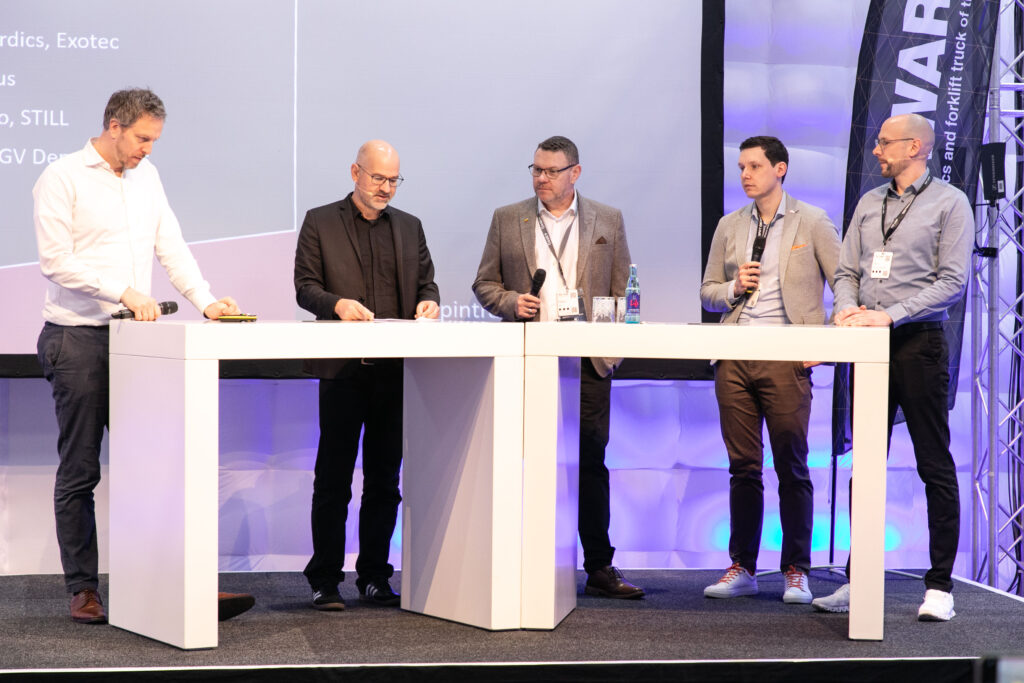
Manufacturers of robotics and intralogistics solutions are calling for changes from politicians so that companies can once again plan ahead and invest in new systems. This was one of the key statements from the panel “Crisis – what crisis? Where does the industry go to?”, which was moderated by Thilo Jörgl from the management of TEST CAMP INTRALOGISTICS. The IFOY Finalists 2025 were also represented at TEST CAMP INTRALOGISTICS.
Dr. Wolfgang Hackenberg, who represented the VDMA’s Automated Guided Vehicles department as a member of the Executive Board, pointed out that German manufacturers are currently suffering from the structural problems in the automotive industry and weaknesses in competitiveness. In this context, he referred to the VDMA’s forecast from the end of January. For 2025, the industry association is forecasting a decline in total sales for the robotics and automation sector of minus nine percent to 13.8 billion euros. At the same time, it emphasized that there had been considerable differences in the sales markets in 2024. According to the VDMA, the eurozone was a bright spot for German robotics and automation: Incoming orders from eurozone countries rose by 44 percent in 2024.
In this context, Simon Houghton, Sales Director Northern Europe at Chinese manufacturer Geekplus, also pointed out that it is important to differentiate between countries: “Business in China is going well for us,” said Houghton. There have also been “interesting discussions” in Europe recently.
Markus Schlotter, Managing Director Central Europe & Nordics at Exotec, said that in order for the industry in Germany to regain momentum, politicians must set a new course and ensure better competitiveness. “The pipelines with major projects have been full for many years, but many projects have been postponed in the past year,” said Schlotter. He also pointed out that a trade war with tariffs and counter-tariffs could weaken manufacturers in Europe.
According to Sascha Jordan, Senior Director Strategy & Solution Portfolio at STILL, many manufacturers are expecting a boost for the industry from simple automation solutions. “They have become cheaper and the barriers to entry for automation are lower than they were a few years ago,” says Jordan. In his opinion, this also opens up new prospects for many SMEs that previously shied away from large automation projects. “Automation can have great success in small steps. You don’t have to start with a large, fully automated system,” says Jordan.
Overall, manufacturer representatives at the major spring trade fairs, such as LogiMAT, were in a better mood than in the previous year. “We had discussions with specific project plans,” reported Schlotter. Many expect a boost from the further development of new technologies – above all artificial intelligence. “Whether industrial image processing or robotics – there are many use cases for artificial intelligence in intralogistics,” said Simon Houghton. Dr. Wolfgang Hackenberg, on the other hand, does not expect any revolutionary applications in intralogistics from the trending topic of humanoid robots: “For many processes, mobile robots with gripper arms are sufficient – humanoid robots are not necessary for this – and ultimately too expensive,” says Hackenberg.