

Automation of industrial trucks: evolution, not revolution
The discussion about automation in intralogistics often oscillates between utopian visions of dark warehouses without people and the stark reality of costs, complexity and human interaction. At the TEST CAMP INTRALOGISTICS in Dortmund, a panel of global experts brought perspective and pragmatism to the debate.
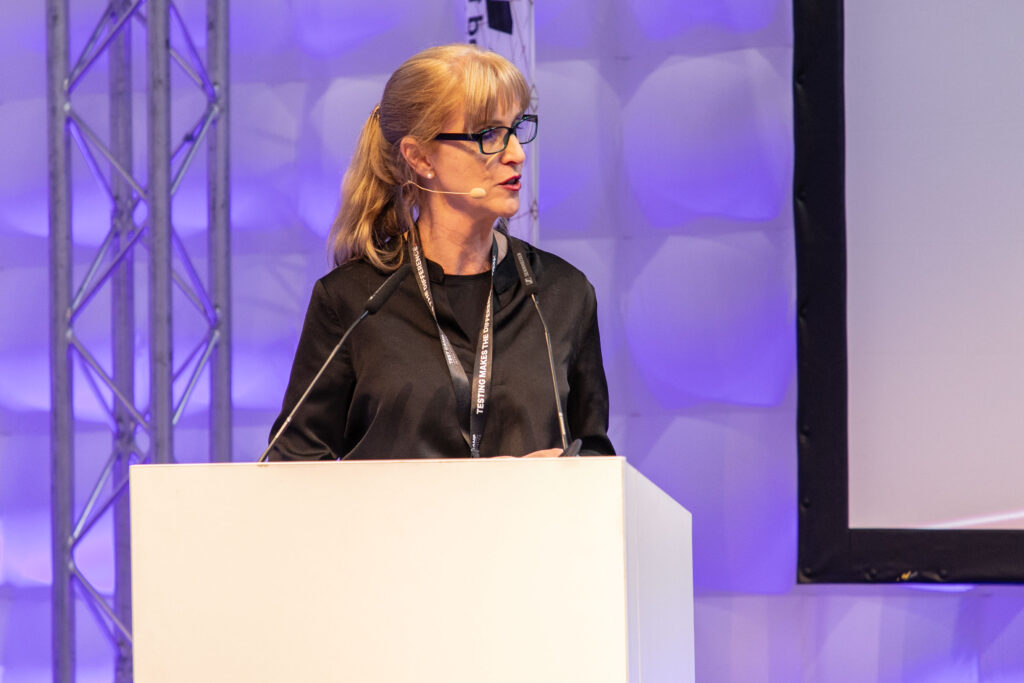
Arjan Van Zanten, Head of EP CARE Dealer Support at EP Equipment, Michael Röbig, Head of Product Management at HUBTEX, Niklas Wilkowski, Head of Segment Stacker Trucks & Low Level Order Pickers at Jungheinrich, and Professor Dr. Johannes Fottner, holder of the Chair of Materials Handling Material Flow Logistics fml at the Technical University of Munich, took part in the discussion. Together, they discussed the real challenges and opportunities of automating warehouse trucks.
Van Zanten believes that the next big step lies in the democratization of automation. “The user interface can be made much simpler. The big companies will continue to drive automation forward. The big breakthrough will come from medium-sized companies. And these companies will benefit from a hybrid approach,” he explained.
For Van Zanten, AI is the key to this change. From the intelligent collection of goods and their positioning to the integration of all data touchpoints in logistics, he sees automation not only as a means of increasing efficiency, but also for structural rethinking: “There is a growing market for hybrid solutions. We will still need people. Because they are very flexible and it is impossible to automate everything that employees can do.”
This hybrid reality was underlined by Röbig. He cautioned against the assumption that fully autonomous systems are imminent. “Less than five percent of customers looking at AGVs go all the way to automation,” he said. “The return on investment is often just not there – especially if the infrastructure or processes aren’t there yet.”
Instead, HUBTEX is investing in semi-automated functions and customized vehicles that are tailored to specific logistical challenges. “We are still at an early stage of true AI integration,” says Röbig: “The future lies in the intelligent combination of manual and automated systems.”
Niklas Wilkowski from Jungheinrich agreed that fully automated distribution centers that are not operated by humans are currently nowhere to be seen. “In some warehouses, there are outdated processes and infrastructures that are not designed for automation,” he explained. “The first step is to optimize these processes, digitize them and only then determine which parts should be automated. In his view, automation should always serve a clear purpose. “It is not a goal in itself. It has to improve efficiency or safety – or help customers achieve their goals. If that’s not the case, manual processes will remain more competitive.”
Prof. Dr. Johannes Fottner brought an academic perspective to the discussion. “There is no universal answer in logistics,” he said. “Success lies in the combination of systems that support people. Sometimes that is automation. Sometimes it’s not. Some people say: we can’t automate everything. I don’t agree with that: I’m sure we can. The question is just whether it makes sense and whether we should do it.” He also questioned the misconception that humans are safer than automated technology: “The opposite is true, and in the race between automated and manually controlled systems, I think this would also improve the chances of automated systems.”
So automation is clearly progressing, and it is safe – but it will continue to evolve. “We’ve already seen big steps in automation, but the real change will be devices in the warehouse that can understand and react to their environment just like a human – only faster, safer and without fatigue,” says Röbig.
Until then, the warehouse of the future will not be deserted. Yes, the equipment in it – especially the industrial trucks – will be smarter, more responsive and better networked. However, the panel’s message was not one of total upheaval. Instead, it was about integration and complementing people – not replacing them.