

IFOY Audit
Finalists undergo the three-stage IFOY Audit as part of the IFOY Audit, which takes place during the TEST CAMP INTRALOGISTICS. This consists of the scientific IFOY Innovation Check, the IFOY Test and the jury test.


Product name and company
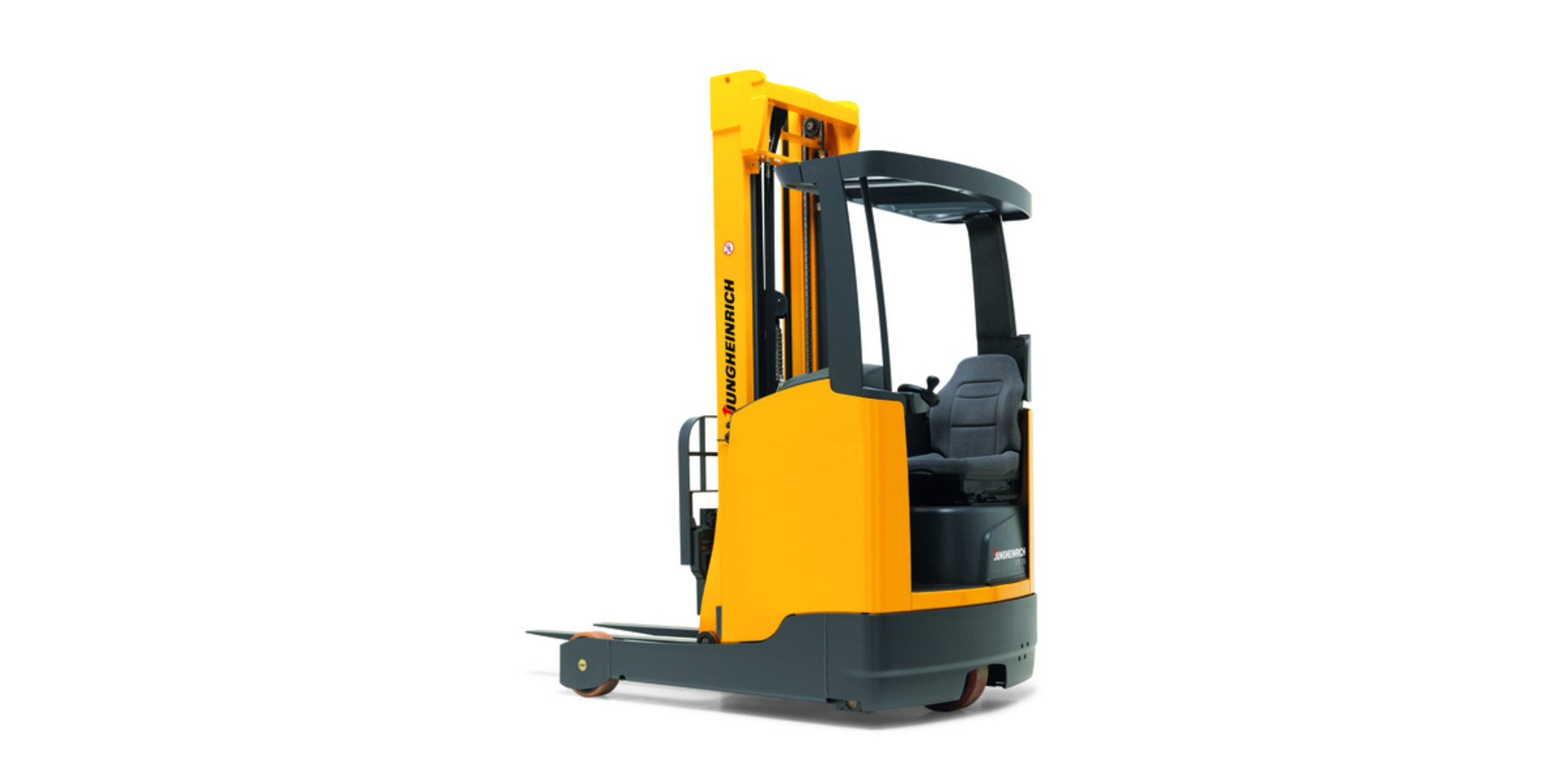
ETV/ETM 216 – Jungheinrich
Category
Warehouse Truck „highlifter“
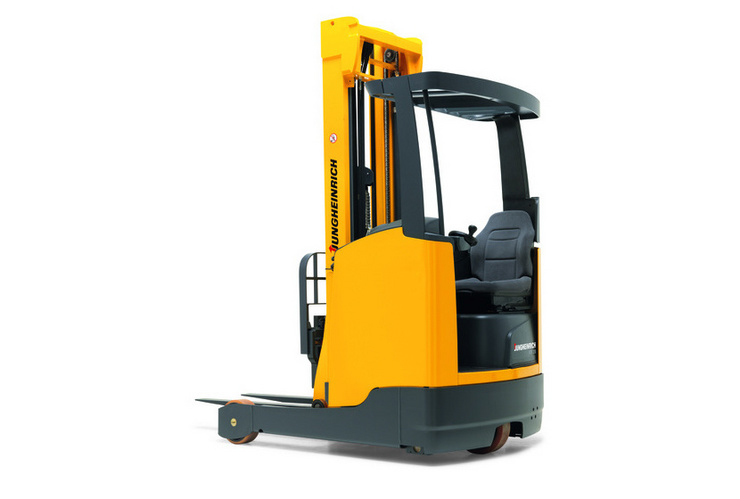
The new Jungheinrich series 2 reach trucks – ETM/ETV 214/216 – are available in capacity classes 1.4 t and 1.6 t. Both a wide (ETV) and narrow version (ETM) are available. Energy consumption has been reduced a further 10 % compared to the predecessor model and the throughput level has risen 10 %. The new generation of series 2 was presented for the first time at CeMat 2011 in Hanover.
A varied selection of configuration packages ensures optimum adjustment to actual application requirements in terms of performance data and energy consumption. The maximum lift height has been extended to 10.7 m with a residual capacity of 1000 kg.
In addition to these aspects, new advances in the series focused on enhancing ergonomics:
Series 2 reach trucks stand for maximum efficiency with low energy consumption. This makes it possible to achieve economical two-shift operation with a compact 48V-775 Ah battery for all available capacity classes.
| This is a | Vollständig neues Modell |
| Date of market launch | 05/02/2011 |
| Competitive products | k. A. |
| Special equipment IFOY test device | Drive & Lift Plus
|
| Drive type | Elektro |
| Lifting weight max. | 1600 kg |
| Truck weight | 3136 kg |
| Driving speed without load | km/h |
| Lifting speed without load | m/s |
| Lifting height max. | 10700 mm |
The Jungheinrich ETV reach truck series (like the narrow-chassis ETM range) has been on the market in its current form since 2003. There have been some updates since then, but very few significant innovations until CeMAT 2011, when Jungheinrich launched the new ETV 214 and ETV 216, with capacities of 1,400 and 1,600 kg. In the development of its ETV series, Jungheinrich focused on higher productivity, improved ergonomics and lower energy consumption.
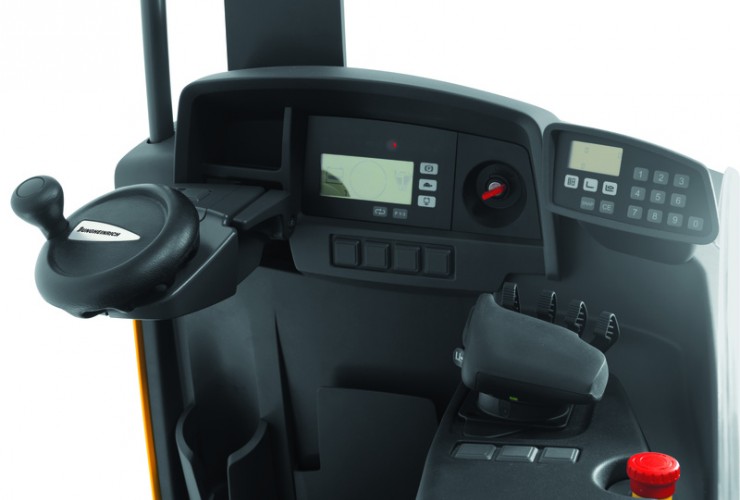
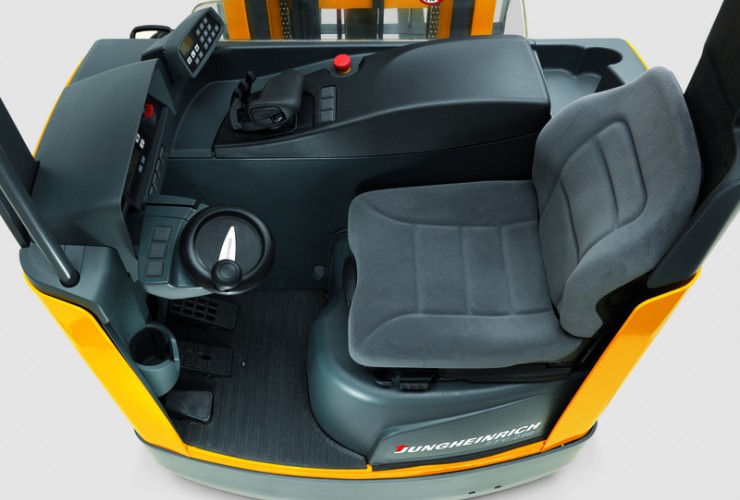
The truck’s appearance has changed very little, but it feels even more organised when you get in. The armrest has been redesigned to provide more space for the driver. The SOLO or MULTI-PILOT control is not adjustable but mounted in a fixed position. The chosen position was ascertained to be ideal in a wide-ranging hands-on study. However, drivers with longer or shorter forearms can vary the distance via the seat adjustment. One major advantage of the fixed position is that the control lever lies extremely firmly in the hand, and in the case of the SOLO-PILOT, also provides support as a handle – and this positively impacts handling and driving safety.
The instruments have also been remodelled and provide far more information than the predecessor series. Control lamps and automatic monitoring features warn the driver of hazards. If, for example, the load weight and the selected lifting height make for an unsafe combination, then the lamp on the dash lights up and an acoustic warning signal is emitted.
The reach trucks are also prepared for the fitting of optional features such as lifting height preset. The operator enters the required height, and the truck recognises this when the lifting movement slows and the load approaches the preset, stopping the fork at exactly the right point. It also detects whether there is a load on the fork.
A further new feature of the ETV 214 and ETV 216 is the so-called “M-Device” on the inside of the roof pillar. Clipboards, monitors and other equipment can be secured to this device without blocking the view of the driver. M stands for media.
In addition, the roof and mast position ensures a good view of the load and the surrounding area. The view is 30 mm wider, and the hydraulic hoses, chains and free lift cylinder have been reconfigured, which means that the driver almost always has an unobstructed view of both fork tips and the lift arms.
Apart from this, the innovations in the ETV 214 and ETV 216 are above all under the motor cover. The entire drive system has been completely overhauled, as have the software and the control system. The gear ratios and motor speeds have also changed. The electronics have been totally re-designed with the aim of further optimising performance and energy consumption. By offering different motor configurations for pump and/or drive motor, Jungheinrich allows its customers to choose between increased power and improved economy. The ETV 214 and ETV 216 are available in the versions “Drive Plus”, “Lift Plus” or “Drive & Lift Plus” and “Efficiency”.
Operation of the Jungheinrich ETV 216 is reliable and precise, simple and safe, paving the way for high productivity. In addition, energy consumption is very low. There are no undesired mast movements or torsion, making the reach truck extremely reliable even at great heights.
| Hard facts | Test Truck IFOY Test | Average other trucks | Value 1 to 10 | |
| Productivity Max mode | 484 | 421 | Pallets p. 8 hrs | 9 |
| Productivity Eco mode | 488 | 408 | Pallets p. 8 hrs | 9 |
| Energy level Max mode | 7.2 | 7.52 | kWh 100 plts | 8 |
| Energy level Eco mode | 6.72 | 7.2 | kWh 100 plts | 8 |
| Driving speed with load | 13.43 | 12.1 | km/hr | |
| Lifting speed with load | 52.13 | 45.7 | cm/sec | |
| Acceleration speed | 5.8 | 6.3 | time for 27,2 meters | |
| Averages soft facts | ||||
| First impression | 8.40 | |||
| Load Safety | 8.50 | |||
| Entry to truck | 7.43 | |||
| Seat & Sit position | 8.00 | |||
| Legg Space | 8.50 | |||
| Activate truck | 9.00 | |||
| Hydraulics | 9.13 | |||
| Steering | 9.00 | |||
| Sight | 8.75 | |||
| Driving acceleration | 9.00 | |||
| Driving braking | 8.67 | |||
| Driving & Turning | 9.00 | |||
| Parking truck | 8.17 | |||
| Safety elements | 8.88 | |||
| General after test | 8.63 | |||
| Sustainability | 8.00 | |||
| Totals | ||||
| Total average soft facts | 8.56 | |||
| Total productivity | 9.00 | |||
| Total Energy consumption | 8.00 | |||
| Total result all facts | 8.53 |
Image/video credits: Jungheinrich AG
Finalists undergo the three-stage IFOY Audit as part of the IFOY Audit, which takes place during the TEST CAMP INTRALOGISTICS. This consists of the scientific IFOY Innovation Check, the IFOY Test and the jury test.
In den Statuten sind die Grundwerte und die Standards des IFOY AWARD festgelegt, nach denen die Organisation handelt. Dazu gehören unter anderem Gremien, Wahlomodus, Bewertungskriterien sowie der Code of Conduct.
The International Intralogistics and Forklift Truck of the Year has three bodies: Jury, sponsors, and advisory board.