

IFOY Audit
Finalists undergo the three-stage IFOY Audit as part of the IFOY Audit, which takes place during the TEST CAMP INTRALOGISTICS. This consists of the scientific IFOY Innovation Check, the IFOY Test and the jury test.
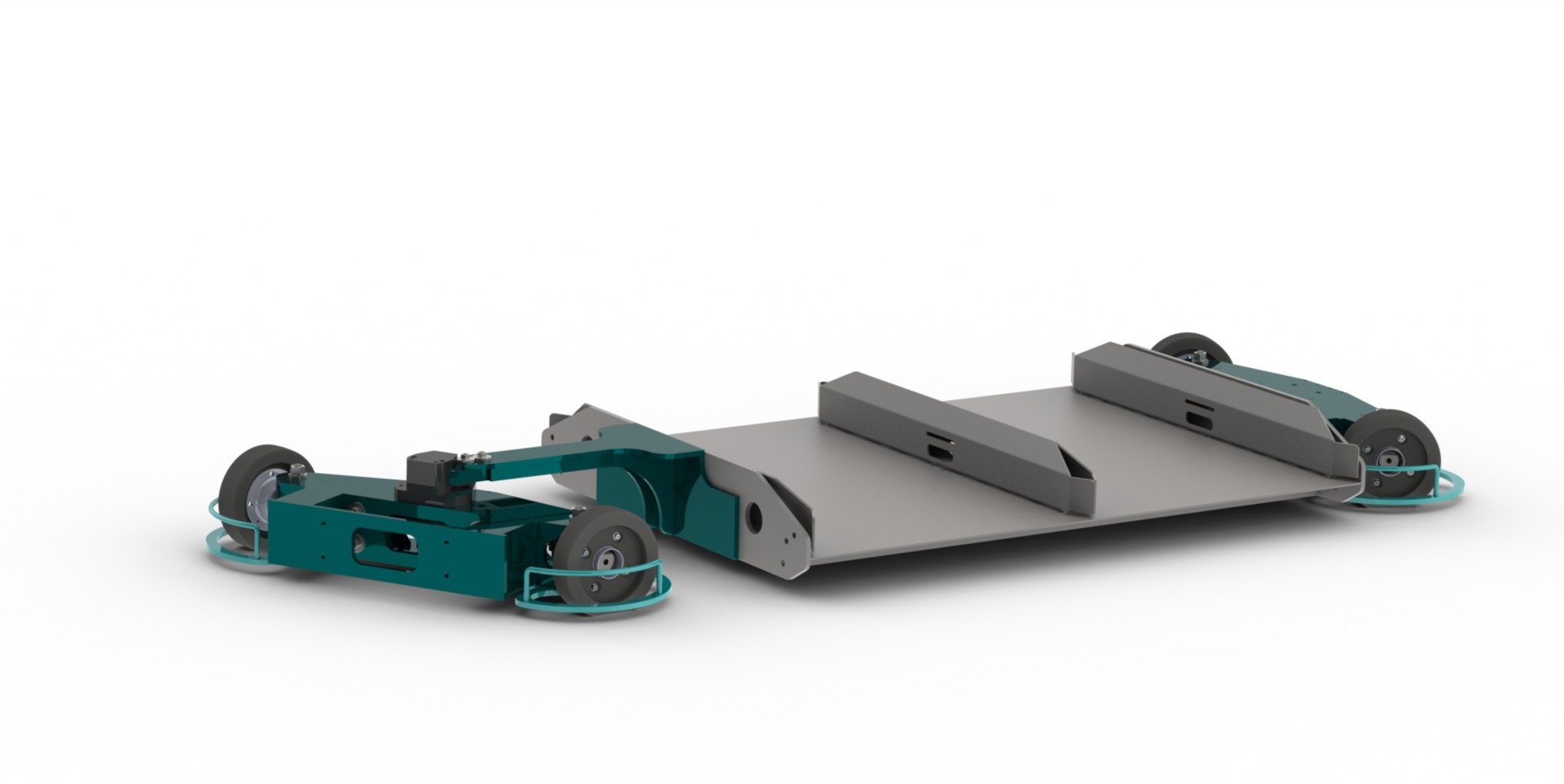
To achieve the best tracking stability in every driving situation, “Wegard Trail” tugger train trolleys are the world first to utilize an autonomous electronic steering. A perfect tracking stability provides better safety. At the same time, the customer can reduce the space needed to operate the tugger train. Due to the intelligent and autonomous steering, no information from the trailer or other trolleys is needed. Hence, the trolleys can be designed freely and without any restrictions according to their auxiliary systems and dimensions. It is now possible for the first time to combine trolleys with different length in one train without negative effects on tracking stability. It is also possible to adjust the position of the trolleys sideways and even backward. These capabilities are a major step for the further automatization of tugger trains.


Product name and company
Wegard Trail – Wegard
Category
Warehouse Truck „lowlifter“
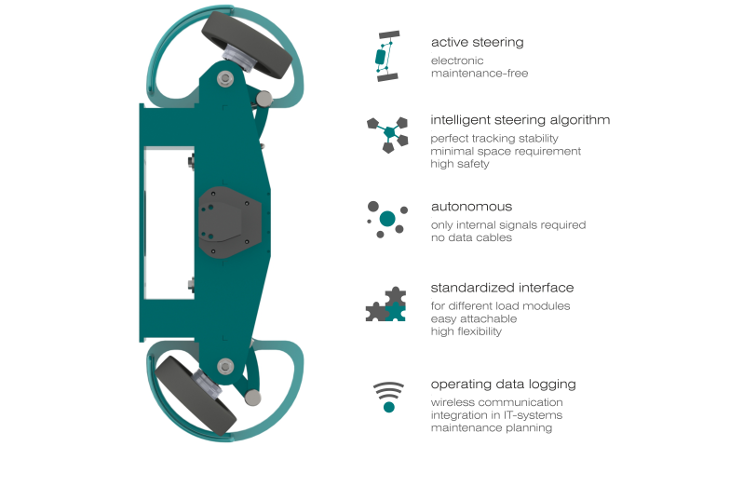
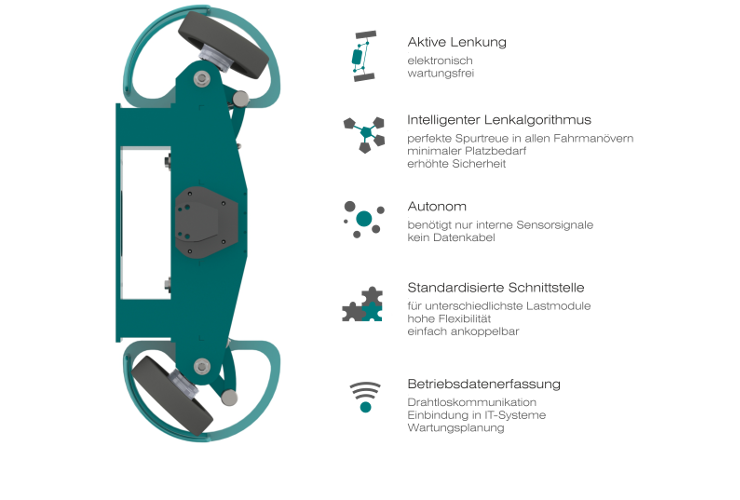
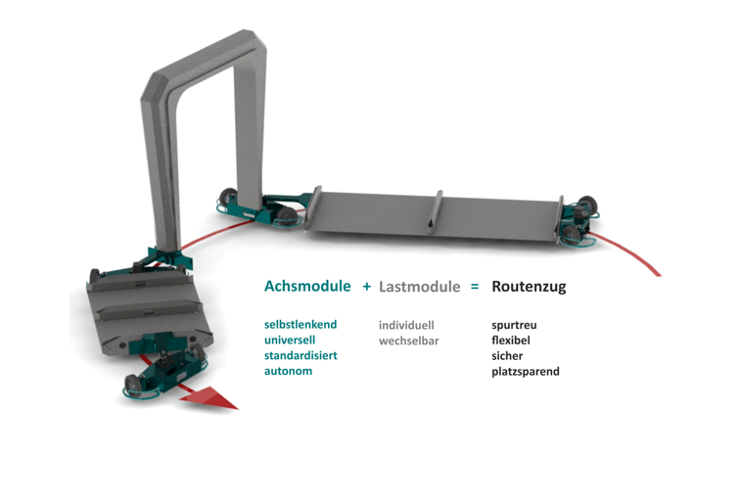
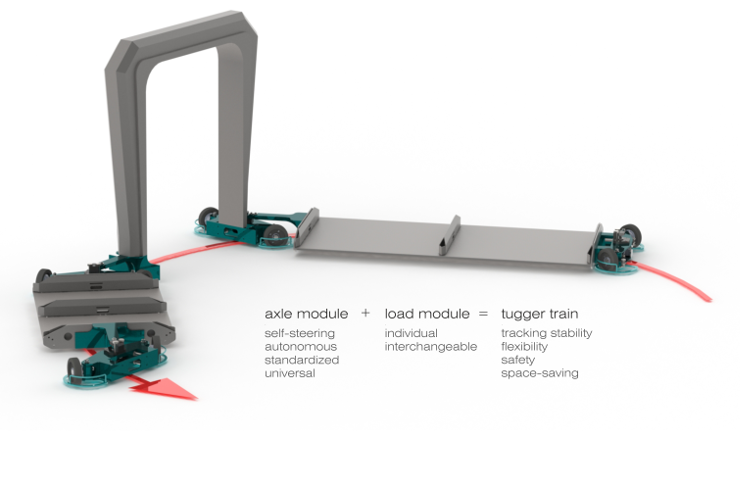
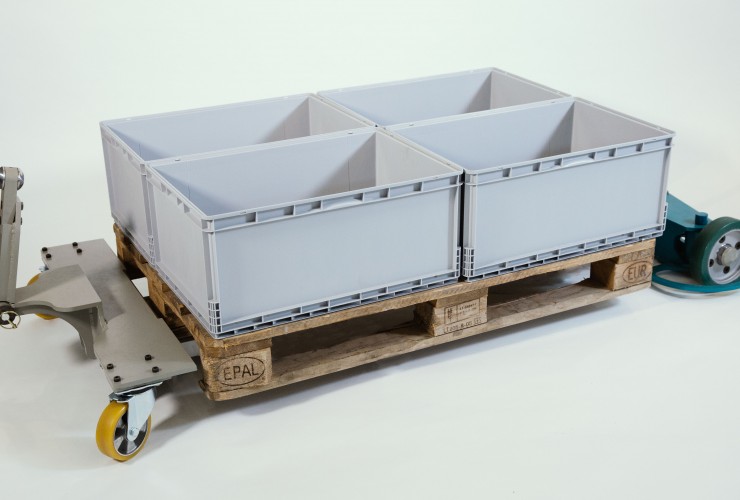
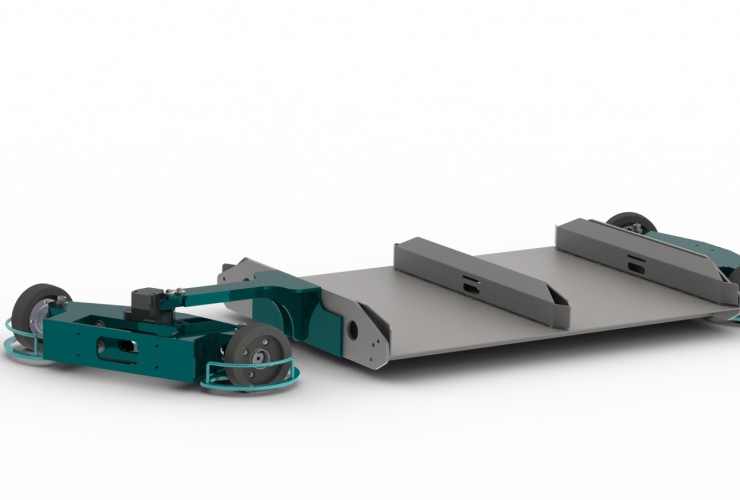
The basis of the Wegard Trail is the autonomous electrical steering in every single axle. The steering of an axle only requires sensor information which is measured directly on this axle. No steering information has to be transmitted mechanically, hydraulically and also electrically over the trolleys. Therefore, the load modules can be designed freely without any restrictions. There is no need for a central control or a special trailer.
The modular design and separation of every trolley in load module and steering axle allow the customer to compile Wegard Trail to their specifications from different trolley types. Even the combination of short and long trolleys in one tugger train is possible.
The innovative steering algorithm provides the best directional accuracy achieved tugger trains on the market. This minimizes the space requirements and increases safety during operation. Sideways parking, precise positioning and reverse driving is also possible, which is particularly important for the automation of tugger trains. In this way, the position at an automatic loading station can be corrected very accurately. Driving backward from the elevator was never that easy! The steering electronics can be easily upgraded with further safety, monitoring or automation functionality.
For the electronic steering of the trolley, only sensor information measured on the respective axis is used. Thus, the trolley functions autonomously, can be combined with various trolleys and do not require a specially equipped trailer.
The new steering algorithm ensures the best tracking stability in all driving situations. This minimizes the required surface area and increases safety during operation.
Driving patterns, such as sideways parking, precise positioning and reverse driving, are now possible for the first time.
The steering electronics in the individual trolleys provide the basis for integration of the customer-specific automation solutions.
The autonomously electronic steering allows the elimination of many mechanical steering components. This allows the load modules to be designed freely. Less wear components are required. Moreover, the system can be offered at an attractive price.
New logistic trends led to a widespread usage of tugger trains in production systems in the recent years. The workstations material supply using forklift trucks was increasing converted to tugger trains to reduce traffic. Smaller companies are also increasingly taking advantage of this trend so that further market growth of around € 80 million per year is expected. In addition, there is a growing demand for tugger train automation solutions. This automation ranges from an automated loading and unloading, to security and monitoring tasks, up to the fully automatic supply systems. Such systems require particularly high directional accuracy and precise maneuverability.
Less space for a tugger train operation is needed
Better operational safety due to the best tracking stability
New driving capabilities (position adjustments sideways and backwards) lead to new applications and environments
Freely customizable tugger trains with new possible trolley combination
Free choice of the trailer
New possibilities as a platform for automatization
Low maintenance and attractive price due to the absence of mechanical components for the transmission of the steering information
| This is a | Completely new model |
| Date of market launch | 10/01/2017 |
| Competitive products | k. A. |
| Special equipment IFOY test device |
| Drive type | Electric |
| Lifting weight max. | 1000 kg |
| Truck weight | 150 kg |
| Driving speed without load | 12 km/h |
| Lifting speed without load | 0,01 m/s |
| Lifting height max. | 40 mm |
In cooperation with the University of Hamburg, Wegard developed the Wegard Trail, an electronic steering system for track accuracy for trailers in a tugger train concept. According to the initiators, the existing mechanical systems do not offer a track-accurate solution in all situations. The Wegard should offer a more reliable and universally applicable alternative.
Due to its modular axle, the system can be connected to all current and future trailers with a transport capacity of up to 1,000 kg per trailer. The axle operates completely autonomously and communication with the towing vehicle (or other systems) is not necessary.
All necessary information for the driving behavior of the trailers is measured on the axle itself. Three sensors are installed to measure the left and right wheel movement as well as the steering angle. An algorithm is used to calculate the exact position of the front and rear drawbar points. The system then uses these values to calculate the route to be travelled, which is driven with a deviation of 3 to 4 cm.
During the test drive with the Wegard Trail the system provides high track accuracy. However, the pilot series tested in Hanover during the Test Days requires fine tuning. For example, sharp curves (above 75 to 80 degrees) can lead to faults or broken cables. It is also not possible to drive in reverse or park sideways.
Wegard is thus currently developing a new version of the Wegard Trail. This new model solves the current weaknesses according to the manufacturer’s specifications, and turns/curves of up to 90 degrees can be made/driven without any problems. It should also be possible to move backwards and position laterally (for easy loading and unloading of the goods) with a tablet. The new implementation is expected in March 2018.
Another advantage of the electronic solution is that it requires fewer maintenance-prone components for certain trailers, such as the A-frame, compared to mechanical systems. The system is however in the price segment of mechanical solutions.
The question arises as to how often the electronic system is needed. According to the test team, existing mechanical systems follow the test team in most cases more than adequately.
IFOY test verdict
The Wegard Trail allows to follow the tugger with almost all types of trailers. The accuracy is remarkable and should improve in the next generation. The simple connection without data cable is remarkable. This also applies to the promising (future) possibilities of automatic reversing and laterally positioning.
Market Relevance
There is still a widespread use of tugger trains to supply production processes. Even though there is a growing competition for this form of supply transport by individual transports with low-cost FTFs, it is still advantageous when it comes to long distances and with a high supply frequency. On one hand, this is due to the lower capacity load on traffic areas, and on the other hand to the efficiency of bundling transports into larger units.
The Wegard Trail solution is consistently focused on the problem of track accuracy of trailers. For this reason, this solution is highly relevant to the market, although not all users of route trains are equally affected by the problem of deviating track accuracy, provided that the roads and trailers are kept in good condition.
Customer Benefit
The individual tugger train trailers on the Wegard Trail are mechanically simpler and can be easily parameterized to suit different geometries, i. e. in particular the changed length of the load carrier between the coupling point and the steering axle. This increases the adaptability compared to mechanical steering couplings.
Another useful function is the possibility of sideways movement of the tugger train at an angle of max. 40 degrees to the front-straight-ahead. This makes it possible to move sideways to transfer positions for loading and unloading. However, the necessary surface moving towing vehicles are not yet available on the market. Only in the area of driverless transport vehicles are surface moving vehicles widespread.
Degree of Novelty
Electric steering of tugger train trailers with autonomous steering angle detection is new and very innovative. The system shows very well the potential for the design of electric steering drives to increase track accuracy and maneuverability of route trains. The consistent focus on self-contained units of trailers increases the flexibility of application in practice.
Functionality / Type of Implementation
On one hand, the roadway itself triggers deviation from directional stability of trailers when dirt leads to changed adhesion coefficients or blockages or unevenness is present. Also the wear and tear or overstressing of steering components leads to the trailers’ track deviation. However, it should be considered that even with the Wegard Trail system, which does not have a continuous calibration of the steering angle adjustment in operation and it is only correctly aligned regarding each other when it is switched on as the tugger train is stretched, deviations in steering angle due to dirt on the roadway and the resulting deviations in odometry do occur. This could also be seen during the driving test.
| Functionality / type of implementation | + |
| Novelty / Innovation | ++ |
| Customer benefits | + |
| Market relevance | + |
| ++ very good / + good / Ø balanced / – less / — not available | |
Image/video credits: Wegard GmbH
Finalists undergo the three-stage IFOY Audit as part of the IFOY Audit, which takes place during the TEST CAMP INTRALOGISTICS. This consists of the scientific IFOY Innovation Check, the IFOY Test and the jury test.
The bylaws set forth the core values and standards of the IFOY AWARD, which guide the organization’s actions. These include, among other things, governing bodies, the election process, evaluation criteria, and the Code of Conduct.
The International Intralogistics and Forklift Truck of the Year has three bodies: Jury, sponsors, and advisory board.