

IFOY Audit
Finalists undergo the three-stage IFOY Audit as part of the IFOY Audit, which takes place during the TEST CAMP INTRALOGISTICS. This consists of the scientific IFOY Innovation Check, the IFOY Test and the jury test.
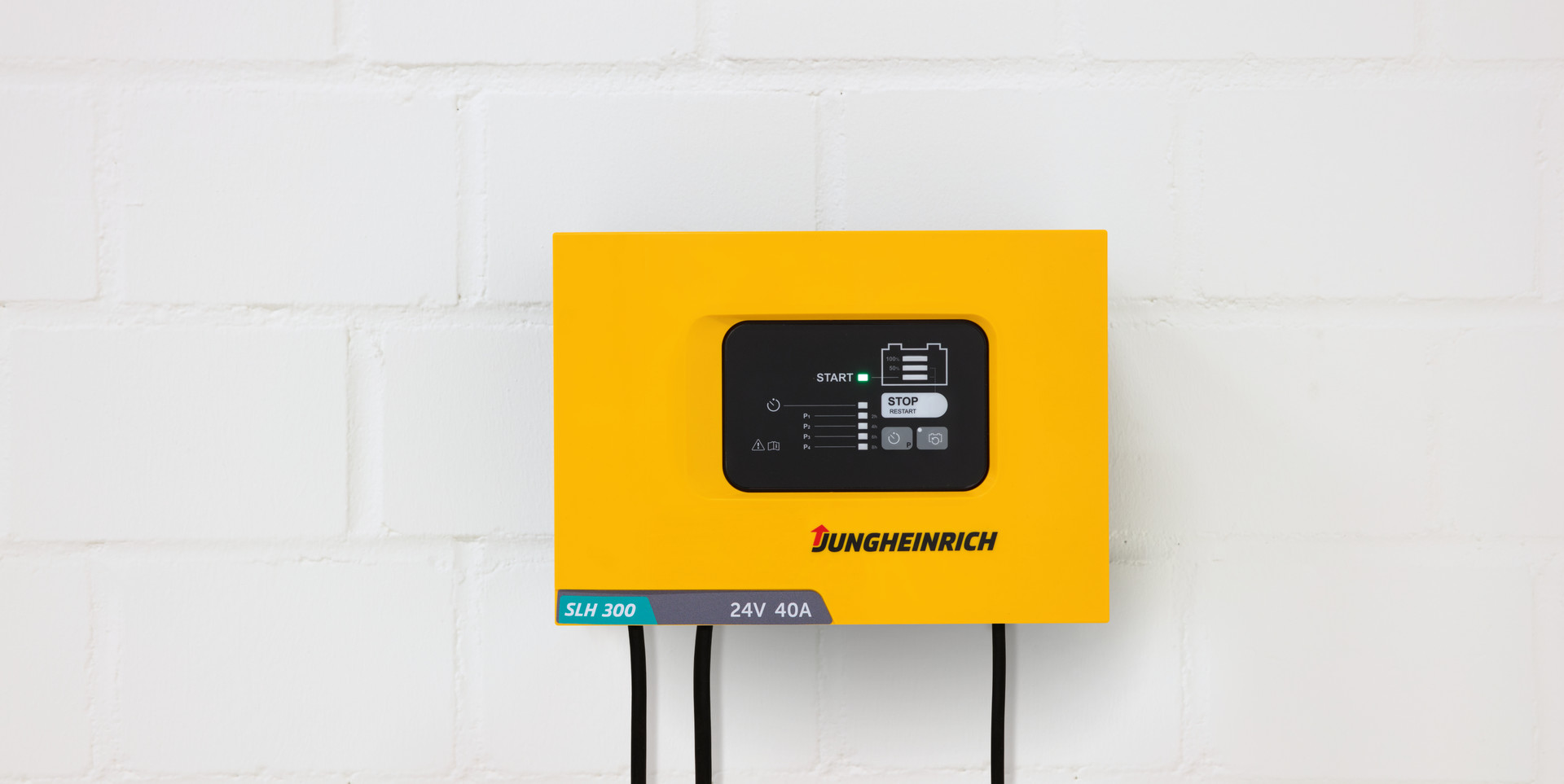
The Jungheinrich charging system SLH 300 for cross-technological, interconnected charging of lithium-ion as well as lead-acid batteries effortlessly bypasses the systemic boundaries of the existing components vehicle, battery and charging system. Therefore, it creates the prerequisites for enhancing operating safety and availability, whilst simultaneously minimising costs for fleet management as well as maintenance and repair of industrial trucks and batteries, respectively.

Product name and company
Cross-technology battery charging system SLH300 – Jungheinrich
Category
Special of the Year
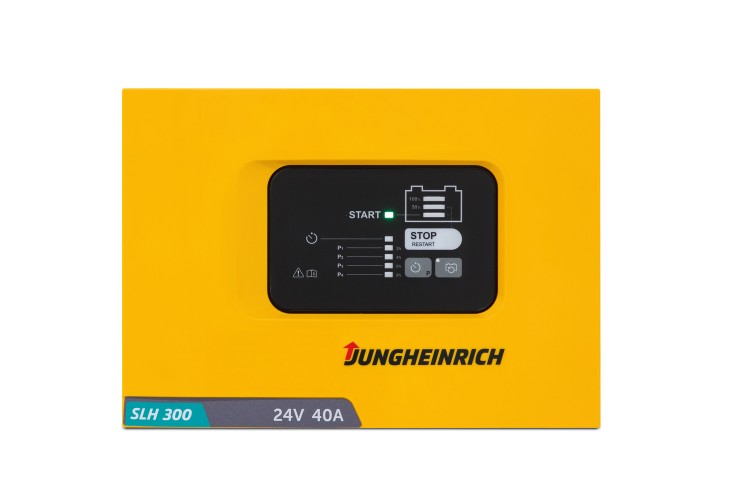
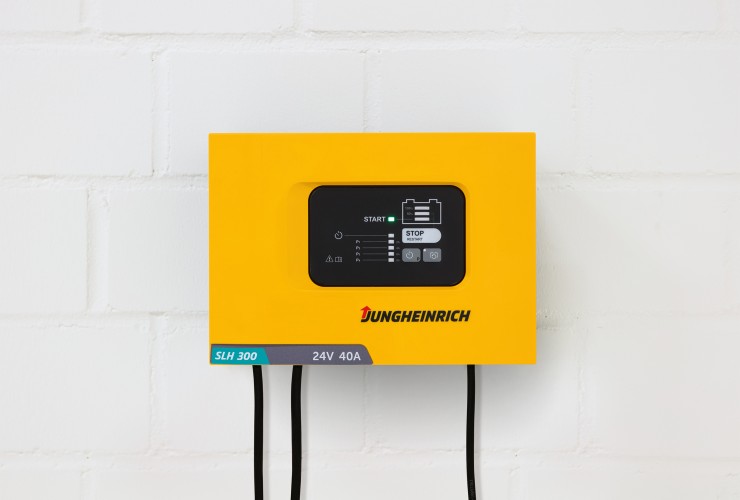
The charging system SLH300 is especially suited for businesses that are planning or have already started to switch their fleet from conventional lead-acid batteries to using the future-proof and more efficient lithium-ion technology. The SLH300 offers these customers the unique possibility to charge lithium-ion as well as lead-acid batteries with only one system. The processor-controlled intelligence inherent in the charging system enables energy-efficient and lifecycle-prolonging charging of both battery types per the demands of their technology: with lead-acid batteries using the battery module and lithium-ion batteries taking advantage of their implemented battery management system. Thus, the customer benefits from a technology-independent charging system that can accommodate future developments and allows carefree as well as cost-efficient use of both energy technologies at the same time.
In combination with the lead-acid battery module and the li-ion battery management system, the SLH300 enables charging of both technologies with only one device. This technology-independent type of charging, especially suited for mixed fleets, offers investment and planning security for the customer.
The charging system monitors the battery’s condition and adjusts the quality and duration of the charge accordingly. This prolongs not only their lifecycle but also improves the entire system’s energy efficiency.
The SLH300 contains an innovative HMI interface in form of a displays incl. softkeys, which presents all adjustment options in a language-neutral and intuitive manner, whilst taking individual customer demands into account. Via power cables, a DC bus transmits a modulated data package and thus prevents downtimes due to defective data pins in connectors. Additional and – moreover – fragile data lines between charging system and batteries become obsolete, which enhances the batteries’ as well as the system’s availability.
The SLH300 is also suited for sole lead-acid truck fleets: Thanks to the new battery module, lead-acid batteries become an intelligent component of the interconnected energy system. Data on battery capacity or cell temperature are transmitted, so that the SLH300 can automatically modify the battery’s optimum characteristic. By analysing the acid level, the charger controls a fully automatic water refill, enhancing safety while using lead-acid batteries.
Essentially, this innovation is relevant for all those customers in any industry, who up to now have fitted their industrial trucks with lead-acid batteries and intend to switch to the battery technology of the future, lithium-ion cells, at a later time. Moreover, the SLH300 was developed for customers, who – in order to increase their energy efficiency – have already partly switched to lithium-ion technology and now operate mixed fleets with lead-acid as well as lithium-ion batteries.
With the SLH300 combi chargers, Jungheinrich offers a unique charging platform – with chargers in 24 V, 48 V and 80 V and capacities from 15 to 320 A – for conventional lead-acid batteries and lithium-ion batteries. The same device can be used without any intervention to charge different batteries optimally.
A special module is installed on the battery for perfect communication. It communicates with the charger via DC bus technology. Therefore, an additional cable is not necessary and communication is carried out (via its own frequency) over the standard power cable of the battery.
In addition, sensors are installed on the battery to monitor temperature and electrolyte level.
Once the battery is connected to the charger, it detects the battery, its capacity and voltage. The charger also registers which optimum charging characteristics belong to the connected battery. Since the different charging characteristics are stored in the charger’s memory, only a minimum amount of information needs to be transmitted.
If for any reason the connected battery is not detected, the charging process cannot be started and a warning message appears on the display. This prevents faulty and damaging charging.
The chargers have a constant current of 300 amps over the entire charging range, even at peak values during charging (when the voltage is temporarily higher than 24 Volt). This is essential for the intermediate charging of lithium-ion batteries, as rapid charging of up to 85 percent is guaranteed.
The new SLH300 series includes several models, from a compact 24V/15A charger to an 80V/170A charger. The chargers have a modular design and can therefore be fully adapted to the specific application requirements. They have the same base size and are also visually identical.
The SLH300 combi charger is ideal for companies that use a mixed battery fleet (and perhaps want to switch to Li-ion technology in the future). This means that it is not necessary to invest in several chargers or – when switching to lithium-ion batteries at a later date – to invest in new chargers.
In addition, the chargers also offer energy efficiency which, with a value of more than 90 percent, is among the best in the market. Compared to the competition, the devices are also cheaper than the market price, which leads to an optimal price-performance ratio according to the supplier.
With the new SLH300 platform, Jungheinrich offers a worry-free, easy-to-use plug & play solution for charging lead-acid and lithium-ion batteries. The battery module turns the battery into an intelligent device; all important data is simply transferred to the charger via the standard power cable. The result: more intelligence, more performance and individual configuration while avoiding misuse or misloading. The platform thus forms a stable basis for the future.
The technical advancement of lithium-ion batteries has led to the fact that many companies are interested in a transition to this type of drive. Rapidly rising sales figures confirm the trend. Changing over the entire fleet of vehicles to the new battery type is usually not possible. The SLH 300 charger allows a step-by-step purchase of new Li-Ion vehicles without having to maintain two charging stations for different battery types at the same time. Overall, there is a high market relevance in the transitional period and for mixed fleets.
Corresponding chargers are already available in companies that use lead-acid batteries today. If the SLH 300 combi unit is purchased instead of the lithium-ion battery chargers, space and one power connection can be saved. Due to this flexibility, the charging stations can be used more efficiently, which means that fewer charging stations are required than when subdivided into lead-acid and lithium-ion charging stations. Monitoring battery status also increases service life, reliability and planning reliability.
However, SLH 300 can be used primarily to charge lithium-ion batteries from Jungheinrich. To improve the efficiency, only batteries with a voltage of 24, 48 und 80 Volt can be charged. To monitor lead-acid batteries, they must be retrofitted with a special controller.
There are chargers on the market that can charge both lithium-ion and lead-acid batteries. These usually have a lower output power. A combi charger in the performance class of one manufacturer represents an innovation. Charging status monitoring, on the other hand, is now state of the art.
Acid level monitoring and fully automatic water filling extend the life of a battery. However, some charger manufacturers already offer this feature as an option.
The SLH 300 charger is robust, easy to connect and operate. The user receives important information via simple and clear user interface. The relevant parameter values for setting the charger are read from the battery.
| Functionality / type of implementation | ++ |
| Novelty / Innovation | + |
| Customer benefits | + |
| Market relevance | + |
| ++ very good / + good / Ø balanced / – less / — not available | |
Image/video credits: Jungheinrich AG
Finalists undergo the three-stage IFOY Audit as part of the IFOY Audit, which takes place during the TEST CAMP INTRALOGISTICS. This consists of the scientific IFOY Innovation Check, the IFOY Test and the jury test.
The bylaws set forth the core values and standards of the IFOY AWARD, which guide the organization’s actions. These include, among other things, governing bodies, the election process, evaluation criteria, and the Code of Conduct.
The International Intralogistics and Forklift Truck of the Year has three bodies: Jury, sponsors, and advisory board.