

IFOY Audit
Finalists undergo the three-stage IFOY Audit as part of the IFOY Audit, which takes place during the TEST CAMP INTRALOGISTICS. This consists of the scientific IFOY Innovation Check, the IFOY Test and the jury test.
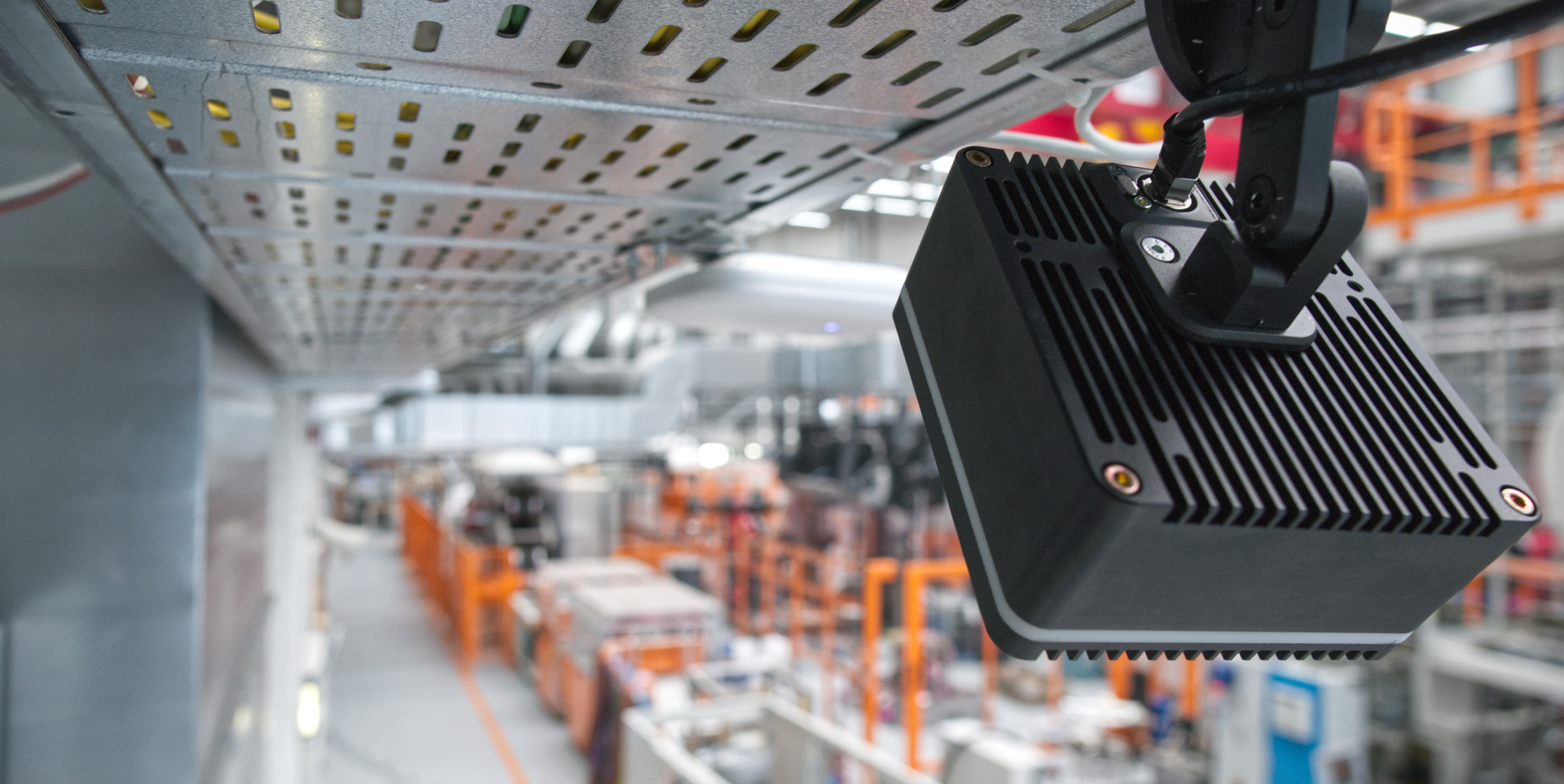
The start-up Sentics has developed and launched the first optical, AI-based real-time location system for industrial applications. The complementary software products significantly increase safety and efficiency in intralogistics.

Product name and company
optical real time locating system (ORTLS) – Sentics
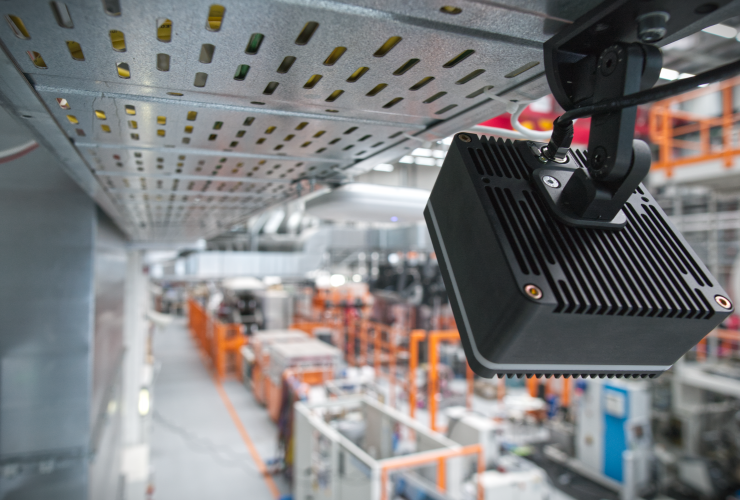
The optical real-time location system from Sentics is based on infrastructure sensors that are installed in the industrial environment. The sensor system detects and locates relevant objects such as forklifts, people, machines, etc. and makes this information available for numerous applications. Through real-time analysis of the locations and movement profiles of people and vehicles, critical situations are detected at an early stage and accidents are effectively prevented through warnings and automated reduction of driving speed. By configuring the driving strategy in a targeted manner, users can also preventively reduce the driving speed in hazardous areas. Conversely, transport vehicles can continue to be operated with high productivity if there are no people or other obstacles in the driving area.
Another area of application is autonomous transport, which currently can only be operated with high restrictions on productivity due to the challenges of mixed traffic with manual vehicles and people. For the first time, the optical real-time location system from Sentics provides information about all driving areas in real time and makes this available to the fleet managers of the autonomous transport vehicles. As a result, it is now possible to react to obstacles such as pallets, manual vehicles or people at an early stage and dynamically adjust route planning. An analysis of the historical movement profiles also makes it possible to permanently increase safety and productivity.
Real-time location systems are currently all based on additional technical devices (transponders), which have to be worn by people or installed on vehicles. Besides the high administration and maintenance costs (issuing to staff and visitors, recharging the batteries, replacing defective devices, etc.), these systems have a major disadvantage for safety applications. If a person is not wearing the transponder or if the transponder is defective, this person cannot be protected. Sentics’ real-time optical location system does not require any additional technical equipment. This means that there can occur no errors in the operation of the system. At the same time, the system is arbitrarily scalable, as there is no limitation of devices compared to transponder solutions.
Furthermore, collision protection systems based on cameras on the vehicles exist. Even though these systems offer a certain degree of protection in some situations (person directly in front of or behind the vehicle), they are characterised by significant weaknesses. People who are hidden from the view of the vehicle (e.g. behind pallets/gates/between racks, etc.) are not detected by these systems. Likewise, visibility may be restricted, e.g. if the industrial truck has lifted a load. The Sentics system covers the industrial environment from multiple perspectives and can also take into account the movement history of objects.
In Europe, there were over 180,000 accidents in internal transport in 2022. In addition to the personal fates of the accident victims, accidents represent a high economic loss for companies. The costs for minor accidents are on average around 30,000 €. Serious to very serious accidents can generate costs of up to 800,000 €. In many cases, there is also the threat of legal consequences and (temporary) closures of branches or the entire company may occur.
Accident statistics show that current solutions have not been able to significantly reduce the number of accidents. It is expected that in the future intralogistics will increasingly be supplemented and partly replaced by autonomous vehicles (AGV/AMR). Today’s vehicles rely on on-board sensors, which have conceptual disadvantages when operating the vehicles. People and other objects blocking the path of travel are detected late, leading to unexpected stops of the vehicles and inefficiencies in the fleet. In order to be able to efficiently use autonomous vehicles in internal transport in the future, holistic information about the status of the routes must be collected and made available to the fleet management of the vehicles. The Sentics system therefore represents a central key technology to enable the transformation to more autonomous transport in intralogistics.
The Sentics system is installed once in the customer’s environment and put into operation.
No further technical devices (wearables) are required on the objects in the environment to use the system.
Software licences allow customers to use the system for numerous areas of application.
Accidents are effectively prevented through warnings and active reduction of driving speeds.
By analysing accident risks (Sentics Safty Score), safety becomes measurable for the first time. Changes in the safety situation are thus made visible and the customer is informed.
Safety can be sustainably increased by deriving measures.
The use of additional interfaces (Senstics INTI) allows the implementation of traffic regulations (e.g. traffic lights).
The Sentics Productivity Score enables an increase in the productivity and efficiency of customers. For example, the utilisation of available space or the efficiency of a fleet of forklifts can be analysed and improved.
The use of the Sentics system enables the efficient use of autonomous transport vehicles in intralogistics.
In addition, there are numerous areas of application, e.g. human-machine collaboration, automation of gates, lighting and air-conditioning and even burglary protection.
Sentics optical real-time localization system is based on infrastructure sensors installed in the industrial environment. The sensor system detects and localizes relevant objects such as forklifts, people or machines and makes this information available for numerous applications. Real-time analysis of the locations and movement profiles of people and industrial trucks enables critical situations to be detected at an early stage and accidents to be prevented by means of warnings and automated reduction of travel speed. With the help of a targeted configuration of the driving strategy, users can also preventively reduce the driving speed in hazardous areas. Conversely, industrial trucks can continue to operate with high productivity if there are no people or other obstacles in the travel area.
The localization system can also be used for autonomous transport systems, which can currently only be operated with limited productivity due to the challenges of mixed traffic with manual vehicles and people. For this purpose, information about all driving areas is provided in real time and made available to the fleet managers of the autonomous transport vehicles. An analysis of historical movement profiles also enables safety and productivity to be increased.
Alternative real-time localization systems are based on additional technical devices (transponders) that must be worn by people or installed on industrial trucks. Besides the administration and maintenance effort (issuing to employees and visitors, recharging batteries, replacing defective devices, etc.), these systems have a disadvantage for security applications. If a person is not wearing the transponder or if it is defective, then that person cannot be protected. Sentics’ system does not require any additional technical devices. Thus, there can be no failures in the condition of the system. At the same time, the system is scalable in any way, because compared to transponder solutions, devices are not limited.
In German companies, there were about 32,000 reportable accidents with industrial trucks in 2020, ten of which ended fatally. This is according to statistics from the German Social Accident Insurance (DGUV). Sentics’ optical, AI-based real-time localization system provides a solution that can help improve these figures. In addition, collaborative concepts can be implemented by integrating people, manually operated and autonomous machines – an aspect that should not be underestimated against the background that forecasts assume further growth in the AGV/AMR sector.
The field of in-process identification technologies and their applications will be of great importance in the future in even more digitalized and automated industrial and commercial environments. Sentics not only offers a camera-based, i.e., optically working solution, but also shows safety-relevant applications of the technology, which make an amortization possible over multiple benefits. This area of occupational safety is emphasized by Sentics itself. Certainly, the feasibility of occupational safety measures with other applications (identification, tracking & tracing) is of particular importance.
The product and the applications shown offer multiple customer benefits by implementing parallel functionalities. On the one hand, the localization of automated devices (AGVs, AMRs, etc., which themselves use localization technology) and non-automated objects (humans, forklifts, etc.) is combined. The objects do not necessarily have to be equipped with their own devices. If control interventions such as speed reduction are to be implemented, the objects are equipped with their own hardware.
Optical recognition using computer vision methods is well known but is not yet widely used for comparable applications. The combination of localization, recognition of people and active intervention in the controls is a good innovation leap.
The integration of automated technology and manual process participants in a closed system shows very good potential for implementation and is an important step into the future world of networked Industry 4.0. Especially the implementation with relatively simple cameras and the avoidance of wearables or other devices for the people participating in the process offers many advantages. The combination of several sensors in a defined environment and the joint use of their data (sensor fusion) is an intelligent solution for the multiple use of the technology employed in several applications.
Nice application for camera-based detection and localization of moving objects. Can neatly increase safety, but can also be used for rule-based actions for control. With this, the forklift learns to “see around the corner”! Certainly in the future, much more innovative goals are achievable with the system (detection of specific containers and load).
| Functionality / type of implementation | ++ |
| Novelty / Innovation | + |
| Customer benefits | + |
| Market relevance | + |
| ++ very good / + good / Ø balanced / – less / — not available | |
Image/video credits: Sentics GmbH
Finalists undergo the three-stage IFOY Audit as part of the IFOY Audit, which takes place during the TEST CAMP INTRALOGISTICS. This consists of the scientific IFOY Innovation Check, the IFOY Test and the jury test.
The bylaws set forth the core values and standards of the IFOY AWARD, which guide the organization’s actions. These include, among other things, governing bodies, the election process, evaluation criteria, and the Code of Conduct.
The International Intralogistics and Forklift Truck of the Year has three bodies: Jury, sponsors, and advisory board.