

IFOY Audit
Finalists undergo the three-stage IFOY Audit as part of the IFOY Audit, which takes place during the TEST CAMP INTRALOGISTICS. This consists of the scientific IFOY Innovation Check, the IFOY Test and the jury test.
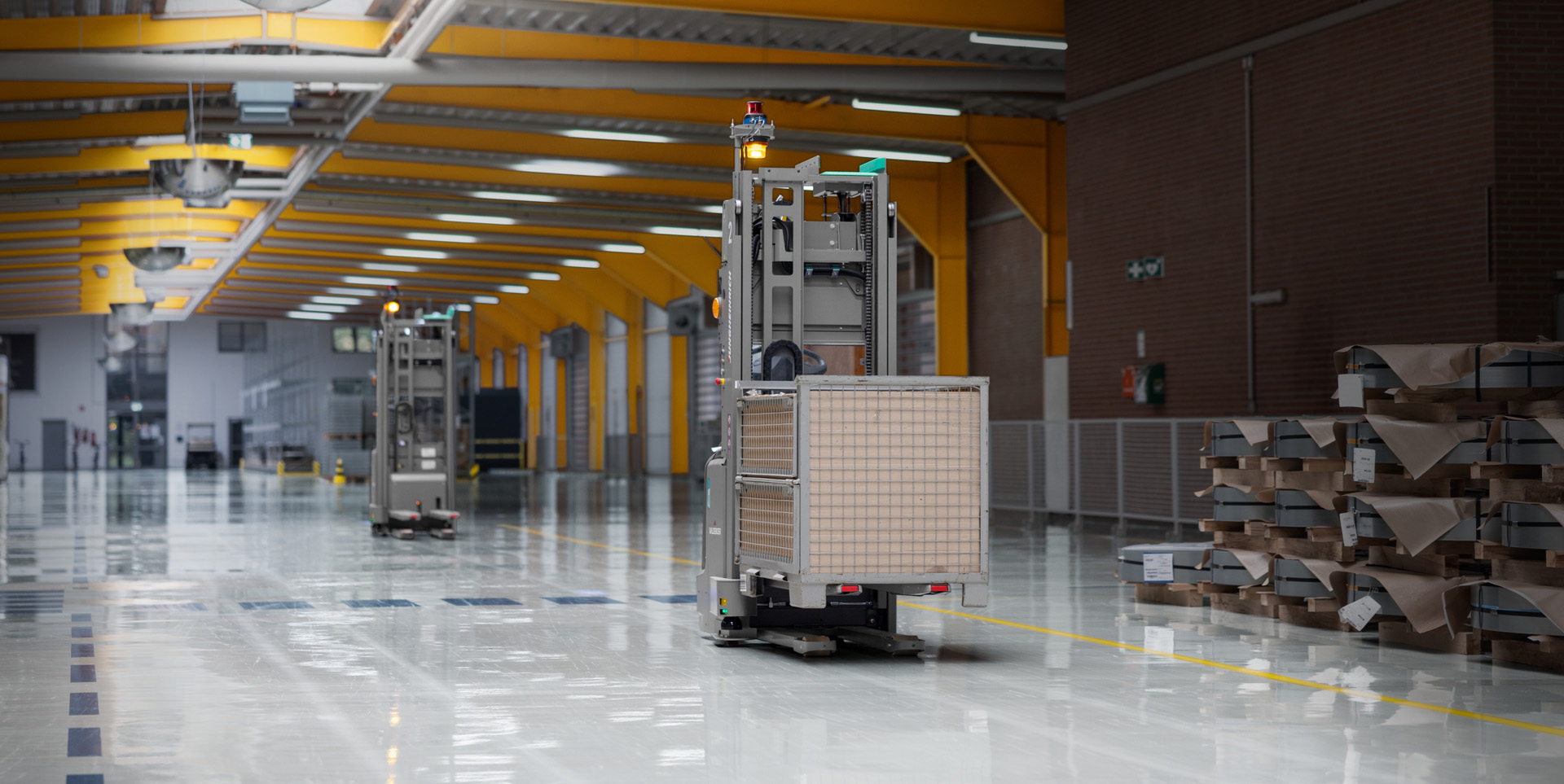
The construction of a new logistics centre was aimed at expanding storage capacity and reducing throughput times. To automate the internal ‘last mile’ from the logistics centre to the production line, Wildeboer Bauteile GmbH uses mobile robots from Jungheinrich in combination with a manufacturer-independent software from MHP. The highlight: the simultaneous operation of different mobile robots controlled by an external VDA 5050 fleet manager.
Product name and company
Jungheinrich & MHP @ Wildeboer – Jungheinrich
Category
Integrated Customer Solution
Customer
Implementation period
From:
Until:
12/21/2024
Investment volume
€
Wildeboer Bauteile GmbH, based in Weener, develops, produces and distributes components for fire protection, air distribution, building system technology and sound insulation. Whether office buildings, shopping malls, hotels, healthcare facilities or events – Wildeboer components are used in a wide range of industries.
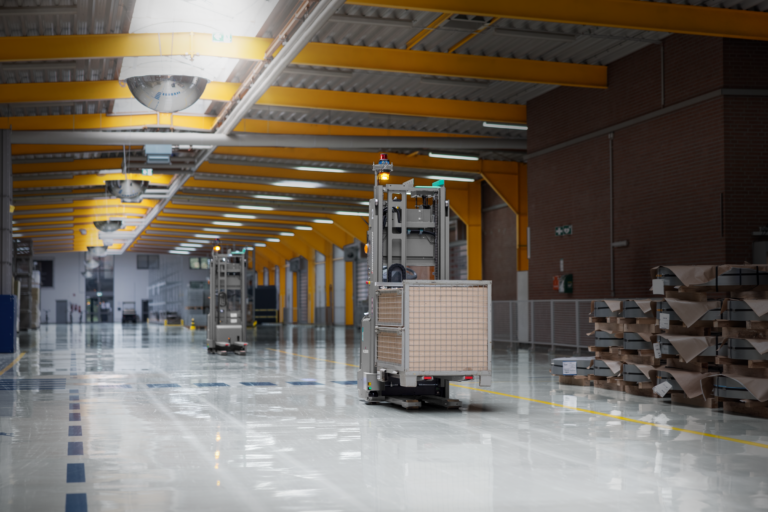
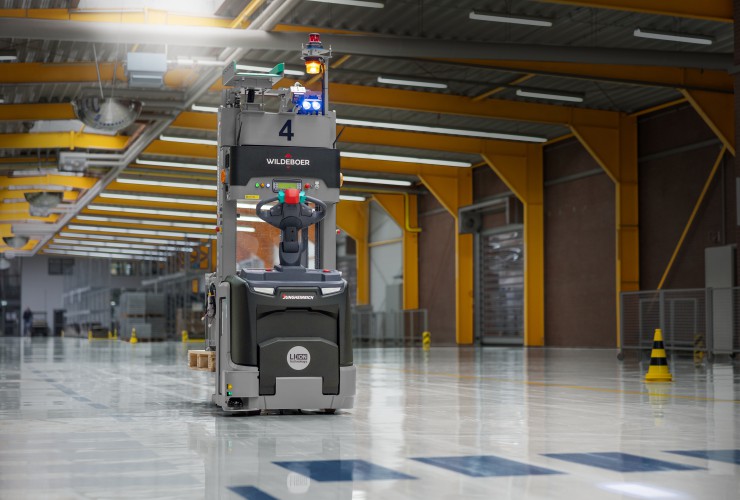
To expand its storage capacity and optimise process times, Wildeboer worked with Jungheinrich to implement a future-proof automation solution in a newly constructed logistics centre. An automation solution with mobile robots was installed to transport load carriers from the automatic warehouse to production and from one production step to production step, as well as for the return transport. Six ERC 213a mobile robots handle the transport of large load carriers (LLC) consisting of Euro plates and mesh boxes, while the autonomous mobile robot SOTO is responsible for transporting small load carriers (SLC). The interaction of the mobile robots is controlled by a manufacturer-independent software, the MHP-FleetExecuter. The Jungheinrich Logistics Interface acts as a middle layer between the MHP-FleetExecuter and the peripherals, consisting of conveyor technology, high-speed doors and a central fire alarm system.
With the Jungheinrich ERC 213a, proven mobile robots have been used to automate recurring transport tasks in confined spaces. Thanks to their compact design, they are ideally suited for narrow aisles. In addition to high process reliability and a short amortisation period, they impress with their efficient drive technology with a sustainable lithium-ion battery, as well as extensive safety systems for smooth use in mixed operation.
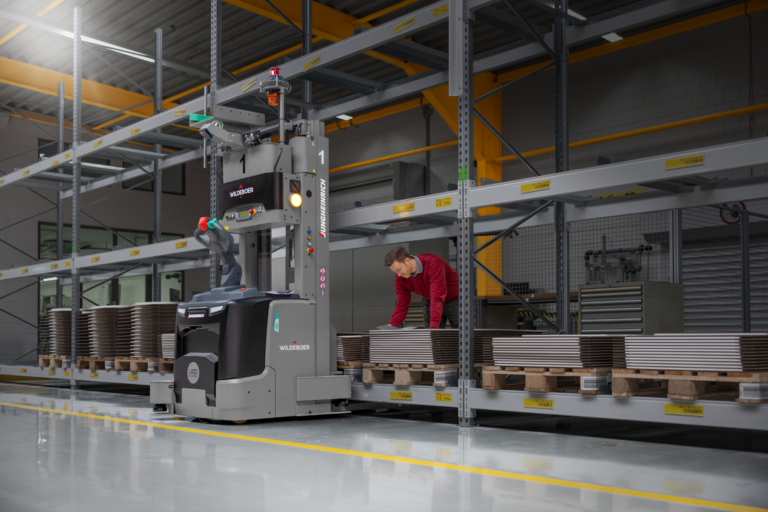
SOTO is ideal for the automated transport of small load carriers along the production line, as well as for storage and retrieval directly into and out of flow racks or onto conveyor belts. It enables real-time material tracking, thus providing maximum process reliability. SOTO can easily pick up 14 SLC in two different sizes from two sides and transport them safely to their destination. Its adjustable gripper can reach heights between 400 and 1,700 mm and allows the SLC to be rotated 180 degrees – for precise and infinitely variable handling at different rack heights. Four laser scanners and two 3D cameras ensure a high level of safety for people working in the vicinity of the machine.
Automated handling at a new level of efficiency
In the automatic high-bay warehouse and the automatic small parts warehouse at Wildeboer, the picked orders are prepared for transport to production on load carriers in the form of large load carriers (LLC) and small load carriers (SLC). The MHP-FleetExecutor allocates the transport orders to the appropriate and optimally positioned vehicle. In the case of SOTO transports, a route is also created based on the shortest intermediate distances to ensure an efficient overall journey. The orders are then transmitted via a VDA 5050 interface to the mobile robot SOTO and the ERC 213a, which in turn execute them and provide feedback. This enables the customer to handle more than 83 pallet and mesh box transports per hour and, thanks to the SOTO, to significantly increase the speed and efficiency of SLC transports with 22 SLC per hour.
What is new about this automation solution is the combination of different mobile robots within a logistics system under the central, manufacturer-independent control of an external fleet management system. The particular challenge in implementing the automation solution, in addition to the route planning and the backpack management of the SOTO via the VDA 5050 host computer, was to coordinate the operation of the different types of industrial trucks, which do not necessarily have to come from the same manufacturer, and to ensure an efficient flow of goods with all components. The requirement for a future-proof system that enables the short-term integration of additional vehicles and suppliers has been successfully realised.
Scalable and future-proof
As general contractor and permanent contact partner for Wildeboer throughout the entire project, Jungheinrich delivered an automation solution that grows with its tasks and offers the customer maximum flexibility. In future, it will be possible to respond to changes in intralogistics by integrating new robot types such as heavy-duty AGVs or cleaning machines at short notice via a standardised VDA 5050 interface. In the first step, six ERC 213a vehicles and a SOTO were installed. If the transport volume increases due to a different production cycle, additional vehicles can easily be added.
The automation of recurring transport tasks has also made it possible to counteract the increasing shortage of skilled labour. Since the automated solution was implemented, Wildeboer has benefited from a significant increase in productivity, while employees have been relieved of the burden of carrying out their tasks by their automated colleagues.
Conclusion
The major challenge of efficiently operating several mobile robots under one roof with the help of an external interface solution was mastered with flying colours in the Wildeboer project. Jungheinrich provides an open and flexible automation solution that offers the customer the freedom to integrate external components and suppliers into the system depending on the task and requirements.
The automation solution implemented at Wildeboer Bauteile GmbH ensures efficient and reliable transport handling within the newly constructed logistics center. This solution relies on various automated guided vehicles (AGVs) to manage internal material flows, handling both pallet-sized load carriers and small load carriers. Six Jungheinrich ERC 213a AGVs autonomously transport pallets between the warehouse, production, and return stations, while the autonomous mobile robot SOTO precisely handles and transports small load carriers along the production line. The manufacturer-independent software MHP-FleetExecuter centrally controls the entire AGV fleet. It not only intelligently assigns transport orders to the optimally positioned vehicles but also optimizes routes for small load carrier transport. The software efficiently communicates with the deployed AGVs via the VDA 5050 interface, ensuring seamless integration with the surrounding conveyor system. By leveraging this technology, Wildeboer has significantly increased transport capacity – handling over 83 GLT and 22 KLT transports per hour – while simultaneously enhancing process reliability and reducing manual effort.
The combination of SOTO for small load carriers and ERC 213a for large load carriers within a shared transport layout represents a forward-thinking solution. The implementation of advanced functions such as route planning and SOTO’s so-called backpack management has enabled a high degree of automation while maintaining flexible scalability. A key innovation lies in the ability to integrate additional AGVs, including models from different manufacturers, without requiring structural modifications to the system architecture. This modular and expandable approach marks a significant advancement in intralogistics. Previously, managing mixed AGV fleets at this level was primarily seen in large-scale systems, such as those used in the automotive industry.
For Wildeboer, the implementation of a mixed fleet of pallet and container AGVs – centrally controlled by a powerful, manufacturer-independent fleet management system – delivers substantial added value. The ability to reliably coordinate all vehicles within shared traffic areas is particularly crucial and is enabled by the VDA 5050 interface. This not only increases process reliability but also significantly reduces the personnel required for internal material flow. Additionally, the solution allows for flexible scalability, supporting future expansions. As a result, Wildeboer benefits from modern, cost-efficient automation, a level of sophistication that was previously reserved for large enterprises.
This solution holds strong market relevance, particularly for industrial SMEs, which are prevalent in Germany. With its adaptive, scalable structure, the system is designed to meet the needs of small and medium-sized enterprises (SMEs) that are increasingly seeking automated logistics solutions but lack the extensive resources of large OEMs. The successful implementation at Wildeboer serves as a pioneering example of how a complex AGV fleet can be operated economically and efficiently even in mid-sized companies. Given the growing shortage of skilled workers and the increasing demand for flexible production and logistics processes, this system presents a future-proof approach with very high potential for widespread adoption.
Jungheinrich and MHP have implemented an impressive automation system in a large-scale layout for Wildeboer. The customer benefits particularly from the selected transport management system, which reliably coordinates the mixed fleet of container and pallet AGVs within shared traffic areas via the VDA 5050 interface. Previously, such innovation was reserved for the large AGV fleets of automotive OEMs. This solution now provides a compelling example of how industrial truck fleets can be effectively deployed in companies with only a few hundred employees. Especially in Germany, where SMEs form the backbone of the economy, this system has a very strong market relevance.
| Functionality / type of implementation | ++ |
| Novelty / Innovation | + |
| Customer benefits | ++ |
| Market relevance | ++ |
| ++ very good / + good / Ø balanced / – less / — not available | |
Image/video credits: Jungheinrich
Finalists undergo the three-stage IFOY Audit as part of the IFOY Audit, which takes place during the TEST CAMP INTRALOGISTICS. This consists of the scientific IFOY Innovation Check, the IFOY Test and the jury test.
The bylaws set forth the core values and standards of the IFOY AWARD, which guide the organization’s actions. These include, among other things, governing bodies, the election process, evaluation criteria, and the Code of Conduct.
The International Intralogistics and Forklift Truck of the Year has three bodies: Jury, sponsors, and advisory board.